IB Bio Topic 1 Science Test
 Call Kai
 Learn
Learn Practice Test
 Spaced Repetition
 Match
Match Flashcards
 Knowt Play
1/69

There's no tags or description
Looks like no tags are added yet.
Name | Mastery | Learn | Test | Matching | Spaced | Call with Kai | Chat |
|---|
No analytics yet
Send a link to your students to track their progress
70 Terms
How is water the substance in which cells first developed and life's processes still occur?
- through its ability to allow chemical/metabolic reactions to take place in cells and its solvent properties
Why is water important?
- makes up majority of our composition
- makes up 75% of Earth
- helps to maintain temperature by absorbing energy
What biological structures does water maintain?
- phospholipids make a membrane form polar/fatty acids
- DNA
- proteins (water is stabilizing for it)
what are the properties of water?
cohesion, adhesion, high specific heat, solvent
cohesion
occurs when "like" molecules are mutually attracted to each other; creates surface tension which counteract gravity (water pulled up into a domed droplet)
adhesion
the force of attraction between water and other substances (water is attracted to polar/charged material→hydrophilic)
high specific heat
Water can absorb lots of heat before changing temperature (maintain temp)
solvent
water dissolves polar substances easily because it is polar
What are the physical properties of water?
buoyancy, viscosity, thermal conductivity, specific heat capacity
buoyancy
a force that counteracts the force of gravity. The high density of water creates high buoyancy, allowing less dense materials to float. Water is less dense as a solid than as a liquid→ due to pattern of hydrogen bonding that develops as water solidifies (ice floats).
viscosity
resistance to flow and is related to how much energy is needed to change the shape of a liquid. Water has low viscosity compared to other liquids
thermal conductivity
ability of a substance to transfer heat when there is a temperature difference. Water has a high thermal conductivity compared to other liquids
specific heat capacity
amount of energy required to raise the temperature of a substance. These forces must be overcome to increase the temperature of the water→additional energy needed gives water a high specific heat capacity.
electronegativity
measures how strongly the nucleus of an atom attracts electrons it shares with another atom
How does a difference in electronegativity between two atoms result in a polar covalent bond?
- Oxygen is more electronegative than hydrogen, so the oxygen atom attracts the shared electrons more strongly than the hydrogen atoms. This uneven distribution of electrons is what creates a polar covalent bond.
water molecules and polar covalent bonds between them

Why are water molecules attracted to each other and how does this property, cohesion, have important impacts on organisms?
- Water molecules are attracted to each other because of their polarity and the hydrogen bonds between molecules.
- Cohesion has important impacts on organisms because it assists in transporting water from the leaf of a plant to the roots of the plant.
How do the properties of water affect its roles as a means of transport? (capillary action)
-Capillary action occurs when water is pulled through narrow tubes and space as a result of cohesion and adhesion
-occurs when adhesion is greater than cohesion. Plants use capillary action to move water into cell walls through the xylem, the cellulose fibers that compose the cell wall pull water into the spaces between them.
- When water evaporates from the surface of the cells inside a leaf, capillary action draws out more water.
Metabolismc
condensation reaction and hydrolysis reactions
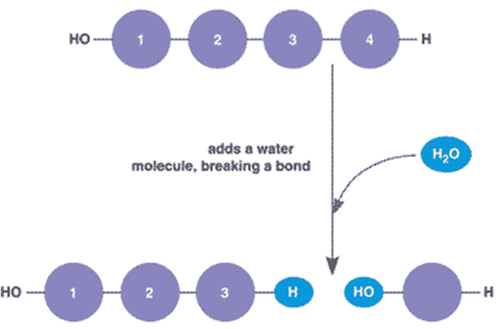
Condensation Reaction
A chemical reaction in which two molecules covalently bond to each other with the removal of a water molecule
(condenses water molecule out through the loss of a hydroxyl group (-OH) and the other loss of a hydrogen atom (-H))

Hydrolysis
a water molecule is used to break down macromolecules into monomers (breaking covalent bonds between monomers that make up polymers)
How does the cohesive and adhesive properties of water link to its role as a medium for transport in plants and animals?
-the action of transporting materials from cell to cell through varying techniques.
- Animals may use blood (water-based) to transport nutrients and hormones to specialized organs. The liquid portion of blood (plasma) uses water as a solvent. The plasma transports easily dissolved materials (glucose) which are small and hydrophilic.
- Plants' roots intake dissolved minerals thorough their roots along with water. Tiny hairs absorb the minerals and water, which are then transported through the xylem.
Explain the movement of water from less concentrated to more concentrated solutions.
- Two regions are separated by a selectively permeable membrane that only allows movement of specific molecules
- water will move from regions of lower solute concentration (hypotonic) to regions of higher solute concentration (hypertonic) through osmosis
- This process will occur until both solutions have equal solute concentration (isotonic).
Hypo"tonic"-solute
- less solute, more water
- water moves into the cell which leads to swelling and could cause the cell to burst/lysis
(where the concentration of solutes outside the cell is lower than the concentration of solutes inside the cell)
Hypertonic
- more solute, less water
- water moves out of the cell and into the surrounding solution which leads to cell shrinking/plasmolysis
(where the solute concentration outside the cell is higher than the solute concentration inside the cell)
Isotonic
equal solute on both sides of membrane and water will have equal movement in and out of the cell
Explain the effects of water movement into and out of cells on cells that have a cell wall. (plant cell)
- hypotonic solution: water will enter the cell and accumulate within the cell leading to an increase in internal pressure. This internal pressure is exerted by the cytoplasm against the rigid cell wall. (wall prevents cell from bursting)
- hypertonic solution: the cell membrane shrinks away from the cell wall (plasmolysis) as water leaves the cell. The loss of water causes the cell to shrink.
nucleotide
monomer of nucleic acids made up of a 5-carbon sugar, a phosphate group, and a nitrogenous base (DNA/RNA)

covalent bonds vs hydrogen bonds
- Covalent bonds: the sharing of electrons to form a strong bond within a molecule; very stable
- Hydrogen bonds: weaker connection between atoms within a molecule
Describe the formation of the sugar−phosphate backbone by nucleotide polymerisation in DNA and RNA.
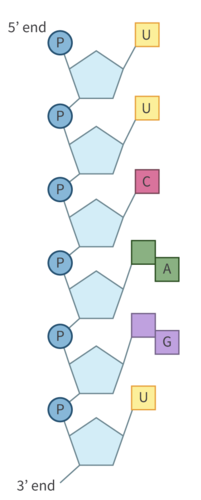
- Each nucleotide unit is linked together by covalent bonds which form a single strand of DNA or RNA. This linking of nucleotides creates two ends ('5 end→phosphate group, 3' end→ -OH group in the sugar)
What are the nitrogenous bases in each nucleic acid (DNA and RNA)?
- In DNA, thymine bonds with adenine and guanine bonds with cytosine
- In RNA, uracil bonds with adenine and guanine bonds with cytosine
Draw and identify diagrams of the structure of single DNA and RNA nucleotides.
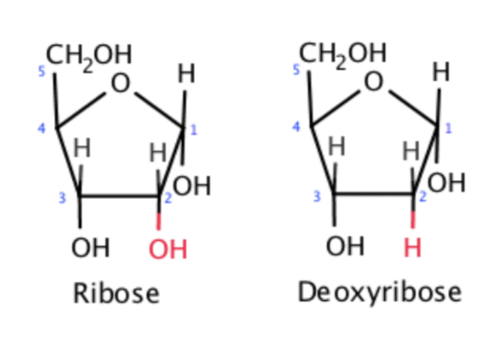
- DNA nucleotides are deoxyribose (five-carbon sugar), RNA nucleotides are ribose (five-carbon sugar)
- DNA has H group at bottom, RNA has OH group at bottom
DNA polymer
covalent bonds (phosphodiester bonds) that connect it to other nucleotides and hydrogen bonds that connects nitrogenous base pairs

RNA polymer
Explain the complementary pairing in a double-strand structure of DNA.
- This base pairing is important to stabilize the double helix structure of DNA as the two strands are "antiparallel"
Describe the alpha helix shape of a DNA molecule
- The DNA molecule is formed in a double helix shape where there are two strands of DNA that are in antiparallel directions of each other (one strand runs from 5' to 3' direction, and the opposite strand runs from 3' to 5')
What is the importance of complementary base pairing in allowing genetic information to be replicated and expressed?
- Complementary base pairing ensures that the same protein is produced every time the gene is expressed because the base pairs provide the same genetic code
- This is significant because it maintains the characteristics of the cell and the organism
Explain that diversity of any length of DNA molecule and base sequence is possible, as there is an enormous capacity of DNA for storing data.
- Any base sequence is possible in DNA, which means there are an infinite number of possibilities for what strand of DNA could be created. A DNA strand can be of any length because it could include just a few bases up to billions.
Understand the genetic code across all life forms as evidence of universal common ancestry.
- All living organisms share a common ancestry because all living organisms use the same genetic code (the instructions in a gene in the form of base sequences). Therefore, the information stored in DNA will be translated into the same protein whether it's read by bacterium, human, or fungus.
What is the nature of a covalent bond within a carbon atom (name 3 forms)
- A carbon atom can form up to four single covalent bonds to an array of molecules, allowing a variety of stable compounds to exist between the molecules
- carbon atoms can create a long chain of carbon atoms through covalent bonds (carbon always bonded 4 ways) an example it fatty acid
- Carbon can also form rings/branched structures, an example is the molecule glucose (glycogen is a polymer of many glucose molecules joined together)

monomers
individual subunits that can be linked together to form longer chains called polymers
macromolecules
large molecules made up of smaller building blocks called monomers
- Carbohydrates
- Lipids
- nucleic acids
Explain how macromolecules, such as polysaccharides, are formed by condensation reactions that link monomers to form a polymer.
- When more than two glucose molecules join together through a covalent bond, the product is called a polysaccharide.
- Starch, glycogen, and cellulose
Monosaccharides (pentoses, hexoses)
classified by the number of carbon atoms they contain
- Pentoses have five carbon atoms such as ribose, whereas hexoses have six carbon atoms such as glucose, galactose, and fructose.
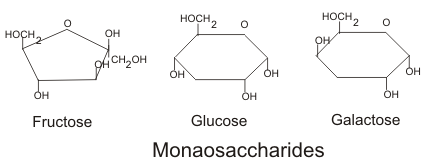
glucose (alpha, beta)
- most common monosaccharide found in nature and is an important source of energy for many organisms
- has two isomers: alpha-glucose and beta-glucose

properties of glucose
soluble: due to its polarity...the oxygen atom present ring has a partial negative charge, so, the carbon-hydrogen groups linked to it have a partial positive charge
- Since it is polar, it can dissolve in water. This makes it so it is easily transported through blood as it can dissolve in plasma.
stable: the -OH groups situated in the axial regions of the molecule→glucose stable molecule chemically
- The stability of glucose is a key feature for the structural role of the polysaccharide cellulose in plants AND for starch and glycogen in the storage of glucose in plant/animal cells
Understand the role of polysaccharides as energy storage compounds in plants (starch)
- STARCH: energy storage in plants (2 forms: amylose and amylopectin)
- Amylose: linear polysaccharide made up of glucose monomers that are linked together through alpha 1-4 glycosidic bonds
- Amylopectin: highly branched polysaccharide made up of glucose units linked together via alpha 1-4 glycosidic bonds with occasional alpha 1-6 glycosidic bonds (these bonds make up the branches)
→ branching structure allows amylopectin to form a more complex structure… allowing for more efficient storage of glucose
Understand the role of polysaccharides as energy storage compounds in animals (glycogen)
- GLYCOGEN: primary storage form of glucose in animals, branched polymer of glucose molecules that form a highly compact coiled structure in cells
→ the linear chains of glucose molecules in glycogen are linked together via alpha 1-4 glycosidic bonds and frequent alpha 1-6 glycosidic bonds
- mainly stored in the liver (maintain blood glucose levels) and muscle cells (provide energy for muscle contraction during exercise) of animals
Understand the role of polysaccharides as structural components (cellulose)
- STRUCTURAL COMPOUNDS: cellulose (composed of beta-glucose molecules and an essential component of the plant’s cell wall)
→ forms straight chain b/c beta-glucose molecules alternate orientation (this structure allows cellulose molecules to form long/unbranched chains that can be grouped into bundles: microfibrils)
- makes cell wall in plant cells sturdy
glycoprotein
proteins that have one/more carbohydrates attached to them (can be attached to specific amino acids residues within the protein, or they can form branched/linear chains that extend from the protein surface)
Cell-cell recognition
glycoproteins act as markers on the cell surface allowing them to identify each other and interact
Receptors
they act as receptors on the cell surface allowing them to receive signals from other cells/molecules in the environment
ABO Blood Groups
- based on the presence of specific glycoproteins on the surface of red blood cells (known as A and B antigens).
- The presence or absence of these antigens determines an individual's blood type.
→ A antigen=type A blood
→ B antigen=type B blood
→ A and B antigens=type AB blood
→ neither=type O blood
lipids
non-polar molecules that are characterized by their low solubility in water (hydrophobic) BUT lipids in non-polar solvents will dissolve
4 forms of lipids
fats, oils, waxes, steroids
fats
- triglycerides (type of lipid that can be consumed in food and synthesized by the liver) are commonly found in foods such as butter/lard.
- solid at room temperature
waxes
- completely water insoluble and have a high melting point, which is why they are solid at room temperature
steroids
naturally occurring hormones that play a vital role in regulating a wide range of physiological functions in the body (composed of four carbon rings that are fused together)
hydrocarbon chain
- long, linear chains of carbon and hydrogen atoms that make up the backbone of fatty acid molecules

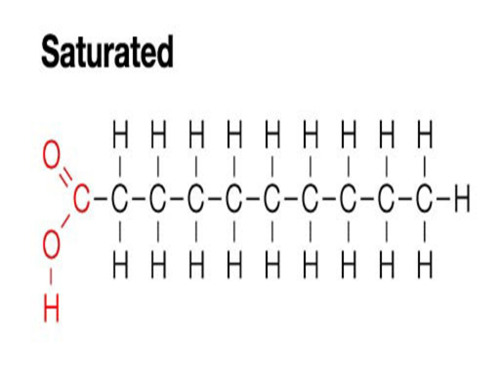
saturated fatty acid
- straight/linear shape
- each carbon atom in the hydrocarbon chain is bound to 4 atoms which allows fatty acids to pack tightly together
- found in animals
- typically solid at room temp
NO DOUBLE BONDS
Unsaturated fatty acids
- have one or more double bonds which form kinks in the fatty acid chain
- found in plants
- typically liquid at room temp
DOUBLE BONDS

Monounsaturated fatty acid (type of unsaturated fatty acid)
- have one double bond in their hydrocarbon chain which causes a kink in the chain
DOUBLE BONDS
Polyunsaturated fatty acid (type of unsaturated fatty acid)
- have two or more double bonds in their hydrocarbon chain causing many kinks in the chain
DOUBLE BONDS
unsaturated-trans
hydrogen atoms are located on OPPOSITE sides of the molecule
unsaturated-cis
hydrogen atoms are located on the SAME side of the molecule (bent configuration)
triglycerides
- lipid which are formed by condensation of one glycerol molecule and three fatty acid molecules (each time a fatty acid molecule joins the glycerol molecule a water molecule is released→creates bond known as ester bond)
- thermal insulator they are used as thermal insulators in many organisms helping regulate body temp and protect against the cold. EX: whale blubber
phospholipid
consists of a negatively charged phosphate head that interacts with water molecules (hydrophilic) and the hydrocarbon tails consist of nonpolar fatty acid chains that repel water molecules (hydrophobic)
phospholipid bilayer
made up of a double layer of phospholipids that are oriented in a special way (hydrophilic heads face water while the hydrophobic tails face each other)
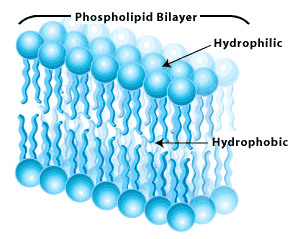
amphipathic
phospholipids considered amphipathic molecules b/c of hydrophobic/hydrophilic properties
how can steroids pass through the phospholipid bilayer?
since they are hydrophobic and non-polar, they are able to pass through the bilayer of cells