Longer answer end of test questions - easy marks!! (paper 1)
 Call Kai
 Learn
Learn Practice Test
 Spaced Repetition
 Match
Match Flashcards
 Knowt Play
1/26

There's no tags or description
Looks like no tags are added yet.
Name | Mastery | Learn | Test | Matching | Spaced | Call with Kai | Chat |
|---|
No analytics yet
Send a link to your students to track their progress
27 Terms
Describe and explain how you would use cell fractionation and untracentrifugation to obtain a sample of nuclei from muscle tissue (6)
homogenise muscle tissue - to break down cells
filter - remove debris/whole cells
solution must be cold - to prevent enzyme activity
solution must be isotonic - to prevent osmosis and cell bursting
solution must be buffered - to prevent enzymes denaturing
then spun at a lower speed so the nuclei ends up as a pellet at the bottom
Describe the role of organelles in the production and release of enzymes by animal cells (5)
DNA in the nucleus codes for enzymes
enzymes produced in the ribosomes
mitochondria produces ATP
RER transports enzymes to the golgi apparatus
golgi apparatus modifies enzymes
vesicles move the enzymes to the cell surface membrane (by exocytosis)
Describe the role of haemoglobin in the loading, transport and unloading of oxygen (5)
loading of oxygen happens in the lungs
oxygen loads best with a high partial pressure
easier for second molecules to bind (cooperative binding) as shape of binding site is changed
oxygen transported as oxyhaemoglobin in red blood cells
oxygen unloads at respiring tissues with lower oxygen pp
in high pp of co2, oxygen unloads
Contrast how an optical microscope and a transmission electron microscope work and contrast the limitations of their use when studying cells (6)
optical uses light vs TEM uses electrons
TEM = higher/greater resolution
so can view smaller organelles/organelles in more detail
optical = colour image vs TEM = black and white image
optical = can use live specimen vs TEM = dead/dehydrated specimen
TEM = more complex preparation process
TEM = magnets to focus vs optical = glass lenses
TEM = requires thinner specimen
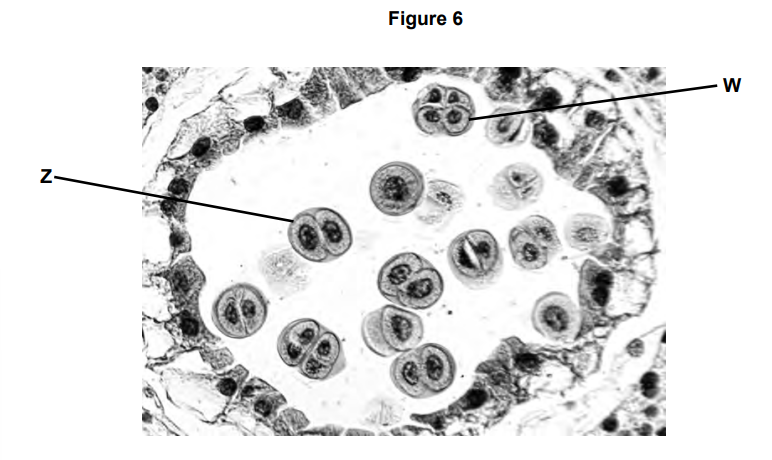
Figure 6 shows an image from an optical microscope of meiosis occurring in a flower bud of a flowering plant. W and Z are undergoing meiosis.
Explain the appearance of W and Z (4)
W shows 4 nuclei - undergone second division
Z shows 2 nuclei - undergone first division
W shows haploid cells/ cells containing n chromosomes
in Z homologous chromosomes have split/cells in W contain half the mass of DNA than cells in Z
An environmental scientist investigated a possible relationship between air pollution and the size of seeds produced by one species of tree.
He was provided with a very large number of seeds collected from a population of trees in the center of a city and also a very large number of seeds collected from a population of trees in the countryside.
Describe how he should collect and process data from these seeds to investigate whether there is a difference in seed size between these two populations of trees. (5)
use a random sample of seeds from each tree
use a large enough sample to be representative
find the mass of a seed
calculate a mean and standard deviation
use a student t test (comparing two means)
analyse whether there is a significant difference between the means of the two populations
Describe the gross structure of the human gas exchange system and how we breathe in and out. (6)
trachea - bronchi - bronchioles - alveoli
^^ must be named in correct order/labelled on correct diagram
breathing in - diaphragm and external intercostal muscles contract
ribs move up and out - increases volume and decreases pressure of thorax/lungs/thoracic cavity
breathing out - diaphragm relaxes and internal intercostal muscles contract
ribs move in and down - volume of thorax decreases and pressure is increased
Mucus produced by epithelial cells in the human gas exchange system contains triglycerides and phospholipids
Compare and contrast the structure and properties of triglycerides and phospholipids (5)
both contain ester bonds
both contain glycerol
fatty acids on both may be saturated or unsaturated
both insoluble in water
both contain C, H and O but phospholipids also contain P
triglycerides have 3 fatty acids whereas phospholipids have two plus a phosphate molecule
triglycerides are hydrophobic/non-polar vs phospholipids having hydrophilic and hydrophobic region
phospholipids form bilayer but triglycerides don’t
Mucus also contains glycoproteins. One of these glycoproteins is a polypeptide with the sugar, lactose, attached.
Describe how lactose is formed and where in the cell it would be attached to a polypeptide to form a glycoprotein (4)
lactose formed from glucose and galactose
formed with a condensation reaction, forming a molecule of water
forms a glycosidic bond
attached to a polypeptide in Golgi apparatus
Explain 5 properties that make water important for organisms (5)
metabolite - involved in photosynthesis/respiration
solvent so reactions can occur
cohesion - so can be pulled up plant in a constant stream
cohesion - so provides surface tension supporting small organisms
high latant heat of vaporisation so provides cooling effect
high specific heat capacity - acts as buffer to harsh conditions
Describe the biochemical tests you would use to con firm the presence of lipid, non-reducing sugar and amylase in a sample (5)
lipid
add ethanol then add water and shake/mix
milky white emulsion
non-reducing sugar
benedicts test and stays blue
boil with acid then neutralise with alkali
heat with benedicts and becomes red/orange
amylase
add biuret reagent and becomes purple
add starch and test for reducing sugar
Describe the chemical reactions involved in the conversion of polymers to monomers and monomers to polymers.
Give two named examples of polymers and their associated monomers to illustrate your answer. (5)
monomers → polymer = condensation reaction + forms chemical bond + releases water
polymer → monomer = hydrolysis reaction + break chemical bond + uses water
e.g. amino acid → protein with peptide bond
e.g. nucleotide → DNA with phosphodiester bond
Describe how mRNA is formed by transcription in eukaryotes (5)
H bonds between DNA bases are broken
one DNA strand acts as template
free mRNA bases align with opposite their complementory DNA base
uracil pairs with adenine in the place of thymine
RNA polymerase joins adjacent nucleotides
with phosphodiester bonds
pre-mRNA is spliced to mRNA/introns are removed
Describe how a polypeptide is formed by translation of mRNA (6)
mRNA attaches to ribosome
anticodon (tRNA) binds to complementory codon (mRNA)
tRNA brings specific amino acid
amino acids joined by peptide bonds
with the use of ATP
tRNA released after amino acid joined to polypeptide
ribosome moves along mRNA to form polypeptide
Define gene mutation and explain how a gene mutation can have:
no effect on the individual
a positive effect on the individual (4)
gene mutation = change in base sequence of DNA
results in formation of a new allele
no effect - dna code is degenerate so multiple codons code for the same amino acid/so amino acid sequence does not change
positive effect - may result in increased chances of survival/chances of reproduction
Describe the structure of DNA (5)
DNA = polymer of nucleotides
nucleotide = deoxyribose, phosphate and nitrogenous base
nucleotides held together by phosphodiester bonds
nitrogenous bases held together by hydrogen bonds
H bonds between adenine, thymine, cytosine and guanine
Name and describe five ways substances can move across the cell-surface membrane into a cell (5)
simple diffusion - small/non-polar molecules down a conc.grad.
facilitated diffusion - down a conc.grad using carrier/channel proteins
osmosis - water across a partially permeable membrane down a conc.grad
active transport - against a conc.grad. uses ATP and a carrier protein
co-transport - transports two substances at the same time using a carrier protein
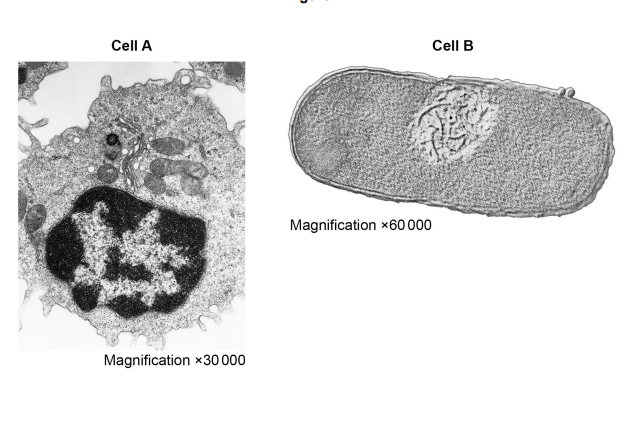
Contrast the structure of the two cells visible in the electron micrographs shown in Figure 14
Magnification (figures) show A is bigger than B;
A has a nucleus whereas B has free DNA;
A has mitochondria whereas B does not;
A has Golgi body/endoplasmic reticulum whereas B does not;
A has no cell wall whereas B has a murein/glycoprotein cell wall;
A has no capsule whereas B has a capsule;
A has DNA is bound to histones/proteins whereas B has DNA not associated with histones/proteins OR A has linear DNA whereas B has circular DNA;
A has larger ribosomes;
Messenger RNA is used during translation to form polypeptides.
Describe how mRNA is produced in the nucleus of a cell (6)
helicase
breaks hydrogen bonds
only one DNA strand acts as a template
RNA nucleotides attracted to exposed bases
attraction according to base pairing rule
RNA polymerase joins nucleotides together
pre-mRNA spliced to remove introns
Describe the structure of proteins (5)
polymer of amino acids
joined by peptide bonds
formed by condensation
primary structure is order of amino acids
secondary structure is folding of polypeptide chain due to hydrogen bonding (alpha helix/beta pleated sheet accepted)
tertiary structure is 3D folding due to hydrogen bonding and ionic/disulphide bonds
quaternary structure is two or more polypeptide chains
Describe how proteins are digested in the human gut (4)
hydrolysis of peptide bonds
endopeptidases break polypeptides into smaller peptide chains
exopeptidases remove terminal amino acids
dipeptidases hydrolyse/break down dipeptides into amino acids
Describe the transport of carbohydrate in plants (5)
sucrose actively transported into phloem
by companion cells
creates lower water potential and water moves in to phloem (from xylem) by osmosis down a concentration gradient
creates higher hydrostatic pressure
mass flow to respiring tissues
sucrose unloaded by active transport (from phloem)
Compare and contrast the structure of starch and the structure of cellulose (6)
both made of glucose monomers
starch = alpha glucose vs cellulose = beta glucose
both have C, H, O2
starch = branched vs cellulose non branched
cellulose has microfibrils vs starch doesn’t
both contain glycosidic bonds between monomers
starch = helical vs cellulose = straight
starch = amylose and amylopectin vs cellulose just one molecule
Describe the complete digestion of starch by a mammal (4)
hydrolysis
of glycosidic bonds
starch → maltose by amylase
maltose → glucose by maltose
by membrane bound maltase
Describe how a quaternary protein is formed from its monomers.
Do not include the process of translation in your answer (5)
amino acids joined by peptide bonds
with condensation reactions
secondary structure formed by alpha helix/beta pleated sheet/hydrogen bonds
tertiary structure formed by hydrogen/ionic/disulphide bonds
quaternary = multiple polypeptide chains
Describe the structure of DNA and the structure of a chromosome (6)
polynucleotide/polymer of nucleotides
double helix held with hydrogen bonds
phosphodiester bonds between nucleotides
nucleotide = deoxyribose, nitrogenous base, phosphate
adenine, thymine, guanine, cytosine
associated with histones
chromosome = sister chromatids joined at the centromere
Mutation can result in an increase in genetic variation within a species.
Describe and explain the other processes that result in increases in genetic variation within a species (4)
crossing over between homologous chromosomes
random fertilisation of gametes
independent segregation/ of homologous chromosomes
produces new combinations of alleles