Lecture 8 Ensemble methods
 Call Kai
 Learn
 Practice Test
 Spaced Repetition
 Match
 Flashcards
 Knowt Play
1/38

There's no tags or description
Looks like no tags are added yet.
39 Terms
model errors can be characterized by three factors
inherent randomness (noise)
bias
variance
model erros : inherent randomness
= noise
bayes error = lowest possible error taking into account inherent randomness
bayes error
lowest possible error taking into account the inherent randomness
when is a modeling procedure biased
if no matter how much training data we give it, the lowest practically possible error (the bayes rate) is never attained/
errors from bias arise due to erroneous assumptions in the learning algorithm
what is the modeling procedure’s variance
how much the prediction tends to vary across different datasets
a mdoellings procedure’s sensitivity to fluctuations in the training set
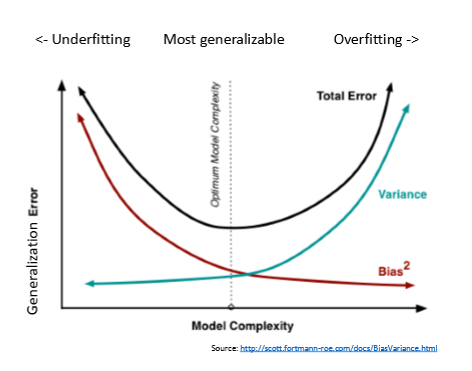
the bias-variance trade-off
more complexity gives higher variance and lower bias
complexity control : find ‘sweet spot’ where geenralization error is lowest
→ regularization (start with high-variance low-bias and regularize)
Q: characterize Decision Tree and logistic/linear regression in terms of bias/ variance
Linear/logistic regression : high bias method
DT : the more we split the less bias but the more variance (pruning)
ensemble methods : wisdom of the crowds
the average is almost always better than any expert individual
what does ensemble benefit more from (to imrpove performance)
from diverse models, with uncorrelated errors → we can make models different by for example using bootstrapping
bootstrapping
to effectively achieve models that make different errors, the samples used to develop these models should be as different as possible
→ bootstrapping : sampling with replacement
→ contains around 63,2% original records in each sample (if # boostrap goed to n)
what does ensemble learning do
it combines multiple ase models (weak learners) to form a powerful ‘ensemble model (strong learner)
what is a weak learner
a model that performs relativerly poorly, but better than random chance, with too high variance, or too high bias
homogeneous ensemble metods
utilize the same base learning algorithm
→ usually decision trees
bagging
random forest
boosting
heterogeneous ensemble methods
utilize different base learning algorithms
(are more difficult to do)
hard majority voting
class output by each model = 1 vote, sum and assign class with most votes (equal to the mode of the class outputs)
soft majority voting
average the (weighted) probabilities returned by the base learner, assign the class with the highest average probability
bagging
focus on reducing variance of high variance base learners (DT when unpruned very high variance)
hyperparameters : N = nymber of trees
Bootstrap Aggregation (bagging)
take N bootstras from the original data sample (you can tune N via validatio set)
build a classifier (DT) for each bootstrap
for classification : a new observation is classifier by letting all N classifiers vote (weighted) majority voting scheme, ties resulved arbitrarily-
for regression : prediction is the average of the outcome of the various regression Trees
→ individual classifiers are learned independently; no pruning, final estimate : simple majority voting
bagging : probability of specific observation being sampled :
constant and equal for all observations
bagging adavantages
since bootstraps and models are independent, models can be trained in parallel
reduced variance by averaging
bagging disadvantages
considered less powerful than other ensemble methods
interpretability
random forest
lots of very diverse high variance and low bias tress combine to generate a low bias low variance forest
hyperparameters :
N number of trees
m = number of variables used to calculate the best split at each node < M = # input features
grow N trees as follows
create a bootstrap sample (usually the same siez as the original training set)
at each node randomly choose m features and calculate the best split (instead of calculating the information gain for everything, you only alclate it for one subset randomly)
each tree is grown to the largest extent possible, no pruning
majority vote determines final predictions
random forest compared to bagging
random forest has more variance reduction due to averaging over more diverse tress (due to random feature subset splitting)
random forest are used for
classification and regression variants
the error rate of random forests depends on
the correlation between any two trees in the forest. increasing the correlation increases the forest error rate
the strength of each individual tree in the forest. A tree with a low error rate is a strong classifier. Increase the strength of the individual trees decreases the forest error rate
reducing m (=number of variables used to calculate the best split at each node)
random forest advantages
models can be trained independently and in parallel
reduces variance by averaging (but chooses higher variance indivdual trees (feature subsampling at each split) )
gives measure of feature importance (compares splits between when certain features are allowed to be used and when not, and that says how important the feature us)
very good classifocation performance with very limited required tuning, also for large datasets
→ usually more powerful than bagging due to random sibset of splitting at each node
random forest disadvantages
interpretability
boosting
iterative porcedure where in each round
observations currently misclassified are made more important → by increasing weight (bootstrap sampling rate or in loss function)
both classification and regression (similar to bagging)
boosting : Adaboost
most well-known boosting algorithm
hyperparameter : T (nuymber of trees/ rounds)
set uniform weigts for all obseravtions
then for T rounds
create a bootstrap sample based on the weights
train a classifier on the sample and apply it on the original training set
records that are wrongly classifier will have their weights increased
records that are classified correclty will have their weights decreased
final prediction : majority vote
boosting advantages
number of rounds (models) is the only parameter to tune
reduces bias
fast, simple and easy to program
boosting disadvantages
increases variance - bossting can have a risk of overfitting to the hard (=noisy) examples in the data
interpretability
sequential : high dependency between ensemble elements
alternative to boosting
gradient boosting
implments tree boosting whereby a tree in the ensemble is fit to the residual of the prediction from the earlier trees
stacking method
used to combine different types of models : base learners → heterogeneous ensembling method
prediction of base learners are used as imput for a meta learner
the base learners use the original dataset as input
the meta learner used the output of the base learners as input
the meta model learns to weight the contributions of the base learners to minimize error
→ ideally reduces both variance and bias
(ignores models that work very bad)
stacking advantages
flexible way to combine heterogeneous models
can sometimes reduce both bias and variance
stacking disadvantages
hard to analyse theoretically
a lot of work to train and optimize different member classifier
is rarely used
what is not required for tree-based ensembles
no normalization or encoding required (handling of missing values depends on the algorithm-
ensemble methods are supervised or unsupervised learning ?
supervised learning methods
neural networks are relatively old, but recent boom with deep learning, why the boom ?
big data
hardware
software
artificial neural networks
collection of connected computational units (neurons) arranged in interconnected layers
very powerful and flexible
very popular for both supervised and unsupervised learning
state of the art across many complex domains, mainly based on unstructured data
artificial neural networks are very powerful and flexible
more layers / neurons → more capacity / complexity
specialized archotectures