Velopharyngeal dysfunction and articulation disorders
 Call Kai
 Learn
 Practice Test
 Spaced Repetition
 Match
 Flashcards
 Knowt Play
1/33

There's no tags or description
Looks like no tags are added yet.
34 Terms
Overview of cleft palate speech
Velopharyngeal dysfunction -> hypernasality
Nasal deformations -> blocked nasal airway -> hyponasality
E.g. septum deviations, baby may stick tongue into nose
Post-surgery, hyponasality may result from blocked nasal passage
Dentoalvolar anomalies (missing or misaligned teeth, malocclusion) -> obligatory artic errors
Palatal Fistulae -> obligatory artic errors
Hypernasality and nasal air loss -> unsuccessful articulatory attempts -> obligatory artic errors
These become active errors after surgery
Hypernasality and nasal air loss -> articulatory mislearning -> compensatory/active artic errors
Often glottal and palatal sounds are used because they have control of these
Velopharyngeal dysfunction -> middle ear effusion -> hearing loss
Levator not pulling to open the Eustachian tube
Unrelated processes -> voice and fluency disorders, phonological disorders, developmental language disorders etc.
If cannot prove causal relationship to cleft palate
What is the purpose for velopharyngeal valving
Ventilation of the middle ear
Regulation of oral-nasal airflow
Prevention of nasal regurgitation
Prevention of pre-deglutitive aspiration
Can chew forever
Contributes to bolus propulsion during swallowing
Oral-nasal balance for speech articulation
Overview of the Nasal Tract
Subdivided by nasal septum
Also meatuses
Turbinates divide the meatuses
Low frequency spectrum sounds come through the nose
2 large anterior cartilages
Septal is biggest
Also has the vomer bone (sail bone)
Overview of the normal hard palate
Trigeminal nerve comes through the papillae
Midline raphe
Past the last molar = pterygoid hamulus

What are the main velopharyngeal muscles
tensor velar palatini
levator velar palatini
palatoglossus
palatopharyngeus
superior pharyngeal constrictor
musculi uvulae
salpingopharyngeus

What is the tensor velar palatini
Changes direction by 90 degrees
Primary Function: Opens ET
Superiorly attached to sphenoid bone and lateral cartilage of the ET
Slings around the hamulus pterygoids, which changes its direction of pull from vertical to horizontal
Inferiorly it fans out and forms the palatine aponeruosis
Secondary function – lateral stretch of the velum
Innervated by the mandibular branch of CN5
What is the levator velar palatini
Most important muscle for closing the velopharyngeal sphincter
Superiorly attached to temporal bone and the medial cartilage of the ET
Inferiorly forms the levator sling
Primary function = velar elevation
Secondary = open ET
Innervated by the plexus pharyngeus/pharyngeal branch of CN10, and the glossopharyngeus
What is the palatoglossus
Pulls the velum down
Seals oral cavity
1st palatal arch
Helps make nasal sounds
Superior attachment is the oral surface of the palatine aponeurosis
Inferior attachment is the lateral posterior dorsum of the tongue
Function: lowering the velum, dorsal elevator of the tongue
Innervated by the plexus pharyngeus (CN10)
What is the palatopharyngeus
Second palatal arch
Brings pharyngeal walls medially
Superior attachment is the palatine aponeurosis
Inferior attachment is the lateral pharyngeal wall and posterior thyroid cartilage
Function: medial displacement of the lateral pharyngeal walls, lowering velum
Innervation: plexus pharyngeus (CN10)
What is the superior pharyngeal constrictor
Tightens pharynx
Originates from the pterygoid plate and the lateral fringes of the velum and runs along the pharyngeal walls to the median raphe
Function: pharyngeal narrowing (naso and upper oropharyngeal segement)
Innervation: pharyngeal plexus (CN10)
What is the musculi Uvuli
Muscle pair, runs parallel to the velar midline into the mucous membrane of the uvula
Function: intrinsic flexion and shortening of the velum, forms velar eminence (helps fill space between elevated velum and Posterior pharyngeal wall)
Commonly small or absent in cleft palate patients
Innervation: plexus pharyngeus
What is the salpingopharyngeus
Originates from ET and inserts into the posterior aspect of the palatopharyngeus muscle
Blends into palatopharyngeus
Thought to contribute to raising of the pharynx and larynx as well as ET opening
Innervation: plexus pharyngeus
Diagram of VP muscles

Diagram 2 of VP muscles

What is the plexus pharyngeus
A network of intersecting nerve fibers, composed of branches of the N. vagus X (motor), N. glossopharyngeus IX (sensation)
Some authors argue that the accessory (XI) and facial (VII) nerves also branch into the pharyngeal muscles
If you scope someone and they gag you’ve touched it
Can induce tacycardia and heart arrest and tachypnoe
Continuum of VP closure
Yawning
Speech
Narrow of nasopharynx, elevated velum
Whistling and blowing are similar
Swallow
Lower velar elevation
Less closure of nasopharynx, but open below
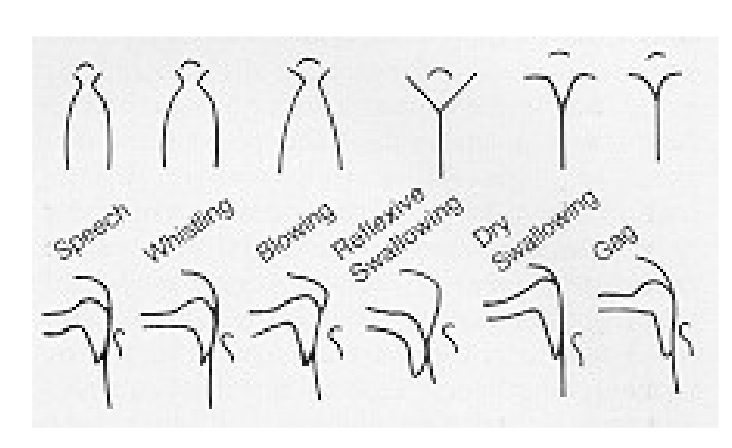
Difference between male and female nasopharynx, child vs. adult
Male nasopharynx is larger and wider than female
Makes need to elevate the velum higher and more posteriorly to achieve complete closure
Uvula muscle can help give extra elevation
Child vs. adult
Nasal sinus is not fully developed in a child, so the nasopharynx is quite small
Have to do less during speech
In adults – the distance increases between the velum and posterior pharyngeal wall
Kids also have adenoid pads
These decrease the distance between the velum and PPW further
What are the closure patterns of the VP sphincter
Coronal
Velum goes up and does most of the closure
Sagittal
Less frequent
The lateral pharyngeal walls move towards the midline
Circular
Velum goes up and the lateral pharyngeal walls close a bit
Circular with Passavant’s ridge
Increased activity of the superior pharyngeal constrictor muscle supports velopharyngeal closure
In some cleft patients see this
Muscular bulge on the PPW on a patient with an unrepaired cleft
Hypertrophic superior pharyngeal muscle
Mainly in cleft palate
Passavant’s ridge = formed by an isolated contraction of a hypertrophic segment of the superior (or medial) pharyngeal constrictor muscle
Direct Methods of VP structure, morphological and functional analyses
Direct visual inspection
Endoscopy
Multiview videofluroscopy
MRI
Not standard, but emerging
Indirect Methods of VP structure, morphological and functional analyses
Tongue anchor technique
Stick out tongue and puff cheeks
Really only tests if velum can go down
Mirror test
Remove quickly before they stop
I-a test
Say ee/a then close nose
Very coarse test for hypernasality
Aerodynamic measurements
Electromyography
Oral inspection
Overview of FEEs, what might you see in 22q11
If you see a concave velum on the scope -> may be a submucous cleft
22q11 -> velocardiofacial syndrome
May see pulses
Due to internal carotid artery being displaced medially
May die during operation
If you cut into the PPW and accidentally cut an artery
Can also look at anterior posterior velar displacement
How far is the velum from the PPW
How much do the lateral walls come in
Overview of MRI
Best but not common
Can see whole levator loop
In the late 80s there was a call for standardization of reporting
Measure the distance of velar elevation
E.g. 60% closure
Lateral view – measurement of velar displacement in the anterior-posterior dimension
Anterior posterior view – measurement of the lateral wall displacement
Posterior lateral walls move towards the velum
Each side is 50%
What are the 4 categories of VPI/VPD
VP insufficiency
unrepaired clefts
post surgical insufficiency
VP insufficiency (non cleft)
mechanical interference
tonsils, adenoid, Post. pillar web
palatopharyngeal disproportion
cervical anomalies
palatal lesions (e.g. cancer)
VP incompetency: it is there but it doesn’t function
stroke
TBI
Congenital (CP, distrophies)
dysarthrias
Motor Programming → AoS
VP mislearning: have a working one but don’t make use of it
PSNE
after post-op with sufficient closure nasal emission
compensatory misartic
deafness
Oral Nasal-Balance Disorders and Associated Observations Overview (what might you see)
hypernasality
hyponasality
mixed nasality
Associated Obs:
cul-de-sac
nasal emission
nasal turbulance
nasal grimance
What is Hypernasality
Can be functional or organic
Too much air and sound escape through the nose
Non-nasal vowels and consonants are nasalized
Give non nasal test sentence (e.g. pick up the book)
Organic etiology: Velopharyngeal insufficiency
Typically etiology is organic
Nerve damage, velum too short
Functional etiology: Velopharyngeal incompetence
Have working velum but doesn’t know how to use
Why is Hyponasality
Can also be functional (rare) or organic
Too little air and sound travel through the nose
Nasal consonants (and vowels) are denasalized
Use nasal sentence: my mum made lemon jam
Organic etiology: Septum deviation, hypertrophic turbinates
Functional etiology (rare): Protective reaction to autophonia
Autophonia = thickening of the ET (like in a really bad cold)
Speaker tends to be hyponasal
Palatous ET
Can happen during pregnancy
What is mixed nasality
Combination of velopharyngeal dysfunction and a blocked nasal passage
May occur in uni- or bilateral cleft lip and palate (VPI and septum deviation)
What is cul-de-sac resonance
A confusing term, describing a muffled sound quality
Sometimes used to denote severe anterior hyponasality
Sometimes used to denote mixed nasality (combined hyper- and hyponasality)
Subtypes:
It can be related to nasal cul-de-sac
Can have pharyngeal cul-de-sac
Yoda/hot potato
Oral form form of cul-de-sac
Difficult to measure
what are the two kinds of nasal emission
2 Kinds:
Nasal emission/nasal escape
Everything wide open
Audible sound of air coming out (with noise)
Laminar -> flowing through a tight space
Steady flow but audible
No noticeable turbulence
Nasal turbulence/friction
High pressure through small opening
Velopharyngeal closure almost there
What is nasal emission generally, what is obligatory vs. learned
Inaudible nasal emission (mirror test)
Audible nasal emission
Audible (non-turbulent) emission
Usually related to a larger VP gap
Nasal turbulence
May indicate close VP approximation
Often interpreted as a counter-indication for secondary velopharyngeal surgery (pharyngeal flap, pharyngoplasty)
Obligatory nasal emission
Structural velopharyngeal insufficiency
Oro-nasal fistula
Velopharyngeal incompetence related to neurological damage
Learned nasal emission
VP mislearning
Phoneme specific nasal emission
Persisting postoperative nasal emission
What is nasal grimace
Some hypernasal speakers with cleft lip and palate may show a visually distracting and unfavourable flaring of the nares
Nasal grimace is interpreted as a subconscious compensatory attempt to reduce nasal escape