Tumor-associated myeloid regulatory cells
 Call Kai
 Learn
 Practice Test
 Spaced Repetition
 Match
 Flashcards
 Knowt Play
1/11

There's no tags or description
Looks like no tags are added yet.
12 Terms
The tumor microenvironment can block normal myeloid differentiation/maturation and skew myeloid cells toward immunosuppressive phenotypes. Why?
Mature DC/M1- Immunogenic and anti-angiogenic.
Immature DC/M1- Tolerogenic & pro angiogenic
What are Myeloid-derived suppressor cells — MDSCs. How are they formed
Myelopoiesis in bone marrow: monocytes → macrophages/DCs and granulocytes → neutrophils
Cancer-associated factors- VEGF and IL-6- can disrupt normal differentiation of IMMATURE MYELOID CELLS
Results in Immature myeloid cells accumulation.
These are called: MDSC
Tumor-derived inflammatory signals → abnormal myelopoiesis → accumulation of MDSCs → immunosuppression.
How does chronic inflammation aid in cancer progression with relation to MDSC
chronic inflammation → expansion/activation of suppressive myeloid cells → causes suppression of anti-tumor immunity too → tumor gets an advantage.
Explain 3 MDSC Suppressive effector mechanisms/
How MDSCs become suppressive
1. ARG1 pathway — starve T cells of arginine
MDSC ↑ ARG1 → breaks down L-arginine → ↓ L-arginine available to T cells → ↓ CD3ζ/TCR function + ↓ T-cell proliferation → T-cell suppression
Memory: ARG1 = arginine starvation.
2. NOS2 pathway — make nitric oxide (NO)
MDSC ↑ NOS2 → uses L-arginine to produce NO → ↓ IL-2 signaling/proliferation + ↑ T-cell apoptosis → T-cell suppression
3. ROS pathway — oxidative damage
MDSC produces ROS → oxidative stress/damage to T-cell signaling → ↓ CD3ζ + ↓ proliferation + ↑ apoptosis → T-cell suppression
By activating pathways that release cytokines/proteins that downregulates T cells and leads to apoptosis or suppression
Function of MDSC
Suppress T cells
Promote angiogenesis
Invasion
Promote metastasis
Pre Metastatic niche formation
Explain how MDSC performs Pre Metastatic niche formation
Accumalation at distant site
NET - to capture the tumour antigen (neutrophil extracellular traps)
ROS and inflammatory signalling for creating a tme
Matric remodelling
Immunosuppressive environment
NK cell killing inhibition
Extravasation from the primary site
What are the 3 Specific strategies against MDSCs
1. Force MDSC differentiation
ATRA → MDSCs differentiate into mature DCs/macrophages → ↓ immunosuppressive MDSCs → ↑ antitumor immunity
2. Block MDSC expansion/recruitment
VEGF blockade → ↓ MDSC recruitment/infiltration into tumor → ↓ immune suppression → ↑ antitumor immunity
3. Block MDSC suppressive function
COX-2 inhibition → ↓ MDSC expansion + ↓ ARG1 expression → ↓ T-cell suppression → ↑ antitumor immunity
How can MDSCs be therapeutically targeted?
A. Deplete MDSCs — remove them
Low-dose chemotherapy → ↓ MDSC numbers → ↓ T-cell suppression → ↑ antitumor immunity
B. Inhibit MDSC recruitment — keep them out of the tumor
CXCR2 or CXCR4 blockade → ↓ MDSC migration into tumor → ↓ immunosuppression → ↑ antitumor immunity
C. Reprogram/disable MDSCs — stop their suppressive functions
ARG1 inhibition / COX-2 inhibition → ↓ MDSC suppressive activity → ↑ T-cell activity → ↑ antitumor immunity
Name 3 Drugs targeting MDSC expansion/recruitment

Reducing inflammation might delay MSDC accumulation→inhibit tumor progression. true or false
True
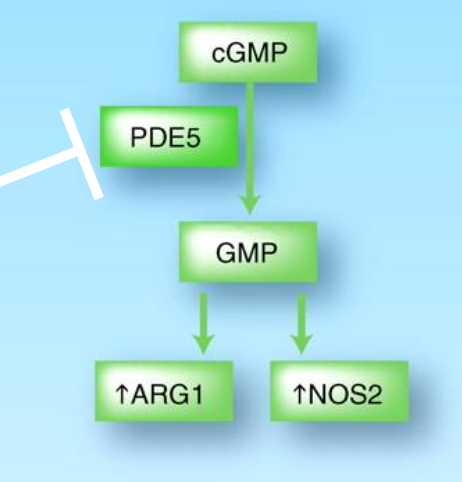
How does Viagra/Sildenafil be involved in MDSC suppression
Sildenefil is a PDE5 inhibitor→ interference with MDSC suppressive pathways (Increased arginine and nitric oxide) → potentially improve anti-tumor immune activity.