LEC 07: ATMOAPHERIC MOISTURE
 Call Kai
 Learn
Learn Practice Test
 Spaced Repetition
 Match
Match Flashcards
 Knowt Play
1/19

There's no tags or description
Looks like no tags are added yet.
Name | Mastery | Learn | Test | Matching | Spaced | Call with Kai | Chat |
|---|
No analytics yet
Send a link to your students to track their progress
20 Terms

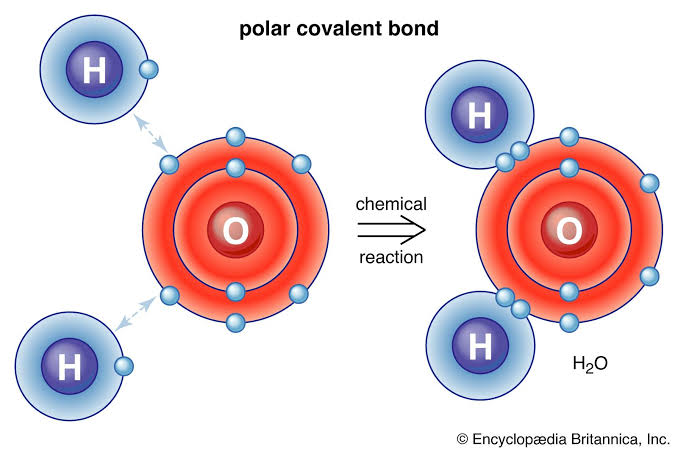
Water is a Polar Molecule
Why?
Molecule with uneven distribution of electrical charge.
Hydrogen atoms are slightly positive (+)
Oxygen atom is slightly negative (-).
Water is a Good Solvent
Why?
Its positive (+) and negative (-) ends allow it to dissolve many substances.

3 Phases of Matter
Solid: Ice, snow, and glaciers.
Liquid: Oceans, lakes, rivers, and rain.
Gas: Water vapor in the atmosphere.

3 Phases of Matter
Relevance
Water changes between these 3 phases.
Through evaporation, condensation, melting, and freezing.
Helps transfer energy throughout Earth's atmosphere.
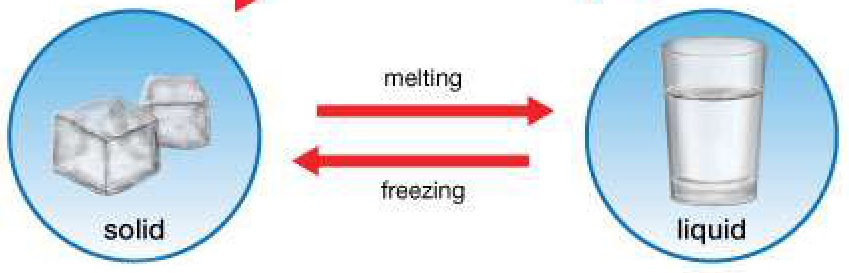
Melting (Solid → Liquid)
Water Cycle
Ice absorbs heat and changes into liquid water.
→ Ice melting into a puddle.
Evaporation (Liquid → Gas)
Water Cycle
Liquid water absorbs heat and changes into water vapor.
→ Water evaporating from an ocean into the atmosphere.

Condensation (Gas → Liquid)
Water Cycle
Water vapor cools and changes into tiny liquid water droplets.
→ Clouds forming in the atmosphere.

Freezing (Liquid → Solid)
Water Cycle
Liquid water loses heat and changes into ice.
→ A lake freezing in winter.
Ice Is Less Dense Than Liquid Water
Why?
Same mass of ice occupies more space
→ v.s. the same mass of liquid water.
Ice Is Less Dense Than Liquid Water
Significance for Life
Floating ice forms an insulating layer on the surface of lakes and oceans.
Helps the water underneath remain liquid
→ Allows aquatic life to survive in cold conditions.
Water Vapor Is Less Dense Than Air
Why?
Water Vapor less dense than dry air at the same temperature and pressure
→ less mass in the same volume.
Water Vapor Is Less Dense Than Air
Effect on Atmosphere
Water Vapor is added to air, it decreases the air's average density.
→ Makes the air more buoyant and more likely to rise.
Saturation Capacity Increases Exponentially with Temperature
Why?
As air temperature increases, its ability to hold water vapor increases rapidly.
Rising Air Switches from Dry → Moist Adiabatic Rate
When?
When it cools to its dew point and becomes saturated
(100% relative humidity).

Adiabatic Rate
The rate an air parcel changes temperature as it rises or sinks
→ without exchanging heat with its surroundings.

Clouds Form when Dew point is Passed
Why?
When air cools to its dew point and becomes saturated
(100% relative humidity)
→ Water vapor condenses into tiny liquid water droplets.
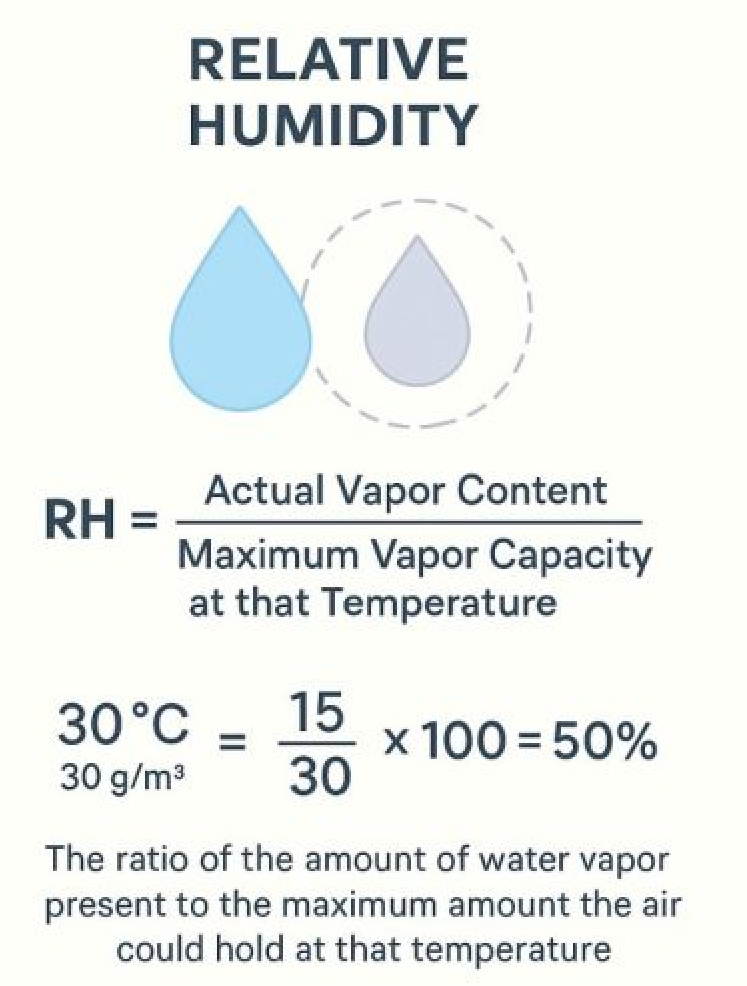
Relative Humidity
% of water vapor amount in the air
→ compared to maximum amount it can hold at that temperature.

Specific Humidity
The actual mass of water vapor in the air
→ compared to total mass of air (g of water/kg of air).
Clausius-Clapeyron Relationship
Why 80% relative humidity feels different in the summer and winter?
Summer: 80% humidity means more actual water vapor in the air, making it feel more humid.
Winter: 80% humidity means less actual water vapor in the air, making it feel less humid.
Lapse Rate
Rate that air temperature decreases
→ as altitude increases.