biol 203 exam 1
 Call Kai
 Learn
Learn Practice Test
 Spaced Repetition
 Match
Match Flashcards
 Knowt Play
1/94

There's no tags or description
Looks like no tags are added yet.
Name | Mastery | Learn | Test | Matching | Spaced | Call with Kai | Chat |
|---|
No analytics yet
Send a link to your students to track their progress
95 Terms
Mass and charge of a proton
1 Da (Dalton (or amu)) and +1
Mass and charge of a neutron
1 Da (dalton (or amu)) and 0 charge
Mass and charge of an electron
0 Da and -1 charge
Cation forms
Loss of an electron
Anion forms
Gain of an electron
Most common bond type in living organisms
Covalent
Most common bio atoms
C H O N P S
Order of relative electronegativities
O > N > S = C = P = H
O > N > S = C > P = H
Ionic bond
An atom transfers one or more electrons to a second atom, resulting in 2 atoms possessing opposite charges (cation/anion)
Why life revolves around water
Molecule is small, bent geometry, and highly polar
Can form hydrogen bonds
Is a great solvent
Hydrogen bonds
Electrostatic force that occurs between H+ in one molecule and another charged atom (often N- or O-) in another molecule
They are weak individually but powerful in large numbers
Types of molecules water can dissolve and why
Hydrogen bonds/small size of h2o allows polar and ionic to dissolve (but NOT nonpolar)
Hydrophobic (definition and interactions)
Nonpolar molecules that won’t dissolve or interact with water
Stabilized by van der waals forces
Water makes a “cage” around them
Hydrophilic
“Water loving” molecules like polar and ionic that dissolve in water
Van der waals forces
Weak, short-range electrostatic attractions between nonpolar molecules or atoms due to tiny temporary partial charges caused by electron movement between atoms
Cohesive
individual molecules stick to each other (same type of molecule) because of hydrogen bonding
Adhesive
A molecule sticks to other charged or polar surfaces
Water is
Cohesive AND adhesive
Density of ice vs liquid water and WHY
Liquid is denser than ice because the hydrogen bonding pulls water molecules in tight, but in ice the molecules are spread out in a crystal lattice
Ice floats
What is special about water’s specific heat and heat of vaporization
High specific heat
High heat of vaporization
(Protected the original lifeforms in the ocean from energy/heat changes)
Specific heat
Amount of energy it takes to heat something
(High means it takes a lot of energy to heat )
Heat of vaporization
Energy required to go from liquid to gas
(High means it takes a lot of energy)
pH scale math
To compare pH, subtract one from the other and that is the number of zeros after 1

Monomer
The smallest whole subunit (of a polymer)
Monomer of protein
Amino acid (There are 20 most common)
Components of amino acid
Carboxyl group (O=C-OH nonionized or O=C-O- more commonly ionized)
Amino group (H-N:-H nonionized or H3N+ when ionized)
H to central C
(+ a unique side chain)
** amino acids are usually ionized
Resonant stabilization
A double bond flips back and forth between same atom with a single bond to stabilize it
R group
Side chain (amino acids)
Determines reactivity and what the amino acid is
Can make it be nonpolar, polar, or acidic/basic(charged)
Peptide bond
Formed through dehydration synthesis (or condensation rxn)
Links amino acids together (the C in carboxyl group connects to the N in amino group)
Usually very stable, taking on many double bond characteristics (like planar geometry)
Dehydration synthesis
Aka condensation rxn
Results in some product and H2O
Residues
The individual amino acids linked together in a peptide chain
Oligopeptide
Short chain
<50 amino acids
Polypeptide
Long chain
Anything >50 amino acids
Protein
Any length of residues (reserved for only fully functional molecules usually)
Peptide chain reading direction
From N-terminus (amino group end) to C-terminus (carboxyl group end)
Why life is organic (carbon based)
C provides molecular skeleton (with 4 valence e-)
C can form links, chains, and rings
Functional groups attach easily to define chemical behavior

primary structure (proteins)
The unique sequence of amino acids in a protein, determining its SHAPE, function, and properties.
dictates the likeliness of alpha helices or beta sheets

secondary structure (proteins)
the alpha helix or beta pleated sheets (distinctly shaped sections of linear sequence stablized by hydrogen bonding between functional groups in the peptide bond backbone

tertiary structure (proteins)
comes from interactions between r-groups or backbone AND r-groups located relatively far apart in primary sequence
**only cistine forms disulfide bonds, otherwise all other bond types may occur

quaternary structure (proteins)
**only SOME proteins have this
multiple polypeptide subunits
quaternary structure naming conventions
prefix+ending
Prefixes: homo- (protein subunits are identical) and hetero- (at leats one polypeptide differs from the others
Endings(# of protein subunits): dimer(2), trimer(3), tetramer(4)
functions of proteins
enzymes catylize rxns
form structural components in body
motor/contractile proteins move cells or molecules within cells
signaling proteins send messages between cells
transport proteins help molecules enter/exit cells or carry them through the body
antibodies attack viruses/bacteria
DNA
deoxyribonucleic acid
stores genetic info (long term=stable)
RNA
ribonucleic acid
many many functions(more reactive, more functions=less stable, breaks down over time): transcribe genetic info, assemble proteins, regulate gene expression, and in some viruses acts as genetic material
monomer of nucleic acids
nucleotide
DNA vs RNA
DNA has deoxyribose sugar (an H on 2’ Carbon) and thymine (extra methyl group)
RNA has ribose sugar (an OH on 2’ Carbon) and uracil
Components of Nucleotides
5 carbon sugar
phosphate group
nitrogenous base (the unique part)
nucleotide to nucleic acid
a phosphodiester bond forms via dehydration synthesis (or condensation rxn)
the O on one phosphate group attaches to the C on 5-carbon sugar
sugar-phosphate backbone
chain of nucleotides making up DNA and RNA, with the nitrogenous bases hanging off
nucleic acid order conventions
sequence of nucleotides written in 5’→3’ direction
(new nucleotides get added to the 3’ end)
how to tell difference in nucleic acid ends
5’ carbon has a free phosphate group
3’ carbon has a free hydroxyl group
secondary structure (DNA)
Nitrogenous bases are flat and perpendicular to sugar-phosphate backbone
twists into a helix—minimizes contact w/ water
complementary base pairs:
thymine—adenine
cytosine—guanine
bond type between complementary base pairs
hydrogen bonds
what do the arrows in a DNA diagram represent
the arrows are the 3’ end, the plain line is the 5’ end
adenine
purine (2 rings)

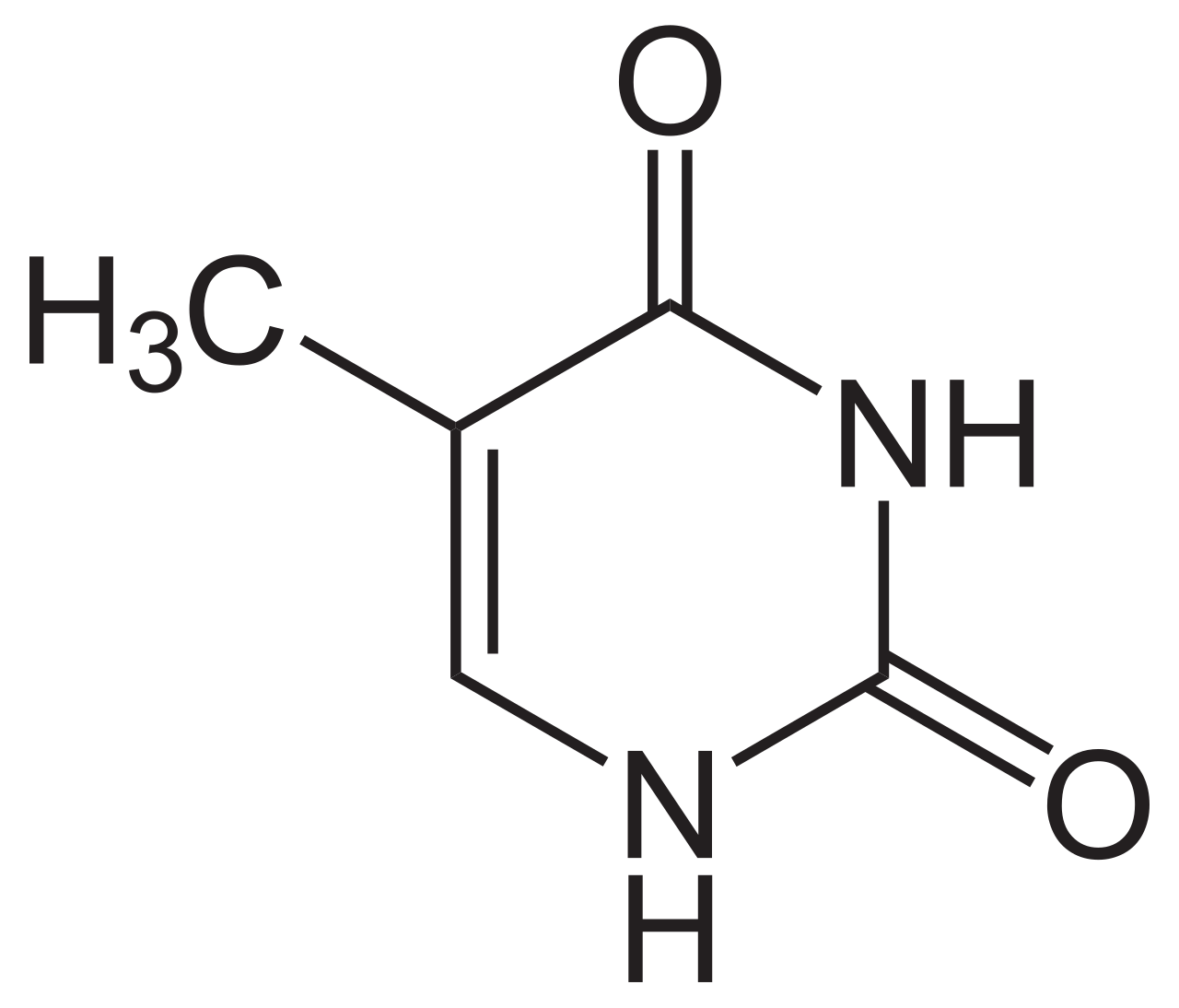
thymine
pyrimidine (1 ring) & has an extra H3C and O
guanine
purine (2 rings) with an extra O

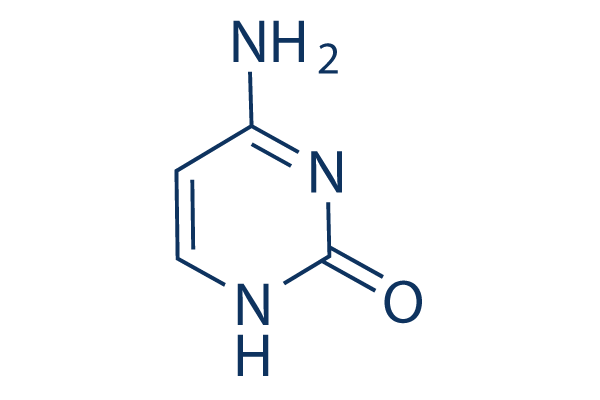
cytosine
pyramidine (1 ring) with an extra NH3
uracil
pyramidine (1 ring) and no extra stuff

tertiary strucure (DNA)
when too tight/loose it can coil on itself to form supercoils
(in eukaryotes and some archea) may wrap around binders called histones
histones
dna binder

why is DNA stable
phosphodiester linkages, h-bonds, hydrophobic interactions
base stacking & twisted helical shape prevent many functional groups from being exposed to chemical reactions
why complementary base pairs
fixed nucleotide pairs means DNA’s structre provides a mechanism for copying the primary sequence, even with only one strand
protein spontaneous folding process
molecular chaperons facilitate, prevent formation of nonfunctional aggregates
primary structure contains all the info to predictably become fully functional with correct structure, though many do not become fully functional until they interact with something to trigger a change/activation
**structure shapes function
molecular chaperons
assist in protein folding by temporarily binding to nonpolar regions of unfolded proteins
(protects nonpolar parts from hydrophobic interactions with water)
prevents formation of nonfunctional aggregates
infectious prions
induce changes in normal protein prions leading to misfolding and aggregation
beta pleated sheets tend to be compact/aggregate
(positive feedback loop so as more turn, more get infected)
RNA secondary structure
RNA is FLEXIBLE and CAN TWIST BECAUSE OF steric hinderance, so its base pairing occurs within a single strand of nucleotides, sometimes looping into a hairpin loop

steric hinderance
the extra OH on 2’ carbon (ribose vs deoxyribose) prevents RNA from coiling into double helix, leaving reactive functional groups exposed
RNA tertiary structure
complementary base pairing from nucleotides located far apart from each other in the primary sequence (ex: pseudoknots)
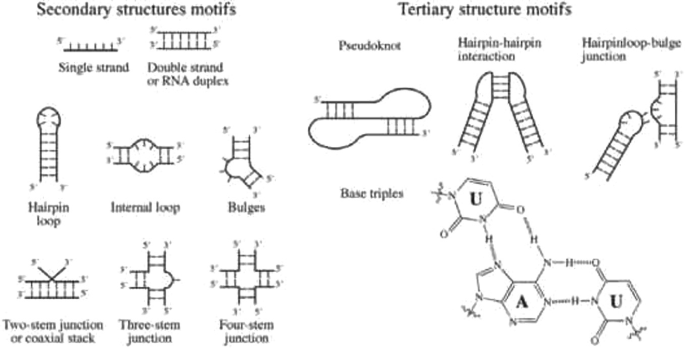
DNA vs RNA: diversity of reactivity & 3D shape
RNA has more level of reactivity and can generate more diverse 3D shapes
carbohydrate functions
energy storage (ex:photosynthesis), structural support(ex:cellulose), cell identification(ex: glycoproteins & glycolipids)
(can vary widely structurally to perform wide variety of tasks in variety of places in body/cells/etc)
monomer of carbohydrates
monosaccharide
monosaccharide basic structure
ALL HAVE: carbonyl group (C=O), several hydroxyl (—OH), and several C—H bonds
monosaccharide distinguishing features
—location of carbonyl group (aldose vs ketose)
—size of monomer (# of carbons… 2 min, 9 max, 3-7 average)
—3D spatial arrangement of atoms/bonds
aldose
any monosaccharide with the carbonyl group at the END of the carbon chain
ketose
any monosaccharide with the carbonyl group WITHIN the carbon chain
how do monosaccharide rings form?
if they have 5+ carbons, they spontaneously take shape when put in aqueous solutions
α configuration, generic structure & purpose
goes BELOW plane
long chain begins to form a helical shape
generally for energy storage
β configuration, generic structure & purpose
goes ABOVE plane
long chain looks planar
generally used structurally
disacharride
smallest polymer of a carbohydrate
2 monosaccharides linked with glycosidic linkages made through dehydration synthesis reaction
glycosidic linkage
(—O—) forms between the hydroxyl groups to connect a carbon on each monosaccharride (alway 1’ carbon and any other carbon, creates partial + charge increasing reactivity)
the location and geometry can vary widely in overall polysaccharide bc of variation in monomers
naming conventions of glycosidic linkages
“(alpha/beta)—1,(#)—glycosidic linkage”
carbs as energy storage plants vs animals
starch for plants has no (alpha-1,4) or rare (some alpha-1,6) branching in glucose residues, takes up less space
glycogen for animals has a lot of branching (alpha-1,4 and many alpha-1,6), makes it easier to break/access energy quickly
carbs as structural polymers
beta monomers linked in planar structure, with hydrogen bonding cross-linking adjacent parallel strands to add strength and rigidity
ex: cellulose, chitan, peptidoglycan
lipids
catch-all term for water-insoluble/hydrophobic compounds with lots of C—C or hydrocarbon C—H bonds
includes steroids, fats, phospholipids, pigments, waterproof coatings, vitamins in cellular processes
bond saturation
number of H a lipid contains relative to max potential amount given a set number of C linked in a chain
unsaturated lipid
at least one C=C in chain, means less H can be attatched
can have bends in structure
saturated lipid
all C—C, max amount of H attatched
linear structure
steroids
type of lipid
function: chemical signals(hormones) & parts of cell membrane
structure: 4 carbon rings w/ functional group to determine purpose
examples: cholesterol, estrogen, testosterone
fats
type of lipid
function: energy storage (2x more than sugars)
structure: long carbon chain w/ carboxyl group & lots of hydrogens
example: fatty acid
phospholipids
type of lipid
function: component of plasma membrane
structure: (charged head) choline—phosphate group—glycerol—nonpolar tail
*are amphipathic & are most common lipid in body
amphipathic
molecule with both both hydrophilic & hydrophobic regions
lipid micelles
circular structure (np tail in, p head out) formed by small amphipathic lipids with single hydrocarbon chains in water
studied via lab-made artificial vesicles called liposomes
forms spontaneously (high entropy)
lipid bilayers
two rows, tails in, heads out; made of bulky phospholipids; have selective permeability
studied via lab-made artificial planar ___
forms spontaneously (high entropy)
factors affecting selective permeability
-molecule size (smaller > bigger)
-molecule polarity/charge (nonpolar > polar; NO charged/ionic cross at all)
-bilayer structure (short tail > long) (unsaturated > saturated) (*cholesterol hinders)
-temperature (high temp=more movement > low temp=slow or even stop)
*in general, it is greatest when phospholipids are freely moving and loose