ACC222 Exam 1
 Call Kai
 Learn
Learn Practice Test
 Spaced Repetition
 Match
Match Flashcards
 Knowt Play
1/85

There's no tags or description
Looks like no tags are added yet.
Name | Mastery | Learn | Test | Matching | Spaced | Call with Kai | Chat |
|---|
No analytics yet
Send a link to your students to track their progress
86 Terms
What is Data Analytics?
The process by which a company utilizes various amounts and types of data (quantitative, qualitative, textual, old, new) to connect strategy to key goals and improve decision making across the organization.
What is the goal of data analytics?
Improve decision making
What are the 4 types of data analytics?
Descriptive
Diagnostic
Predictive
Prescriptive
What question is descriptive analytics answering?
What is happening?
What is the focus on descriptive analytics?
Historical data
What is an example of descriptive analytics?
Creating a Profit & Loss analysis of products to see if the company is making or losing money on past financial points.
What question is disgnostic analytics answering?
Why is it happening?
What is the focus on diagnostic analytics?
Historical data, identifying causes/drivers
What is an example of diagnostic analytics?
Analyzing drivers of customer preferences or revenue/cost to understand why a trend is occurring.
What question is predictive analytics answering?
What is likely to happen?
What is the focus on predictive analytics?
Future-oriented, forecasting
What is an example of predictive analytics?
Forecasting the financial impact of opening new product lines or the lost revenue if a competitor innovates first. Often involved pilot testing.
What question is prescriptive analytics answering?
What do I need to do to optimize performance?
What is the focus on prescriptive analytics?
Optimization (maximize revenue, minimize cost, optimal quality defects)
What is an example of prescriptive analytics?
GPS navigation apps providing the optimal route by analyzing real-time traffic data. Requires advanced modeling and simulations, often leveraging AI.
What are the 7 questions of accounting and data analytics
What am I measuring?
Why am I measuring?
How am I going to measure?
Where can I get the data?
Which tool/method will I use?
When is my analysis complete?
Who in the business needs to understand?
Financial Accounting
Externally Focused
Financial Accounting Purpose
Create financial statements (Income Statement, Balance Sheet, Cash Flows) for external use (investors, lenders)
Financial Accounting Rules
Governed by Generally Accepted Accounting Principles (GAAP); allows for comparability
Financial Accounting Time Horizon
Historical data (rear view mirror)
Financial Accounting Objectivity
More objective
Managerial Accounting
Inwardly focused
Managerial Accounting Purpose
Measure and analyze information to help internal managers make better decisions
Managerial Accounting Rules
No GAAP rules - companies can measure what they want, how they want, to best serve internal decision making
Managerial Accounting Time Horizon
Future oriented
Managerial Accounting Information Types
Uses both financial and non-financial information (customer satisfaction, employee loyalty, ethics)
Managerial Accounting Creativity
encourages creative approaches to measurement
Managerial Accounting Importance
The quality of managerial accounting strategies and measurements is critical for a company’s success and ability to differentiate itself.
Cost
An amount of cash or cash equivalent sacrificed for goods or services, expected to bring a current or future benefit
Cost Object
Any item for which a specific measurement of cost is required for decision-making (product, service, geographic region, new store, project)
Cost Object Strategic Link
Should link to strategy to ensure time and effort are spent on relevant cost analysis
Cost Driver
A causal factor that measures the output of an activity that leads (or causes) cost to change
Cost Drive Purpose
Understanding cost drivers allows for cost control and reduction
Cost Driver Example
Reducing quality defects can drive down associated costs like inspection and rework
Direct Cost
A cost that can be traced directly to its cost object in an economically feasible manner
Direct Cost Example
denim for jeans, assembly worker’s time
Indirect cost
A cost that cannot be trace to its cost object in an economically feasible manner (Also know as overhead or support costs)
Product Cost
Any cost that is necessary in the production or acquisition of a product for sale
Total Product Cost
Direct Materials + Direct Labor + Manufacturing Overhead
Prime Cost (costs of inputs)
Direct Materials + Direct Labor
Conversion Cost (cost of processing)
Direct Labor + Manufacturing Overhead
Period Cost
Any cost that is not a product cost (not necessary for production)
Period Cost Examples
Marketing, Advertising, R&D, shipping, customer service, CEO salary
Value Chain
The entire process from research and design to customer service
Upstream Cost
Anything that happens before manufacturing/production
Upstream Cost Examples
Research and design, prototyping, development
Downstream Costs
Anything that happens after manufacuting/production
Downstream Cost Examples
Warehousing, storage, shipping, marketing, installation, customer service, warranty
Full Cost Perspective
Important to consider costs across the entire value chain, not just production
Cost Behavior
Describes whether and how a cost changes when the level of output volume changes. Foundational for accurate cost estimation and forecasting
Fixed Cost
A cost that in total does not change as the level of output volume changes. *Manage on a total basis, not per unit)
Fixed Cost Graph

Fixed Cost Example
Leasing sanding equipment for $100,000/month for boat manufacturing; this cost is fixed whether 0 boats or 10,000 boats are produced
Variable Cost
A cost that on a per-unit basis does not change as output volume changes, but in total varies in direct proportion to changes in output volume.
Variable Cost Graph

Variable Cost Example
Steel props for boats costing $300 each. Total prop cost increases with the number of boats, but the cost per prop remains $300.
Mixed Cost
A cost that has both a fixed and variable component
Mixed Cost Graph
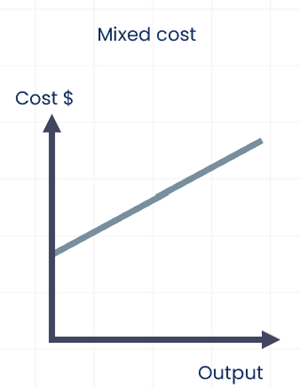
Mixed Cost Examples
Airbnb: Fixed cleaning/service fee + variable cost per night
Cost Behavior Qualifications: Linearity
Assumes variable and fixed costs can be approximated using a straight line within the relevant range