EQ - Topic 1 : Lifestyle, Health and Risk
 Call Kai
 Learn
 Practice Test
 Spaced Repetition
 Match
 Flashcards
 Knowt Play
1/21

There's no tags or description
Looks like no tags are added yet.
22 Terms
Sweating is a thermoregulatory mechanism.
A student stated that loss of heat when sweating is related to the dipole nature of water molecules.
Justify this statement.

Explain how the properties of water make it an ideal transport medium. (3)

Explain how the structures of amylopectin and glycogen make them suitable for storing energy. (3)


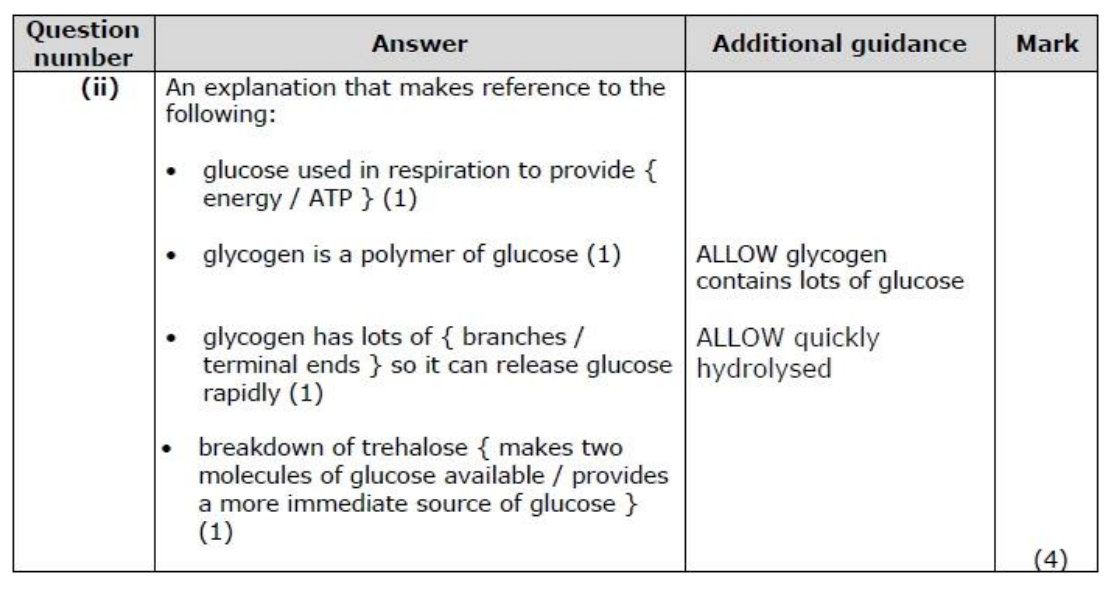
Explain how the structure of glycogen relates to it’s role as an energy storage molecule
a polymer of glucose and so is used in respiration to release ATP
its is branched so many terminal glucose molecules are broken down at tje same time (rapid hydrolysis)
it is a polysaccharide therefore has a high energy content
large molecule therefore insoluble - has no osmotic effect
compact so can be stored easily
Most human cells use carbohydrate as a source of energy
Explain why glycogen release energy more slowly than glucose
glycogen is a polysaccharide
therefore the glycosidic bonds need to be broken
Compare and contrast the structure of cellulose and amylopectin
both are polysaccharides
both have 1-4 glycosidic bonds
cellulose consists of beta-glucose whilst amylopectin consists of alpha-glucose molecules
amylopectin has 1-4 and 1-6 glycosidic bonds whilst cellulose only has 1-4 glycosidic bonds

energy intake of sugars is greater than energy output
excess amount of sugar in the body results in it being stored as fats
this results in weight gain
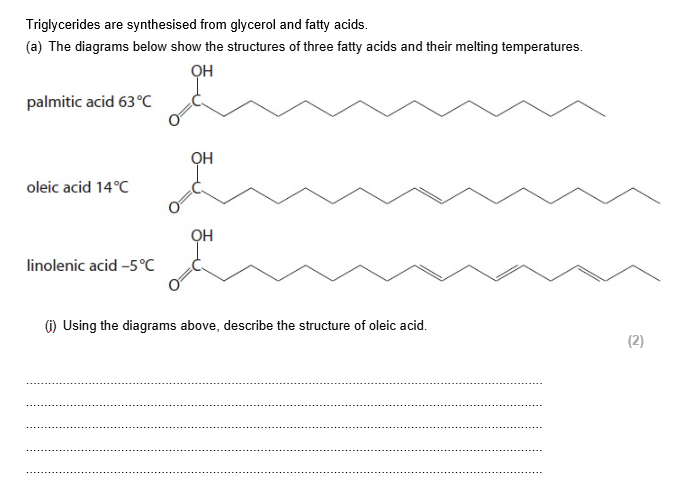
has a hydrocarbon chain and a carboxylic acid (-COOH)
has a single carbon to carbon bond and so is monounsaturated

the greater the number of double bonds the lower the melting point
because the fatty acid chain is more bent - results in kinks
so fatty acids do not pack closely together
hence has weak intermolecular forces
less energy needed to separate the fatty acid chains

different types of coconuts were used
the coconuts were grown in different conditions


use the same concentration of sugar solution
student one should taste all of the sugars
yet have a dried biscuit in between
compare the sweetness of each sugar with the sucrose solution
repeat with different students where each student tastes all the sugars
give two differences between the structure of a ribose molecule and the structure of a glucose molecule
ribose has 5 carbon atoms whereas glucose has 6 carbon atoms
ribose has the formula C5H10O5 whereas glucose has the formula C6H12O6

Cofactors are non-protein molecules that help enzymes to function.
Magnesium ions act as cofactors for some enzymes.
Devise an experiment to investigate the effect of magnesium ions on the initial rate of this reaction (5)
add 10 cm3 of isomerase enzyme solution in one test tube and 7cm3 of substrate solution in another test tube
combine the two test tubes together then start a timer, measure the mass of fructose produced at regular intervals
plot a graph then calculate the initial rate of reaction from the gradient of the linear part of the graph
use excess substrate so that substrate is not limitting
control temperature using a water bath
repeat to calculate a mean
repeat with and without magnesium ions
Explain how the structure of cellulose is adapted for its function in plant cell walls. (3)
cellulose molecules are not straight
there are hydrogen bonds holding the chains together
hence it is strong to resist turgor pressure

carbohydrates and proteins are polar molecules, hence are hydrophilic
triglycerides are non-polar (hydrophobic)
therefore water will form hydrogen bonds with carbohydrates and proteins but not with triglycerides

Using information from the table explain why triglycerides are good energy stores
triglycerides store a greater amount of energy per gram in both dry and wet matter than carbohydrates and proteins
because it has a high carbon content
and it contains no water

Explain why the 'total energy stored' column in this table is of limited use in drawing conclusions about the energy content of these food sources.
units are given for energy only
therefore a comparison cannot be made

a fatty acid as it has a carboxyllic acid
a monounsaturated fatty acid as it has only 1 carbon to carbon double bond
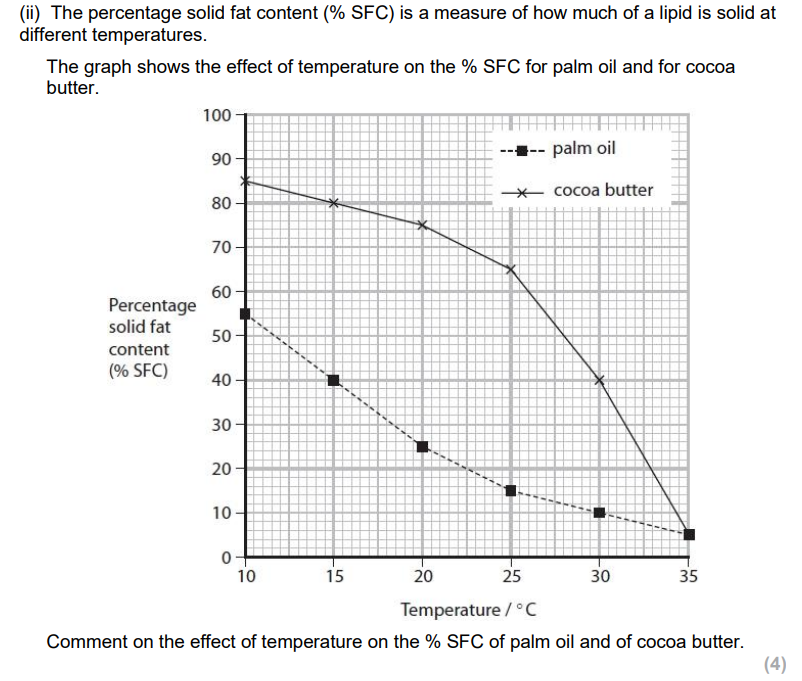
% SFC for both palm oil and cocoa butter decreases as temperature increases
the % SFC of cocoa butter is higher at all temperatures except 35oC
because cocoa butter is amore saturated fat
so fatty acud chains can pack together more tightly