Social Policy & Social Welfare
 Call Kai
 Learn
Learn Practice Test
 Spaced Repetition
 Match
Match Flashcards
 Knowt Play
1/232

Earn XP
Description and Tags
Test 1
Name | Mastery | Learn | Test | Matching | Spaced | Call with Kai | Chat |
|---|
No analytics yet
Send a link to your students to track their progress
233 Terms
What is Social Welfare?
is the term used in contemporary society to describe the structure and network of policies, services, legislation, institutions, and personnel that have developed over ... [a] country’s history.
What system exists to provide the psychosocial needs of all?
The Social welfare system.
It seeks to enable us to achieve and maintain a position in a just society that fosters the development of each person’s
What are social welfare 4 core institutions?
1. The state
The market
Civil society (i.e., non- governmental organizations)
Family/household
What is Social Policy?
refer to actions of government that have ‘an impact on the welfare of citizens by providing them with services of income.
Social policy is concerned with the what?
public admini-stration of welfare services, that is, the formulation, development and management of specific services of government at all levels, such as health, education, income maintenance and welfare services
What is Social Welfare Policy?
anything a government chooses to do, or not to do, that affects the quality of life of its people. Broadly conceived, social welfare policy includes nerarly everything.
What is policy (policies)?
They are guidelines or strategies adopted by governments or organizations to guide decisions and achieve goals.
What are Law (Laws)?
They serve as formal instruments of policy: Laws are legally binding, created by
Whats makes policy and law different?
policy sets out the goals and planned activities of government, but it needs laws to implement the policy. Laws, when they are being drafted, will be guided by the current policy
When did the term welfare state come to be used to describe and when was it introduced ?
societies where the power of the state is used to modify the play of market forces in order to protect people from unforeseen events that caused disruption.
was purportedly first used in 1941, in a book by William Temple, the Archbishop of York, in England.
The welfare state has been loosely described as a what?
A social safety net
It “catches” individuals and families in need, and is designed to help them get back on their feet.
What are the key elements of a welfare state?
the use of the powers invested in government to provide essential social services to citizens;
the use of grants, taxes, pensions, and other programs to provide basic income security.
What are the 3 major kinds of contingencies are addressed in welfare state?
Economic survival-related – e.g., unemployment, retirement, decreasing income, rising prices.
The integrity of the person-related – e.g., disability, illness, violence, homelessness, substance use, racism, discrimination, warfare, death.
Survival of the family-related – e.g., separation, divorce, child custody and protection, the care of aging family members.
What is the welfare state?
is a system in which the state aims to reduce social and economic inequities, to protect the health and well-being of its communities and citizens, especially those in social and financial need,
What are Income Security Programs?
are at the centre of the Canadian welfare state; they are designed to protect citizens from unforeseen economic disruptions.
provide monetary or other material benefits to supplement income or maintain minimum income levels (e.g., Employment Insurance, Social Assistance, Old Age Security
What are the levels of program that provide income security.
These programs are provided by the 3 levels of government: federal (national); provincial/ territorial; and local (municipal and regional).
What does Social Services (personal or community services) provide?
non-monetary aid to those in need (e.g., child protection services, women’s shelters, youth drop-in centres, counselling).
Who uses/ are affected by income security programs and social services?
Nearly every single member of the population at some point in their life.
What does social policies do ?
They set the framework for social welfare activity (i.e., the provision of income security programs and social services).
What does social policies encompass?
Laws
Rules
Regulations
Other administrative directives
What implements/put social policies into practices?
Social Programs (or targeted initiatives)
What is public welfare?
Monetary benefits and services provided directly by any of the 3 levels of government.
Governments also enforce legislation and policy associated with labour standards, minimum wage legislation, and services such as housing, health, and child care.
Whats is public welfare typically associated with?
Income security
What are private welfare ?
(mostly social services)
Delivered through non-profit organizations or for-profit organizations and individuals.
Whats another name for welfare pluralism?
“The Mixed Economy of Welfare”
What is Welfare pluralism?
These terms are used broadly to describe the multiple arrangements and public-private partnerships for the provision of social welfare; have come to increasing prominence in social policy discussions.
What are the 4 types of income security programs?
Minimum Income
income supplementation
Social Insurance
Demogrants
Whats the purpose of Minimum Income?
Its to support those without income (social assistance – e.g., Ontario Works).
What are income supplementation?
They are addition to earned income (e.g., the Guaranteed Income Supplement for low-income seniors).
What is social Insurance?
They are shared risk between contributing parties – individuals, government, employers (e.g., EI, Workers’ Comp, C/QPP).
What is Demogrants?
They are flat-rate programs based on demographic characteristics, such as age or the number of children (e.g., Old Age Security, the Canada child benefit).
What are universal programs?
They are programs available to everyone in a specific category, regardless of income or financial situation.
Although basic eligibility criteria (e.g., age or residency) may have to be met, no further test of need is required.
What is the benefits of universal programs?
Have lower administration costs
Lower or no stigma
Promote solidarity in society
What is the critiques of universal programs?
Too costly
Why should average taxpayers sponsor the rich?
What was Canada first universal program?
The Family Allowance (Baby Bonus, 1945-1992)
Whats are targeted (selective) programs?
Target those identified as ‘in need’; provide benefits based on a means test (sometimes called an “income test” or a “needs test”) –complex selection criteria based on income, work history, or the willingness to find a job.
Example: To receive social assistance, one must prove that income and assets fall below a certain level. In provinces with workfare (e.g., Ontario), applicants must also comply with an employment or training placement.
Whats are some cons of targeted programs?
Administratively complex and costly.
Susceptible to cutbacks, lacking public support.
What is the residual approach?
Its is consider a “Passive protection system”: Limited, temporary response to those most in need.
Minimal assistance, based on strict eligibility criteria – highly stigmatizing, intrusive means-testing, meant to discourage use, prevent people from being ‘lazy.’
How much of a role does government play for the residual approach?
limited role – state intervention is seen as a last resort measure.
What can Canadian public social welfare programs, from early history up to World War II (at least up to the Great Depression of the 1930s) can be characterized as?
Essentially residual in nature.
What is the Institutional approach meant to ensure?
a reasonable standard of living and well-being/health for all citizens.
It is understood that people can’t always meet all of their needs through family and work.
What is the goal of public funded and organized programs?
They are aimed to ‘even out’ economic differences.
Became wide-spread post-World War II in Canada and other industrialized nations; Canada has gone back and forth between the residual and the institutional models.
What are the thoughts around structural approach?
Social problems/inequalities are seen as a built-in feature of an exploitive, oppressive (capitalist) society.
Calls for radical change in society’s major institutions, rather than mere provision of social welfare benefits.
Draws attention to the ways in which existing social policies stereotype and discriminate against various groups of people.
Structural approach has never underlined Canada’s official social policy; rather, voiced by groups and movements (e.g., Occupy, Idle No More, Black Lives Matter).
What was the product of the social inclusion framework?
The social investment approach
What is the social inclusion framewrok?
concept which emerged in Europe in the 1980s, and became a central topic in Canadian social policy discussions in the 21st century.
Challenged us to consider non-economic aspects of society that lead to disadvantage and exclusion – e.g., access to education, health care, political participation.
In what way is the social investment approach about the need to remove barriers and sources of exclusion ?
“Removing the Bar” [to participation in society] rather than “Raising the Bar” [income protection].
Whats is the Social Investment Approach aims?
to integrate the economic and social objectives underlying social welfare through investment in “human capital” – inclusion, equity, and social justice – e.g.:
Investment in children through early childhood education;
Investment in opportunities to assist in obtaining employment (e.g., training and education);
Investing in ways that alleviate the structural disadvantages faced by high-risk and vulnerable populations.
Social investment programs are generally well established in what country?
Across Europe
The common themes of such programs include:
Reduction in the duration of social assistance and unemployment benefits and levels;
Pressure to either accept suitable job offers or participate in education;
Provision of various forms of assistance to obtain employment: personalized support, core skills training, and individual guidance;
Expansion of childcare and parental leave options;
Provision of wage subsidies to employers in the private sector;
Financial support for education and training.
What are some example of Canadian social investment programs?
Grants and loans for post-secondary education
Increased support for Indigenous communities, lone parents, and people with disabilities (including larger grants to Indigenous students, lone parents, and people with disabilities)
Increases in early childhood and kindergarten spaces
Political ideologies are usually classified along the what?
“left-right wing” continuum:
socialism (left wing);
liberalism (centrism);
conservatism (right-wing).
In political sphere, the terms “left” and “right” first appeared where and when?
in France, during the 1789 French Revolution, when members of the National Assembly divided into those loyal to the old regime (religion and the king), who sat to the president’s right side, while the supporters of the revolution sat to his left side.
What is neoliberalism?
a term used to describe the 20th-century resurgence of the 19th-century ideas associated with free-market capitalism, such as reductions in government spending and interventions in order to increase the role of the private sector in the economy and society. Associated with contemporary conservative (right-wing) parties.
What is collectivism?
associated with institutional social welfare approaches; emphasizes citizen rights and the welfare of society as a whole.
What is individualism?
associated with residual approaches to social welfare, which emphasize individual self-reliance and a reliance on the market to sort things out.
What is Populism?
a political approach that strives to appeal to ordinary people who feel that their concerns are disregarded by ‘the elite.’
Whats are some common facts on populism?
Populists can be located anywhere along the left-right wing spectrum, or outside thereof.
They present themselves as ‘one of the regular folks’; ironically, they usually come from an ‘elite’ group (e.g., Donald Trump).
They tap into people’s anger and various grievances, and give them somebody concrete to blame.
Populists tend to focus on small(er) things instead of having comprehensive political and socio-economic plans and agendas.
What is Autocracy?
a system of government by one person with absolute power (e.g., absolute monarch, dictator); often used interchangeably with “totalitarianism.”
What is Totalitarianism?
a system of government that is centralized and dictatorial and requires complete subservience to the state, and is reliant on strong army (e.g., the Soviet Union – left-wing; the Nazi Germany – right-wing); often headed by military or a charismatic leader.
What is Oligarchy?
a form of power structure in which power rests with a small number of people who may or may not be distinguished by one or several character-ristics, such as nobility, fame, wealth, education, or corporate, religious, political, or military control.
What are Kleptocracy (Thievocracy)?
a government whose corrupt leaders (kleptocrats) use political power to appropriate the wealth of the people and land they govern, typically by embezzling or misappropriating government funds at the expense of the wider population (e.g., post-Soviet Russia prior to its invasion of Ukraine).
What are plutocracy (plutarchy)
a society that is ruled or controlled by people of great wealth or income; unlike most political systems, it’s not rooted in any established political philosophy.
What are the policy dimension/scale
International
National (federal or central government)
Provincial/territorial (state in the US)
Local (municipal, regional)
Organizational
Canadian legislative policy-making process is what?
a core function of governance.
process can be relatively simple or very complex.
the same at federal and provincial/territorial levels of government, except that federal legislation requires approval of the House of Commons and the Senate, and provincial/territorial only of their respective unicameral legislature.
What are the 3 major global influences on national policy?
Heightened corporate power (businesses invest time and resources into lobbying, etc.)
International organizations’ ideas (including those of multi-national consulting firms, which commonly serve interests of Transnational Corporations)
Restrictions imposed by international organizations (esp. financial organizations - the World Bank, the International Monetary Fund)
Whats normally cause a development of a new policy?
It starts with a tragic incident (e.g., murder, accidental death of a child), Coroner’s inquest, media stories, and a growing public sentiment that ‘something has to be done about this’ – e.g., Brian’s Law (Bill-68) in Ontario.
How are new polices normally announced?
Through a news release by PM or Premier, or a minister, through a budget decision, or through court ruling.
Whats is Brain’s Law (Bill 68)
In 1995, the Ottawa sportscaster Brian Smith was killed by a man diagnosed as ‘paranoid schizophrenic.’
Due to this + other high-profile incidents involving person with mental illness, Bill-68 was introduced by ON government; meant to create a balance between patient rights and community safety.
It responded to recommendations from coroner’s juries, families, police, and mental health professionals that people with serious mental illness require alternatives to hospitalization.
It amended the Mental Health Act and the Health Care Consent Act: it introduced community treatment orders & lower threshold for involuntary commitment to psychiatric facilities.
Whats are the stages models of policy making seen as?
rational and incremental exercise that follows predictable process: identify a problem; set agenda; adopt an option; implement & evaluate.
Has some descriptive and analytical value in breaking complex process into manageable activities.
Whats is the major critique of the models of policy making?
For being overly linear
What does model 1 of policy making?
Agenda-setting
Adoption
Implementation
Evaluation
What does model 2 of policy making?
Pre-parliamentary stage → Initiation
Parliamentary stage → Formulation
Execution
Post-parliamentary stage → Implementation,
Evaluation
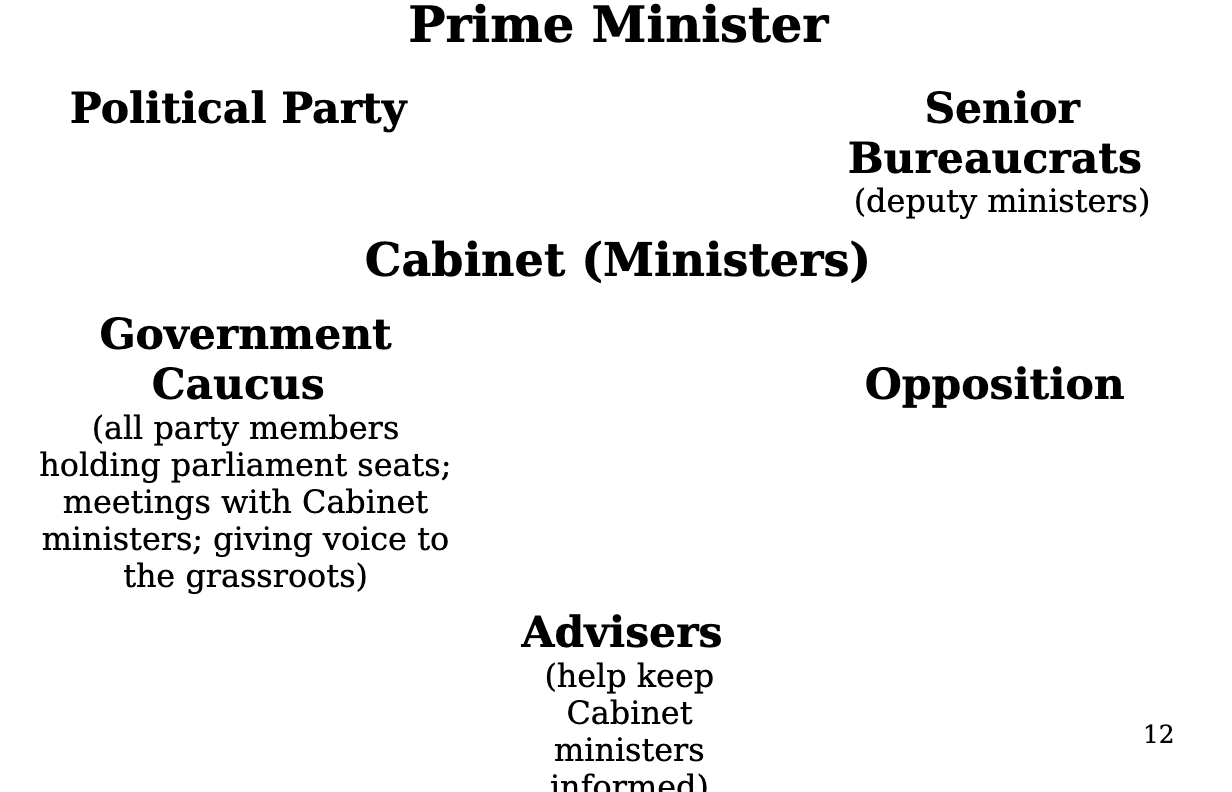
What does the federal policy making structure look like?
Prime Minister
Political party, Senior Bureaucrats
Cabinet (ministers )
Government Caucus, Opposition
Advisers
Interset groups, Consultants
What are the phases of policy making?
The Political Party Phase
The Pre-legislative Phase
The Legislative Phase
What is the political party phase consist of?
Vision and strategies of political parties are determined by some combination of the party leaders, the executive, and the members.
Great power in the hands of the leader of the party in power (PM); policy process is highly confidential, contained mostly within the caucus (all party members holding parliament seats) and the Cabinet (ministers).
Weak policy capacity within political parties results in growing influence of interest groups and independent think tanks.
What does the pre - legislative phase consist of?
The Cabinet and bureaucracy make many critical policy decisions out of public eye.
Government is centered on ministers who are individually and collectively responsible to the House of Commons for government policies and programs.
Ministers lead departments staffed with career civil servants, who provide the minister with background on policy issues and policy analysis. Each minister also is supported by political advisers.
What does the legislative phase consist of?
Policy approval follows discussion and debate in the House of Commons and the Senate (or provincial/territorial legislature) – the most visible locations of social policy-making.
Legislation is introduced to the House in the form of public bills (introduced by a Cabinet minister) and private bills (introduced by any other member of the legislature).
A bill can be described as a legal manifestation of a policy idea: it’s not a policy itself, but a proposal for a new law or a change to an existing one (including an abolition of a law). It consists of clauses until it passes, at which point its parts are referred to as sections.
Whats does majority government in power mean?
the ruling party has 172 or more seats (more than 50% of 343 total seats) in the House of Commons – the bill is expected to pass.
What does minority government mean?
the ruling party failed to secure more than 50% of 343 total seats) or a slim majority government (i.e., the ruling part has only 2-4 seats above 172), it gets complicated because compromises must be struck between the ruling party and the opposition parties.
At the introduction of the new legislation, the Speaker of the House moves bill to what reading?
The first reading
Member’s brief statement explaining the bill’s principles is followed by a vote on whether to accept the bill for future debate.
If accepted, it’s assigned a number, printed, and scheduled for second-reading debate several days later. This allows MPs time to study the proposed bill and the opposition parties to caucus on it.
What happens during the second reading debates at the Federal Level?
MPs opportunity to make statements on the principles of the bill.
Bills receiving a majority vote are referred to the appropriate committee.
Decision re: sending a bill to House of Commons (the committee of the whole) or a Standing Committee (e.g., Justice and Human Rights) is made by the minister introducing the bill, usually in consultation with the House leaders.
What at the Federal Level stage is a major opportunity for social workers to influence policy-making?
The second-reading debate
Standing Committees of the House of Commons (currently 22 + 2 joint committees with Senate) have all-party representation; review and amend proposed legislation, conduct special inquiries into proposed policy changes not associated with particular bill; call public hearings, call expert witnesses, hear directly from ministry staff; accept submissions and oral presentations from private citizens and stakeholder groups.
Once the work of the Standing Committee is completed, the amended bill is returned to the House.
What happens at the third reading at the Federal Level
the bill is voted on by MPs without debate or it may be returned to the Standing Committee with instructions to make specific amendments.
Following third reading, the bill is referred to Senate and the process of first, second, and third readings is repeated.
When both the House of Commons and the Senate approve the bill, it receives Royal Assent from the Governor General (Lieutenant Governor for provinces). That person has constitutional authority to withhold Royal Assent, but in practice this doesn’t occur.
Royal Assent and proclamation dates are set by the Cabinet.
A unanimous vote of all members present in the House will enable what?
a bill to bypass the committee stage and be ordered for third reading – e.g., Bill C-4, An Act to amend the Criminal Code (conversion therapy):
Introduction: November 29, 2021 (House of Commons)
House Approval: December 1, 2021 (Unanimous)
Senate Approval: December 7, 2021 (Unanimous)
Royal Assent: December 8, 2021
In Force: January 7, 2022
What is the most common reason for delaying policy implementation?
is to allow the bureaucracy to put the administrative machinery in place.
Almost all bills contain a crucial provision authorizing government to issue legally binding regulations that set out details of the policy without requiring any approval from the legislature. So, vast areas of policy making don’t come under scrutiny of elected members – serious weakness in the legislature’s ability to hold government accountable (e.g., border control, immigration, environmental protection).
What is an omnibus bill?
It’s a proposed law that covers a number of diverse or unrelated topics (omnibus is derived from Latin and means “for everything”).
It’s a single document that’s accepted in a single vote by a legislature but packages together several measures into one or combines diverse subjects.
What was the original job of the omnibus bill?
It was to efficiently repeal a bunch of obsolete statutes (a “cleaning job”).
Because of their large size and scope, omnibus bills limit opportunities for debate and scrutiny, and sometimes have been used to pass controversial amendments. Thus, some consider omnibus bills to be anti-democratic.
What is a famous omnibus bill?
(Bill C-150) became the Criminal Law Amendment Act, 1968-69 (126-page, 120-clause amendment to the Criminal Code of Canada), introduced by then Minister of Justice Pierre Trudeau:
It dealt with issues as varied as h*m*sexuality, prostitut**n, ab*rtio*n, c*ntracepti*n, lotteries, g*n ownership, gambling, drinking-and-driving penalties, harassing phone calls, regulation of misleading advertising, and even cruelty to animals.
The underlying purpose was to make criminal law more in tune with modern times, but the argument could be made that these were really different issues and that few members of Parliament were likely to agree with each and everyone of the proposed solutions.
How could an omnibus bill be used as a weapon?
By minority governments to ensure their survival, as they may diminish the likelihood that all opposition parties agree to defeat the government on one specific issue.
How can Social Workers Influence Policy-Making ?
By seeking support of elected officials
By participating in public consultations, presenting to Standing Committees as expert witnesses during hearings
Through lobbying (mainly in the U.S.)
By using international policies to advance local & national causes
By engaging in policy analysis
By starting petitions, letter-writing campaigns
By utilizing power and influence of professional associations, unions, celebrities, sympathetic business people
By using the mainstream media: writing letters to the editor; giving interviews; alerting media contacts about relevant issues
Through alternative and social media, blogs, independent publications
By organizing community protests, large-scale demonstrations, marches and the like
What is now know as the Constitution Act, 1867
Canada’s governmental structure was originally established by the British Parliament through the British North America Act
But the federal model and division of powers were devised by Canadian politicians.
Post-WWI, citizens of self-governing Dominions, such as Canada, began to develop a strong sense of identity, and, in the Balfour Declaration of 1926, the British government expressed its intent to grant full autonomy to these regions.
What happened in 1931?
British Parliament passed the Statute of Westminster, giving legal recognition to the autonomy of Canada and other Dominions
What happened in 1982?
Amendments to Canada’s constitution no longer require approval of the British Parliament.
Explain how Canada is a constitutional monarchy and parliamentary democracy?
it’s a federated state with a democratic government, Westminster-style democracy – ‘divided sovereignty’: 3 levels of government – federal, provincial/territorial, and municipal, each with certain jurisdiction, policy-making power, spending power, judicial interpretation.
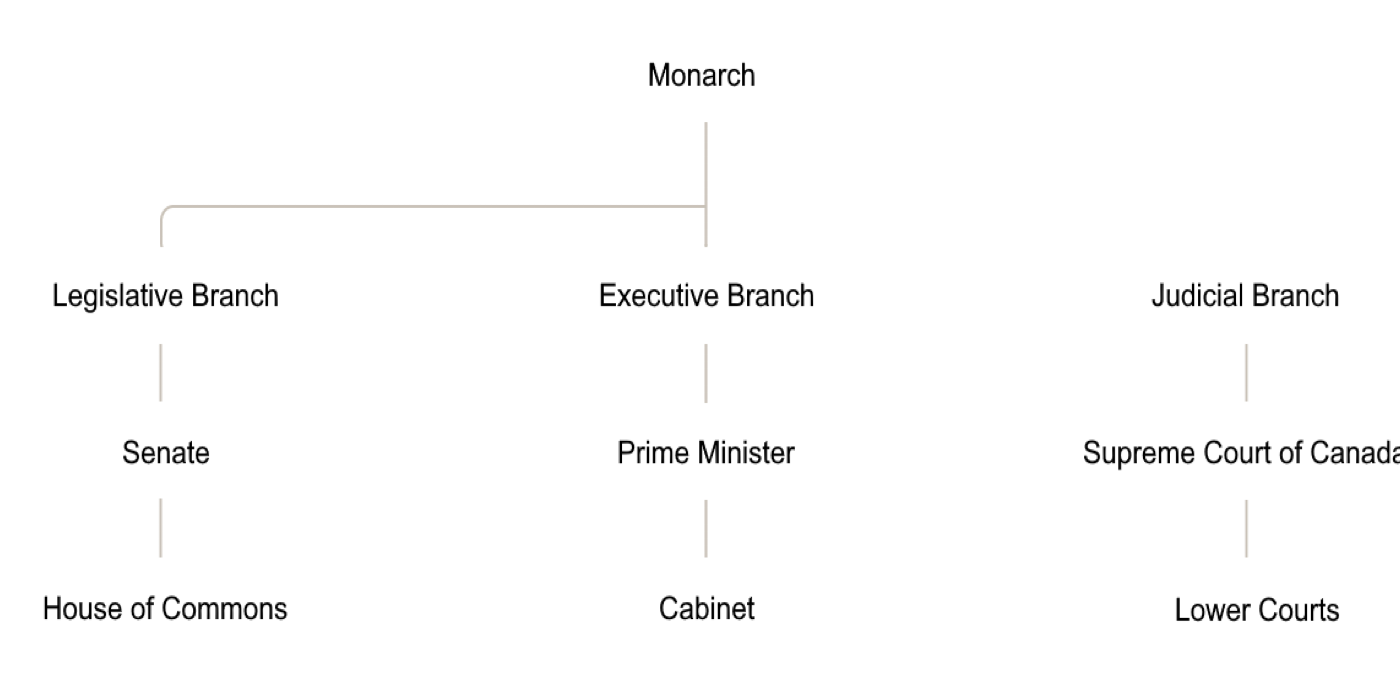
Canada’s system of government has how many branches and what are they?
3 each one has separate powers and responsibilities that are defined in the Constitution:
the legislative branch (Parliament of Canada) passes laws
the executive implements them
the judicial interprets them
What and how many main componets of parliament does Canada have?
The Crown:
King Charles III is Canada’s formal head of state.
The Governor General represents the King and carries out the duties of head of state; is appointed by the King, based on the recommendation of the Prime Minister of Canada, for non-specific term (~5 yrs)
The Senate: The upper house of the federal legislature; has 105 members appointed by the Governor General on the Prime Minister’s advice.
The House of Commons: The lower house of the federal legislature; has 343 elected members.
What happens during national elections in Canada?
Canadian citizens elect representatives of their respective ridings (geographic electoral districts in which voters reside) to the House of Commons.
What is Plurality voting system?
Candidates need to attain only a plurality (the most votes of any candidate) rather than receive a majority of votes (50% of the votes + 1).
What happens to the political party that wins the largest number of seats?
They have the largest number of elected representatives, forms the government, and the party leader becomes the Prime Minister of Canada (P
What are elected representative called and for how long?
Members of Parliament (MPs); they belong to a political party (with few exceptions). MPs mandates can’t exceed 5 years – an election must occur by the end of this time.
Who are Senators and how long are they there for?
They are appointed by the Governor General, on the advice of the Prime Minister, to serve until age 75.