mechanical properties of materials
 Call Kai
 Learn
 Practice Test
 Spaced Repetition
 Match
 Flashcards
 Knowt Play
1/34

35 Terms
stress
σ=A0F
F: force (N)
σ: stress (Pa)
A0: Area in square meters (m2)
strain
Ɛ=l0l1−l0=l0Δl
Ɛ: strain (unitless)
l, l0, Δl : length (m)
shear stress
τ=A0F
τ: shear stress (Pa)
σ: stress (Pa)
A0: square meters (m2)
shear strain
γ=tanθ
γ: shear strain (dimensionless)
θ: angle (in degrees or radians: rad)
1MPa=
1MPa=106Pa=106N /m2
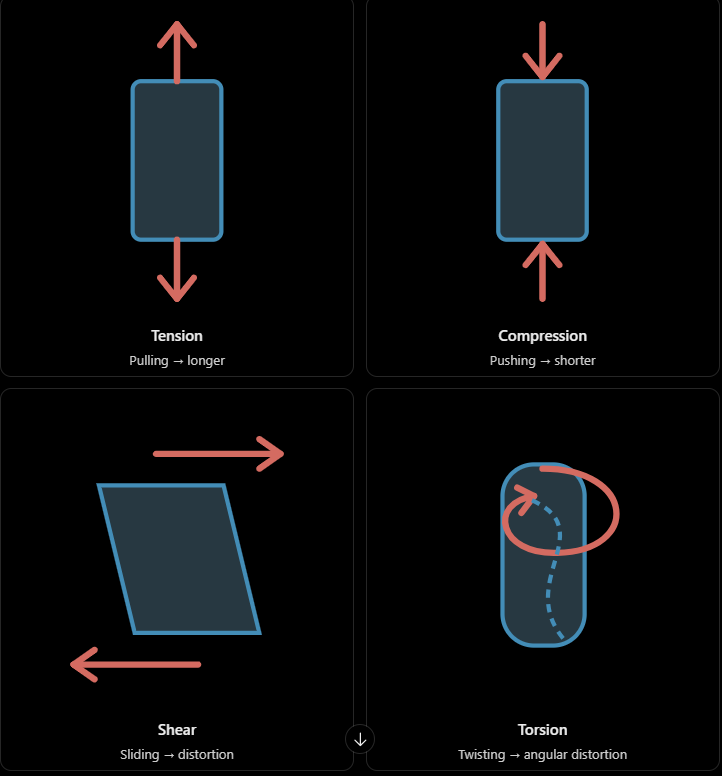
tension
pulling force that causes elongation
compression
pushing force that causes shortening
torsion
twisting around the longitudinal axis
Example : holding one end of a metal stationary while twisting the other end
load cell
measures applied force F in newtons (N)
extensometer
measures elongation Δl in mm or m
imagine you have a steel rod holding up a very heavy object.
why do mechanical properties matter?
when force is applied, the rod might:
stretch (elongate)
shorten (compress)
change shape (deform)
break (fracture)
engineers need to understand how materials respond to forces so they can prevent excessive deformation and fracture.
what affects a material's mechanical behavior?
nature of load: (type of force) whether the material is pulled, pushes, or sheared, and whether the force changes
duration: how long the load is applied (from seconds to years)
environment: temperature and surrounding conditions
a) what is ATSM
b) why does it matter
a) ATSM: American society for testing and materials.
it develops and publishes standards for testing materials.
b) to compare results fairly, we need consistent testing procedures.
what do structural engineers do?
determine stresses and stress distributions in loaded structures.
use experimental testing and mathematical analysis.
select materials with suitable combinations of mechanical properties
4 types of loading
tension tests
a tension test measures how a material behaves when it is pulled until it deforms or fractures
the middle section is narrower than it ends so that we can concentrate the deformation in the middle rather than near the grips
the machine gradually increases its tensile load, while measurements are recorded.
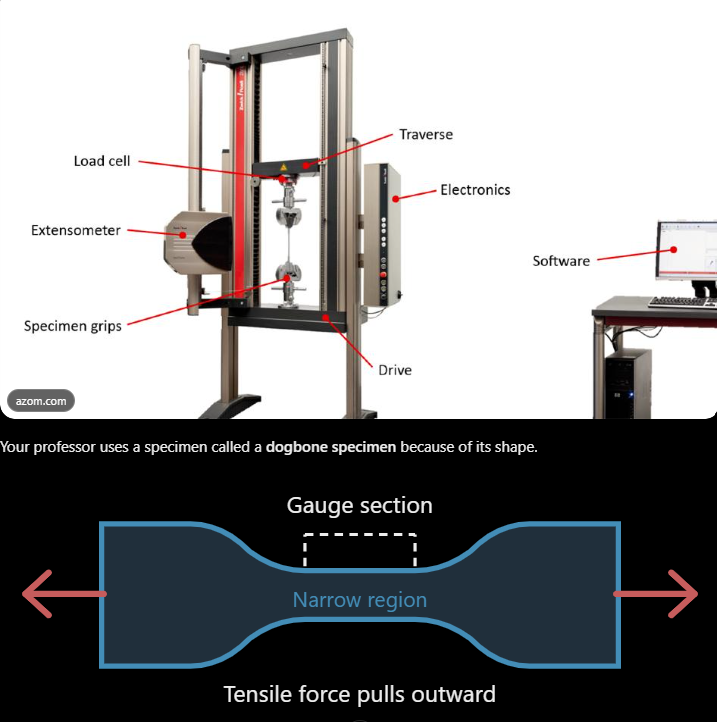
parts of the testing machine
instruments:
load cell: measures the applied force F
extensometer: measures elongation Δl
characteristics of a tensile test
the specimen elongates at a constant rate
the test typically lasts several minutes.
it is
Area of a circle
A=πR2
R=2d
Comparison test
A comparison test measures how a material behaves when a pushing force is applied

-ve stress or strain
-ve answers ←→ Compression
When are compressive tests used?
compressive service loads: when the material will experience pushing forces in real/actual uses
Large plastic deformation: when studying permanent (plastic) deformation, such as metal forming
Brittle materials: when tensile testing is impractical, such as with ceramics or cast iron
Which test is more common? Why?
Tensile tests are more common
they are easier to perform and instrument
For most structural metals, compression tests provide little additional information
What is shear?
Shear occurs when forces are applied parallel to a material’s surface → causing angular distortion

Normal stress vs shear stress
They have identical formulas but…
Normal stress → force acts perpendicular to the cross section
Shear stress → force acts parallel to the surface
Elastic deformation
Temporary deformation (reversible)
When applied force is removed → material returns to it’s original shape and dimensions
Ex: stretching a spring and (applied force) then releasing it (removing applied force → back to its original form)
Hook’s law
σ=Eε
σ: normal stress (MPa)
E: Young’s modulus (modulus of elasticity) (MPa)
ε: normal strain (unitless)
Young’s modulus
Modulus of elasticity E: measures stiffness
Higher E → stiffer material → less strain for the same stress
Lower E → less stiff material → more strain for the same stress
Stress - strain graph
SLOPE=ΔεΔσ=E
So if the question gives a straight line stress-strain graph and asks for stiffness (E) calculate its slope.

Non Linear elastic behavior
Some materials (cast iron, concrete, polymers) exhibit nonlinear elastic behavior
For a point (ε,σ) → secant modulus → Esecant=εσ
For a point (ε,σ) → tangent modulus is the slope at that point→ Etangent=dεdσ

Why are some materials stiffer than others?
Because it depends on interatomic bonding forces.
E∝(drdF)r0
F: interatomic force (N)
r: atomic separation (m)
r0: equilibrium separation (m)
Stronger bonds → higher modulus E
Weaker bonds → lower modulus E
Temperature and shear modulus
As temp increases:
atomic vibrations increase
Effective bond stiffness decreases
Modulus E decreases
T increases → E decreases
Shear modulus
τ=Gγ → G=γτ
G: shear modulus (MPa)
τ: shear stress (MPa)
γ: shear strain (unitless)
Anelasticity
Anelasticity: delayed elastic response and delayed recovery (unlike elastic deformation which recovers immediately)
strain can continue increasing after a load is applied
Recovery takes time after the load is removed
The material eventually goes back to its original form