Proteins: Degradation, Urea Cycle, Amino Acid Biosynthesis and Conversion to Biologically Important Molecules
 Call Kai
 Learn
Learn Practice Test
 Spaced Repetition
 Match
Match Flashcards
 Knowt Play
1/76

There's no tags or description
Looks like no tags are added yet.
Name | Mastery | Learn | Test | Matching | Spaced | Call with Kai | Chat |
|---|
No analytics yet
Send a link to your students to track their progress
77 Terms
matches
in normal adults, nitrogen intake _______________ nitrogen excreted
positive nitrogen balance
excess of ingested nitrogen over excreted nitrogen; accompanies growth and pregnancy
negative nitrogen balance
output of nitrogen exceeds intake; may follow surgery, advanced cancer, and some nutritional disorders
ammonia
highly toxic compound; arises in humans primarily from the alpha-amino nitrogen of amino acids
glutamine
tissues convert ammonia to the amide nitrogen of the nontoxic amino acid _________________________
urea
subsequent deamination of glutamine in the liver releases ammonia, which is converted to _______________, which is not toxic
liver
if ____________ function is compromised, as in cirrhosis or hepatitis, elevated blood ammonia levels generate clinical signs and symptoms
turnover
the continuous degredation and synthesis of cellular proteins that occurs in all forms of life
1-2
humans turn over __________% per day of their total body protein, principally muscle protein
structural rearrangement
high rates of protein degredation occur in tissues that are undergoing ______________ ________________, for example, uterine tissue during pregnancy and skeletal muscle during starvation
75
approximately ______% of the amino acids liberated by protein degredation are reutilized
degreaded
the remaining excess of free amino acids liberated by protein degredation are not stored for future use and are rapidly _______________
amphibolic, urea
in humans, the major portion of the carbon skeletons of the amino acids is converted to ________________ intermediates, while the amino nitrogen is converted to _____________ and excreted in urine
stomach
protein digestion begins in the ____________ and consists of two steps:
1) denaturation by effect of very low pH (1-2)
2) degredation by the proteolytic enzyme pepsin
pepsin
proteolytic enzyme that degrades proteins in the stomach
oligopeptides
stomach digestion of proteins results in a mixture rich in ____________________
small intestin
where digestion of oligopeptides occurs by pancreatic peptidases that further breakdown to di- and tripeptides as well as amino acids
secretin
stimulates the pancreatic secretion of HCO3- to restore normal pH in the small intestine
cholecystokinin
stimulates the secretion of pancreatic peptidases that break oligopeptides into di- and tripeptides, as well as amino acids
intestinal
full degredation of amino acids is completed inside the _______________ cells
blood
amino acid leave intestinal cells and are transported by _____________ to different tissues to be transformed to other molecules or to build new proteins
housekeeping
typical _____________ enzymes such as those for glycolysis have half lives (t 1/2) values of over 100 hours
regulatory
key __________________ enzymes may have half lives (t 1/2) values as low as 0.5 to 2 hours
PEST sequences
regions rich in proline, glutamine, serine, and threonine in enzymes that act as signal peptides for intracellular degredation
endopeptidases
enzyme that hydrolyzes internal peptide bonds, degrading peptides into amino acids
aminopeptidases
enzyme that removes amino acid sequentially from the amino end
carboxypeptidases
enzyme that removes amino acids sequentially from the carboxy end
lysozomes
extracellular, membrane-associated, and long-lived intracellular proteins are degraded in _______________ by ATP-independent proteases
proteasome
degredation of regulatory proteins with short half-lives and of abnormal or misfolded proteins occurs in the cytosol and requires ATP, ubiquitin protein, and _______________________ as part of the UPP
muscle
generates over half of the total body pool of free amino acids; they are transported to different organs for processing (ex: the glucose-alanine cycle)
feeding
there is an amino acid exchange between organs and tissues immediately after _______________ to maintain steady-state concentrations, even between meals
liver
the site of the urea cycle enzymes necessary for disposal of excess nitrogen
ureotelic
humans excrete excess nitrogen as urea
ammonotelic
fish excrete excess nitrogen as ammonia
uricotelic
birds excrete excess nitrogen as uric acid
nitrogen removal
the first step in the degredation of amino acids
aminotransferases (transaminases)
catalyse the transfer of an alpha-amino group from an amino acid to an alpha-ketoacid (ex: alpha-ketoglutarate)
oxaloacetate
aspartate aminotransferase converts aspartate and alpha-ketoglutarate into ________________ and glutamate
glutamate
what alpha-ketoglutarate gets converted into after an aminotransferase reaction
pyruvate
alanine aminotransferase converts alanine and alpha-ketoglutarate into ___________ and glutamate
glutamate
transfers and releases amino groups by two mechanisms:
1) release of transferred amine from the aminotransferase reaction as free ammonium ion
2)accepting an ammonium ion on its carboxylate residue and transporting it as glutamine which can later be converted back to glutamate
oxidative deamination
reaction in which the transferred amine on glutamate gets released as a free ammonium ion and produces alpha-ketoglutarate

glutamine synthase
enzyme that allows glutamate to accept a free ammonium ion on its carboxylate residue, allowing for transport to other tissues

glutaminase
enzyme that converts glutamine back into glutamate, releasing the free ammonium ion

serine and threonine
amino acids that can be directly daminate to release ammonium ions by their respective dehydratase enzymes
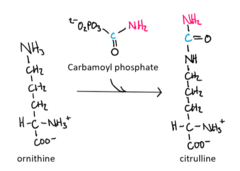
carbamoyl phosphate
once in the liver, ammonium is released and converted into _______________ to begin the urea cycle in the mitochondria (three steps)
carbamoyl phosphate synthetase
major regulatory enzyme of the urea cycle
ornithine transcarbamoylase
enzyme that converts ornithine into citrulline with the addition of carbamoyl phosphate; occurs in the mitochondrial matrix
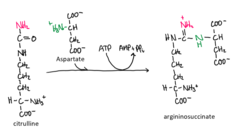
argininosuccinate synthetase
enzyme that uses ATP to convert citrulline into arginino succinate with the addition of aspartate
argininosuccinase
enzyme that releases fumarate from argininosuccinate, producing arginine

arginase
enzyme that produces urea through the hydrolysis of arginine, forming ornithine and restarting the urea cycle

cytosol
most of the urea cycle--except for the formation of citrulline--occurs in the _______________
reactants
Urea cycle _____________:
CO2
NH4+
3ATP
aspartate
2H2O
3
number of ATP molecules required for one cycle of the urea cycle
products
Urea cycle __________:
urea
2 ADP + 2 Pi
AMP + PPi
fumarate
10
an adult human excretes ___________ kg of urea/year in urine
hyperammonemia
defective enzymes or a cirrhotic liver cannot convert ammonia to urea, causing high blood levels of ammonia
nervous system
ammonia is toxic to the _____________________ and can cause coma and death
25
cirrhosis of the liver arises in the _______% of alcoholics
75
about _____% of all cases of liver cirrhosis are the result of alcoholism
viral hepatitis
a nonalcoholic cause of liver cirrhosis
amino acids
once deaminated, the carbon skeletons of the 20 fundamental ____________________ are funnelled into only 7 molecules: pyruvate, acetyl CoA, acetoacetyl CoA, alpha-ketoglutarate, succinyl CoA, fumarate, and oxaloacetate
ketogenic
______________ amino acids can contribute to synthesis of ketone bodies and fatty acids via acetyl CoA and acetoacetyl CoA
glucogenic
________________ amino acids can give rise to glucose via gluconeogenesis intermediates
glutamate
glucogenic amino acid that forms alpha-ketoglutarate when deaminated
alanine
glucogenic amino acid that forms pyruvate when deaminated
aspartate
glucogenic amino acid that forms oxaloacetate when deaminated
leucine
ketogenic amino acid that ultimately forms acetyl CoA and Acetoacetate when deaminated
glycine
______________, through combination with succinyl CoA, is the precursor of heme
glutathione
Glutamate, cysteine, and glycine are the three amino acids that produce the biological antioxidant ___________________
arginine
a precursor of nitric oxide, an important vasodilator and neurotransmitter
glutamate
precursor of GABA, an inhibitory neurotransmitter
histidine
precursor of histamine, which is produced in asthma and allergic reactions
tryptophan
precursor of serotonin, in which there are low levels in depression and related disorders
tyrosine
precursor catecholamines: dopamine, epinephrine, and norepinephrine
dopamine
catecholamine that has low levels in parkinson's
epinephrine and norepinephrine
catecholamines that raise blood pressure and control many metabolic functions