2.2.1 fluvial processes
 Call Kai
 Learn
Learn Practice Test
 Spaced Repetition
 Match
Match Flashcards
 Knowt Play
1/25

There's no tags or description
Looks like no tags are added yet.
Name | Mastery | Learn | Test | Matching | Spaced | Call with Kai | Chat |
|---|
No analytics yet
Send a link to your students to track their progress
26 Terms
What are fluvial processes?
Fluvial processes = stream or river-related processes.
Three main processes:
Erosion
Transportation
Deposition
What determines river energy?
Mainly:
Discharge = volume of water flowing through a channel at a given point, measured in m³/s (cumecs)
Velocity = speed of river flow
Generally:
Discharge ↑ → river energy ↑
Velocity ↑ → river energy ↑
Velocity doubles → river energy increases 4×
River energy is used to overcome friction, erode the channel and transport sediment.
What is river discharge and how is it calculated?
Q = A × V
Q = discharge
A = cross-sectional area
V = mean velocity
What is the difference between laminar and turbulent flow?
Laminar flow:
Water travels in parallel paths
Uniform velocity
No mixing
Rare in natural rivers
Turbulent flow:
Chaotic flow with velocity fluctuations + eddies
Dominant in natural rivers
Produces upward motion that supports sediment
About 95% of river energy under normal conditions may be spent overcoming friction associated with turbulence.

What are calibre, competence and capacity?
Calibre = size of load actually carried.
Competence = largest individual particle the river can transport.
Velocity doubles → competence 64×
Capacity = total amount of material the river can transport.
Velocity doubles → capacity 8×
Remember:
Calibre = SIZE
Competence = MAX SIZE
Capacity = AMOUNT
What are the 3 main processes of fluvial erosion?
Corrasion
Corrosion
Cavitation
How does corrasion occur?
Corrasion/abrasion = coarse/angular river load grinds, scrapes and scours the bed and banks.
Most effective when:
Coarse bedload is abundant
Turbulence is high
Can cause:
Vertical erosion
Lateral erosion
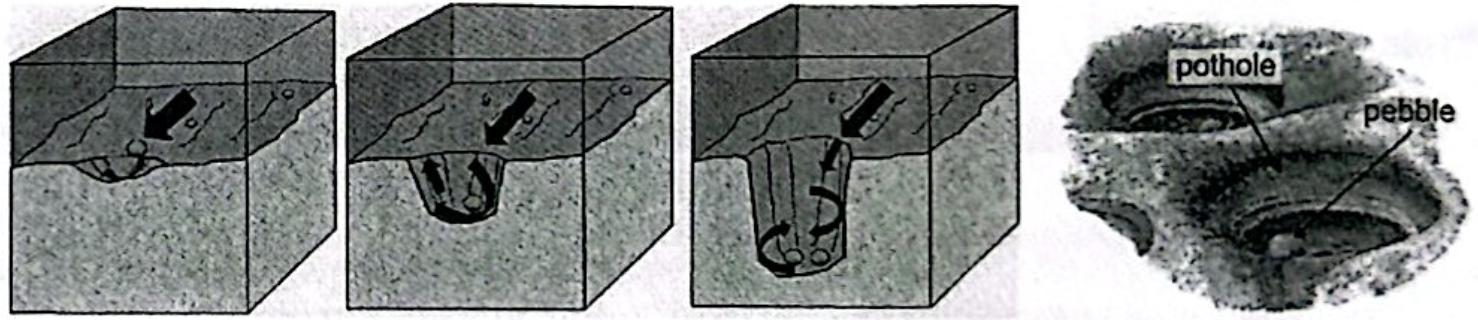
Potholes:
Rock fragments trapped in hollows → turbulent eddies rotate them → abrasion enlarges/deepens hollow → pothole forms.
How does corrosion occur?
Corrosion = solvent action of water, where minerals dissolve and are carried away as solute load.
Especially important for:
Limestone
Rock salt
Gypsum
Depends mainly on:
Chemical weathering
Mineral/rock susceptibility
Unlike most fluvial erosion, corrosion is largely independent of river discharge and velocity.
How does cavitation occur?
Turbulent flow traps air bubbles.
Air bubbles:
Compressed into cracks
Pressure builds
Bubbles burst/collapse
Shockwaves produced
Repeated shockwaves weaken rock → rock splits apart
Common in plunge pools at waterfalls.
Main effect:
Lateral erosion more significant than downcutting
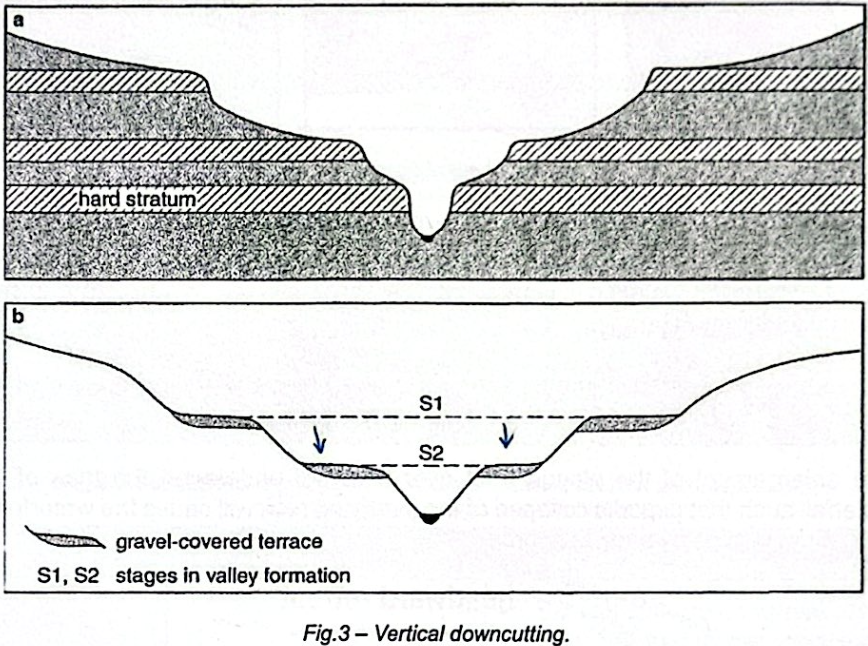
What is vertical erosion/downcutting and when does it increase?
Vertical erosion = erosion that deepens the river channel.
Typically dominant in the upper course due to:
Steep gradient
High velocity/energy
Coarse bedload → corrasion/potholing
Rate of vertical erosion increases due to:
Uplift of land
Fall in sea level
→ river gradient relative to base level steepens
→ river energy ↑
→ increased downcutting
How does lateral erosion occur?
Lateral erosion = erosion that widens the river channel/valley.
At meanders:
Outer/concave bank:
Velocity ↑
Erosion ↑
Undercutting → bank collapse
Inner/convex bank:
Velocity ↓
Deposition ↑
→ river migrates laterally → valley widens
What is headward erosion?
Occurs especially at waterfalls.
Sharp gradient → velocity ↑
→ vertical erosion enlarges plunge pool
→ waterfall face undermined
→ overlying rock collapses
→ waterfall retreats upstream
= headward erosion

What is fluvial transportation and what are its 4 processes?
Transportation = downstream movement of previously eroded sediment.
Four processes:
Traction
Saltation
Suspension
Solution

How do traction and saltation transport sediment?
Traction:
Large/coarse particles
Roll + slide along river bed
Important where energy is sufficient to move coarse bedload
Saltation:
Usually sand-sized particles
Move in jumps/bounces
Hydraulic force lifts particle → travels downstream → gravity returns it to bed
How do suspension and solution transport sediment?
Suspension:
Fine particles, e.g. silt + clay
Held up by turbulent upward currents
Usually forms the largest proportion of river load
Turbulence ↓ → coarser suspended particles deposited first
Solution:
Dissolved minerals/ions + organic substances
Mainly produced by chemical weathering
Largely independent of river velocity
How does sediment change downstream?
Amount of sediment generally ↑ downstream due to:
Tributaries
Channel erosion
Valley-side inputs
Individual particles generally become:
Smaller
Rounder
due to:
Attrition
Corrasion
When does fluvial deposition occur?
Deposition occurs when the river is no longer competent to carry its sediment.
Caused by:
Velocity/energy ↓
Discharge ↓
Gradient ↓
Friction ↑
River reaches mouth
Flow slows at inner/convex meander bank
River becomes overloaded with sediment
Generally:
largest/coarsest particles deposited first → finer particles deposited later
Where does fluvial deposition commonly occur?
River/channel bed:
Flood ends → velocity ↓ → sediment deposited
Floodplain:
River overflows → water spreads → velocity ↓ → deposition
Inner/convex meander bank:
Velocity ↓ → deposition → point bars
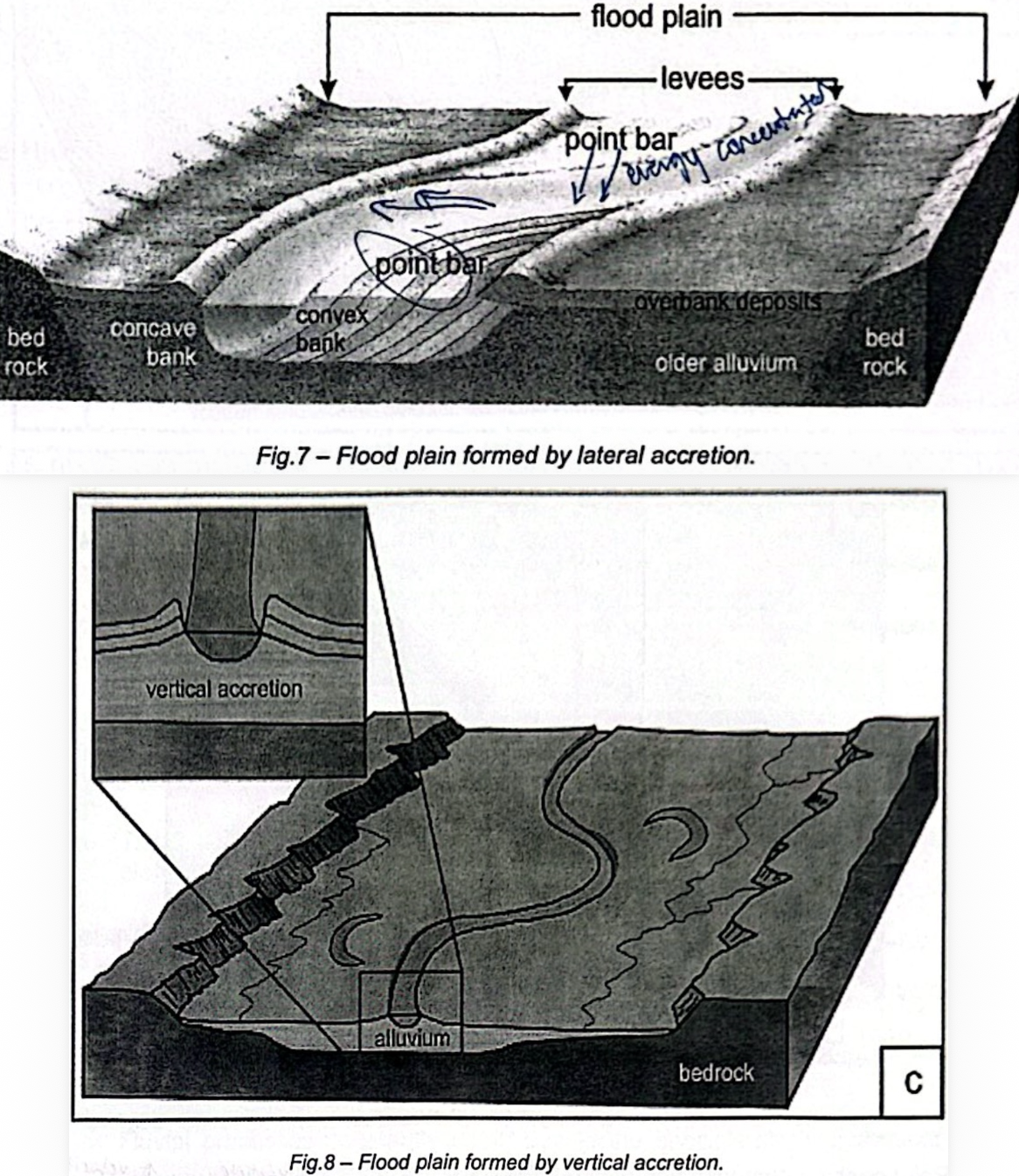
How do lateral and vertical accretion form floodplains?
Lateral accretion:
Outer/concave bank → erosion
Inner/convex bank → deposition/point bar
Meander migrates sideways
→ floodplain develops laterally
Vertical accretion:
Floodwater spreads across floodplain
Velocity ↓
Suspended sediment deposited
Repeated floods → floodplain builds vertically
How do natural levees form?
During floods:
River overtops banks
Water leaves channel → velocity/competence ↓ rapidly
Coarser sediment deposited first near channel
Finer sediment transported further away
Repeated flooding + deposition:
→ banks build upwards
→ natural levees form
What does the Hjulström Curve show?
Relationship between:
Particle size
River velocity
Erosion
Transportation
Deposition
Key thresholds:
Erosion velocity = minimum velocity needed to pick up/erode particle
Transportation velocity = minimum velocity needed to keep it moving
Settling velocity = velocity below which it is deposited

Why are both very large and very fine particles difficult to erode on the Hjulström Curve?
Large particles:
Heavy → high velocity needed to move them
Very fine clay/silt:
Strong cohesion between particles
High velocity needed to detach them
Once clay/silt is entrained, it can remain suspended at very low velocities
What are the main natural factors influencing fluvial processes?
Climate
Vegetation
Sediment characteristics
How do sediment characteristics differ between humid and arid tropical rivers?
Arid tropics:
Physical weathering dominant
→ generally coarser sediment
Loose/unconsolidated material may be rapidly transported during floods
Humid tropics:
Chemical weathering dominant
→ more fine silt/clay
Perennial rivers can carry large sediment loads
What is a river long profile and how does it change downstream?
Long profile = change in river gradient from source to mouth.
Generally:
steep source → progressively gentler gradient → mouth
Upper course:
Steep gradient
Vertical erosion dominant
Coarse load
Middle course:
Gradient ↓
Lateral erosion increasingly important
Meanders develop
Lower course:
Gentle gradient
Deposition increasingly important
Finer sediment

How do dams affect fluvial processes?
Upstream reservoir:
Velocity ↓
Erosion ↓
Sediment deposited/trapped
Downstream:
Sediment supply ↓
River becomes sediment-starved
River may erode bed/banks to obtain sediment
→ river incision/vertical erosion ↑