Chemistry lab exam 2
 Call Kai
 Learn
 Practice Test
 Spaced Repetition
 Match
 Flashcards
 Knowt Play
1/51

There's no tags or description
Looks like no tags are added yet.
52 Terms
Serum protein electrophoresis (SPE)
What it does
Separates charged serum proteins in an electric field at approx pH 8.6
SEPERATION TECHNIQUE NOT DEFINITIVE DIAGNOSES!!!!
Serum protein electrophoresis (SPE)
Migration
(Fast to slow)
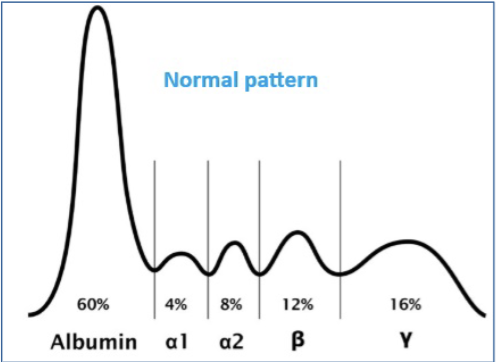
Albumin → a1 → a2 → B → y
Nonuniform migration: investigate voltage, gel condition, and overheating
Proteins migrate differently due to net charge, size (molecular weight), and shape
Normal pattern protein electrophoresis
Monoclonal gammopathy
Sharp spike in gamma region
Narrow M - spike
Often in Y or B region
Suggests: Monoclonal Gammopathy of Undetermined Significance (MGUS), Multiple myeloma, and Waldenstrom macroglobulinemia
(NOT PROOF OF IT THOUGH!!)
Next step: immunofixation to characterize the immunoglobulin heavy/light chain

Nephrotic syndrome
↓ albumin and y bands | ↑ a2 band
(Low albumin with prominent a2 region)
Suggests: “selective proteinuria” smaller proteins (albumin and y) excreted and only larger proteins (a2) retained

Active cirrhosis
B - Y bridging (decrease in albumin from liver disease)
Suggests: most common cause is cirrhosis; also seen in RA, SLE, chronic infections

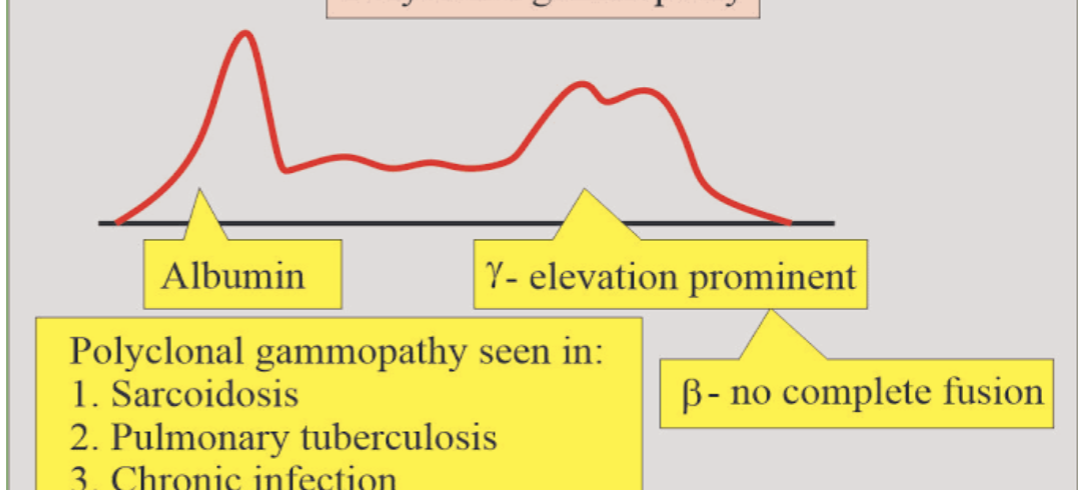
Polyclonal gammopathy
y elevation prominent (Domed broad increase)
broad y region increase
Increased antibodies in blood (can mean multiple things)
Acute phase reactions
↑ in both a1 and a2 bands
↑ in B globins C3, C4, and C reactive protein,
a1: a1 antitrypsin and a1 glycoprotein
a2: ceruloplasmin and haptoglobin
Suggests: infection, malignancy, RA, hepatitis, surgery, trauma, burns, and heart attack

Total protein
6.0 - 8.3
Albumin
3.5 - 5.5
Hypoalbuminemia
breakdown from tissue damage and inflammation
Hyperalbuminemia
reflects dehydration
Calcium
8.6 - 10.3
Hypocalcemia
low albumin, chronic liver disease, and nephrotic syndrome
Hypercalcemia
less excretion in kidneys & increase absorption in gut
(stones, bones, abdominal groans, and mental moans)
Creatinine
Serum:
♂: 0.72 - 1.18 mg/dL
♀: 0.55 - 1.02 mg/dL
Spot urine:
♂: 20 - 320 mg/dL
♀: 20 - 275 mg/dL
↑ creatinine = ↓ GFR
↓ creatinine = malnutrition, low muscle mass, liver disease
Enzyme kinetics
LAG phase: Mixing, stabilization, and reagent equilibration
LINEAR phase: constant reaction rate; measure activity here
Depletion: rate falls as substrate becomes limiting
Enzyme kinetics
Substrate in excess + controlled pH, temperature and cofactors → comparable rates
How analyzer reports enzyme activity
Kinetic measurement
Collect absorbance values in the linear window
Activity (U/L) = ΔAbs/min × stored factor
The factor depends on reaction volumes, path length and molar absorptivity
How analyzer reports enzyme activity
Troubleshooting
Excessive absorbance change before the
measurement window can indicate an
overly rapid reaction or substrate depletion
A factor is method/analyzer specific
Coupled reactions: ALT
Pyruvate coupled with LDH to convert NADH to NAD+
measured signal: NADH ↓ at 340 nm
****More liver specific****
Coupled reactions: AST
Oxaloacetate is coupled with MDH to convert NADH to NAD+
measured signal: NADH ↓ at 340 nm
ALP method
substrate: p-nitrophenyl phosphate (pNPP) +H2O
Product: p-nitrophenol + phosphate
ALP releases a yellow p-nitrophenolate product measured kinetically near 405–408 nm
Zinc and magnesium support enzyme activity
AMP buffer accepts phosphate so it doesn’t inhibit ALP
Clinical interpretation (ALP and GGT)
ALP may originate from liver, bone, and other tissues
ALP ↑ with GGT ↑ supports a hepatobiliary source
(Extrahepatic obstruction)
ALP ↑ normal GGT may indicate bone disease
Bilirubin method: Total bilirubin
Diazo method; solubilizer enables indirect fraction to react
0.2 - 1.0 mg/dL
(React with diazotized sulfanilic acid)
Indirect is solubilized by:
Jendrassik Grof = sodium benzoate and caffeine
Evelyn Malloy = methanol
DMSO (Walters Gerarde) = dimethyl sulfoxide
Bilirubin method: Direct bilirubin
Reacts with diazo reagent without solubilizer
(Reacts directly with sulfanilic acid; no solubilization needed)
0.0 - 0.2 mg/dL
Bilirubin method: Indirect bilirubin
total - direct = calculated
NOT DIRECTLY MEASURED
0.2 - 0.8 mg/dL
total and direct bilirubin method
Both total and direct bilirubin methods form azobilirubin complex that’s measured around 554 - 560 nm
Bilirubin sample
Protect bilirubin specimens from light, exposure can falsely lower measured bilirubin
Total protein: colorimetric assay
Biuret reaction
Cupric ions react with peptide bonds under alkaline pH to form a violet complex measure at 544nm
Albumin (Colorimetric assay)
Bromcresol green (BOG)
BCG binds albumin to form a blue green complex measured at 629 nm. Signal proportional to albumin concentration
Jaundice patterns: Prehepatic
0.2 - 0.8 mg/dL
Indirect bilirubin ↑
Due to excess RBC destruction
Ex.) hemolytic disease, hereditary spherocytosis, sickle cell anemia
Jaundice patterns: Hepatic
Direct and/or indirect ↑
Due to impaired uptake, conjugation, or secretion
Ex.) hepatitis, cirrhosis
Impaired: Gilbert (lack enzyme to conjugate bilirubin effectively)
Conjugation: Crigler - Najjar (liver cant conjugate bilirubin)
Secretion: Dubin johnson (liver can’t pump conjuagted out of cells)
Jaundice patterns: Post hepatic
Direct bilirubin ↑
Due to blockage preventing elimination of conjugated bilirubin
Ex.) gallstones, tumors, cholestasis
Hepatocellular
35 & 0- 35 U/L
AST & ALT ↑ ↑ ↑
ALT may exceed AST
Viral, toxic, ischemic injury
(bilirubin ↑ with injury)
Cholestatic
33 - 98 & 6 - 45
ALP & GGT ↑ ↑ ↑
Dark tea like urine and pale stool
(bilirubin ↑)
Alcohol associated
35 & 0- 35 U/L
AST ↑ ↑ ↑ (significant) > ALT
GGT ↑
AST is commonly 2x of ALT
Advanced liver disease
AST & ALT (variable)
ALP & GGT (variable)
3.5 - 5.5
Albumin ↓↓ and/or PT prolonged
Bilirubin consistency check
Total bilirubin 0.3 mg/dL
Direct bilirubin 0.4 mg/dL
Physiologically inconsistent fractions. Check units, transcription, QC, interferences and repeat as appropriate.
Above analytical range
If AST/ALT exceed the validated analytical measuring range: perform an approved dilution, rerun and multiply by the appropriate dilution factor
Dilution calculations

Dilution calculations

RF latex agglutiantion: On latex particle
Human gamma globulin (IgG), including the Fc region recognized by rheumatoid factor.
Passive/indirect latex agglutination assay: antigen - coated particles detects patient antibody
RF latex agglutiantion: in patient serum
Rheumatoid factor: usually IgM autoantibody against the Fc of IgG
Positive RF ≠ diagnosis of RA
Negative RF ≠ exclusion of RA
Rheumatoid factor (RF): what are we detecting?
Rheumatoid factor is an autoantibody (commonly IgM) that binds with the Fc portion of IgG
Kit uses latex particles coated with human gamma globulin (IgG)
RF in patient serum cross links the coated latex particles → visible agglutination
RF IS NOT DISEASE SPECIFIC

RF titer: where does reactivity stop?
Last reactive dilution = 1:16
Infectious mononucleosis assay
What it detects
Heterophile antibodies associated with IM, NOT EBV antigen or EBV-specific antibody
Guinea pig kidney antigen absorbs many non-IM heterophile antibodies
Infectious mononucleosis assay
Indicator and limits
Treated horse RBCs agglutinate when relevant antibodies remain
Early infection and younger children may test negative despite EBV infection
Agglutination: visual result and controls
Reactive appearance
RF latex: Visible particle clumps
Color slide II IM: Dark clumps on blue green field
Agglutination: visual result and controls
Non reactive appearance
RF latex: Smooth suspension
Color slide II IM: Uniform tan/brown ; fine granularity may occur
Agglutination: visual result and controls
Decision rule
If positive or negative control fails, do not report patient results.
Timing, mixing, reagent volumes and drying can change appearances
Lipid methods: from analyte to signal
Total cholesterol
Cholesterol esterase hydrolyzes esters.
Cholesterol oxidase generates H₂O₂.
Peroxidase uses H₂O₂ in a colored dye reaction
Lipid methods: from analyte to signal
Triglycerides
Lipase releases glycerol.
Enzymatic reactions ultimately generate H₂O₂, which drives a measurable chromogenic reaction
Calculated LDL - C: work the numbers
Total cholesterol - HDL-C - (triglycerides / 5)
If triglycerides are over 400 then the equation is invalid; alternative equations may be used
An AST result flags “above linearity.” What is the best laboratory response?
Dilute according to validated procedure and repeat
An IM slide shows fine brown granularity but no distinct dark clumps. Both
controls passed. How should you interpret it?
Nonreactive in this assay