Module 3 - Fine touch, Vibration, and Proprioception
 Call Kai
 Learn
 Practice Test
 Spaced Repetition
 Match
 Flashcards
 Knowt Play
1/56

There's no tags or description
Looks like no tags are added yet.
57 Terms
What are the two major components of the sensory system? Names, abbreviations, and what they detect?
Medial Lemniscus System | MLS | Fine touch, Vibration, proprioception |
Anterolateral System | ALS | Pain, temperature, crude touch, itch |
Two subtypes of MLS (fine touch, vibration, proprioception). What is each?
Conscious touch → Sensation allowing you to identify what you’re touching (is it rough/smooth, how many objects)
Conscious Proprioception → Sensation allowing you to identify position of limbs and body in the dark
What does a deficit in just conscious proprioception look like?
UNABLE to walk around w/ out looking where you’re walking. Need to see that
Somatosensory ___ convey information from the ____ to the CNS
Afferents, Periphery
What does contralateral mean? Ipsilateral?
Contralateral → Relating to, occurring on, or affecting the opposite side of the body.
Ipsilateral → SAME side of body
Do sensory and motor neurons cross over from the point they enter to get to the brain? Even MLS and ALS in sensory?
YES. Both types of sensory and Motor cross

Fill table for where each type of neuron crosses. + 3 neurons signaling

What are the 5 major receptors in the skin, that are Dorsal root ganglian endings for sensation
Meissner Corpuscle
Pacinian Corpuscle
Ruffini’s Corpuscles
Merkel’s disks
Free Nerve Endings
Functions of each skin receptor?
Meissner Corpuscle → Skin movement, grip
Pacinian Corpuscle → Pressure, fine textures
Ruffini’s Corpuscles → Stretch Movement
Merkel’s disks → Texture
Free Nerve Endings → Pain
Signal transuction path ofr the receptors?
Stimulus changes permeability of cation channels → receptor potential generated → AFFERENT action potential

Which receptors are slow adapting and fast adapting, and what does that mean respectively?
Slow adapting (spatial info: Size, stretch, texture, pain)
Merkel’ disks
Ruffini corpuscle
Rapid adapting (movement, group detection)
Meisner’s corpuscle
Pacinian corpuscle

fill in table of receptors, their function, and rate of adapatation

Which receptor is responsible for reading of braile?
Merkel’s disks
What is two point discrimmination
the ability to distinguish two simultaneously applied touch stimuli as two separate points rather than one.
What is receptive field of an individual sensory neuron
Region of sensory space (body surface, visual field), where stimulus triggers firing of neuron
is density of sensory neurons uniform across body?
No. Highest on fingertips, toes, lips, lowest on back
What is the relationship between receptive field and density?
Minimum seperation needed b/n two points that allows you to distinguish them as different points → CHANGES with the density of receptors on your skin.
ex: Fingertip has higher density
Compare receptive field, density, and two-point discrimination between back and fingertip
Conclusion: Fingertip is the one on the right, with two equidistant stimuli, it falls within two diff receptive fields activating two diff sensory neurons. The left one is back and they activate the same, large receptive field
Characteristic | Left (Back) | Right (Fingertip) |
|---|---|---|
Receptive field size | Large | Small |
Receptor density | Low | High |
Sensory neurons activated | One | Two |
Two-point discrimination | Poor | Good |

WHat is the MLS 3 functions again? and how many neurons are involved?
MLS:
Touch
Propprioception
Vibration
3 neurons involved
1st - Receptor in periphery
2nd - in brainstem (medulla)
3rd - Thalamus
Sketch out MLS path including crossing over. What would happen if you cut at the marked locations (marked in yellow)
I → (below crossing, NO CROSS ocurred) Ipsilateral loss of sensation (on the same side). in this case it would be left side
II → (above crossing, CROSS OCURRED) Loss of sensation on the left side, OPPOSITE side of the NS that was affected

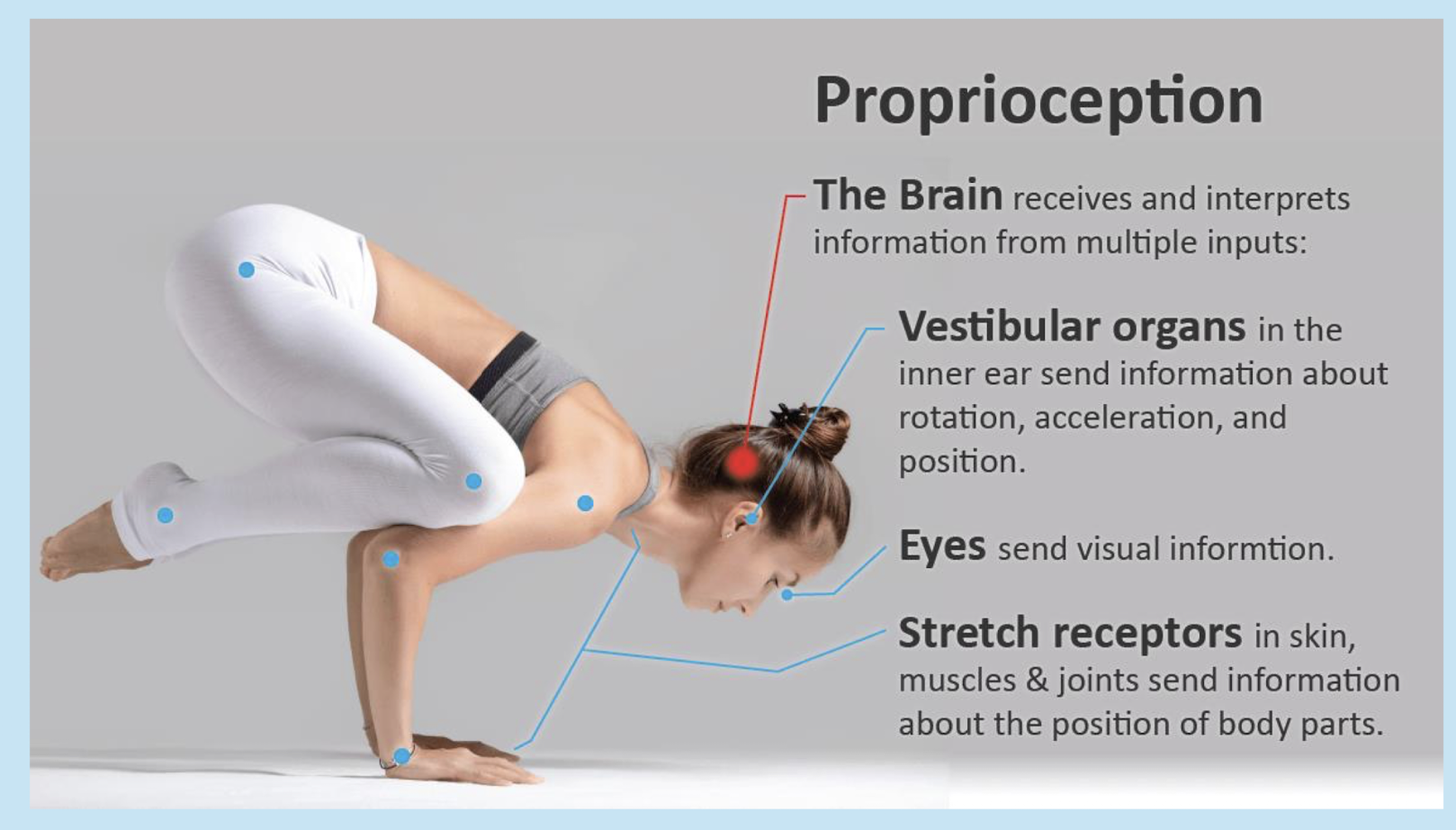
What is proprioception?
Body’s ability to sense movement, action, and location
What type of system is the face specifcally?
Trigeminal system
What is the Sensory Homonculus
Representation of sensory innervation strength in the body
Increase in density = Increase in strength
Contralateral inverted representation of the body (right controlling left, vise versa)
Somatosensory cortex = Parietal lobe

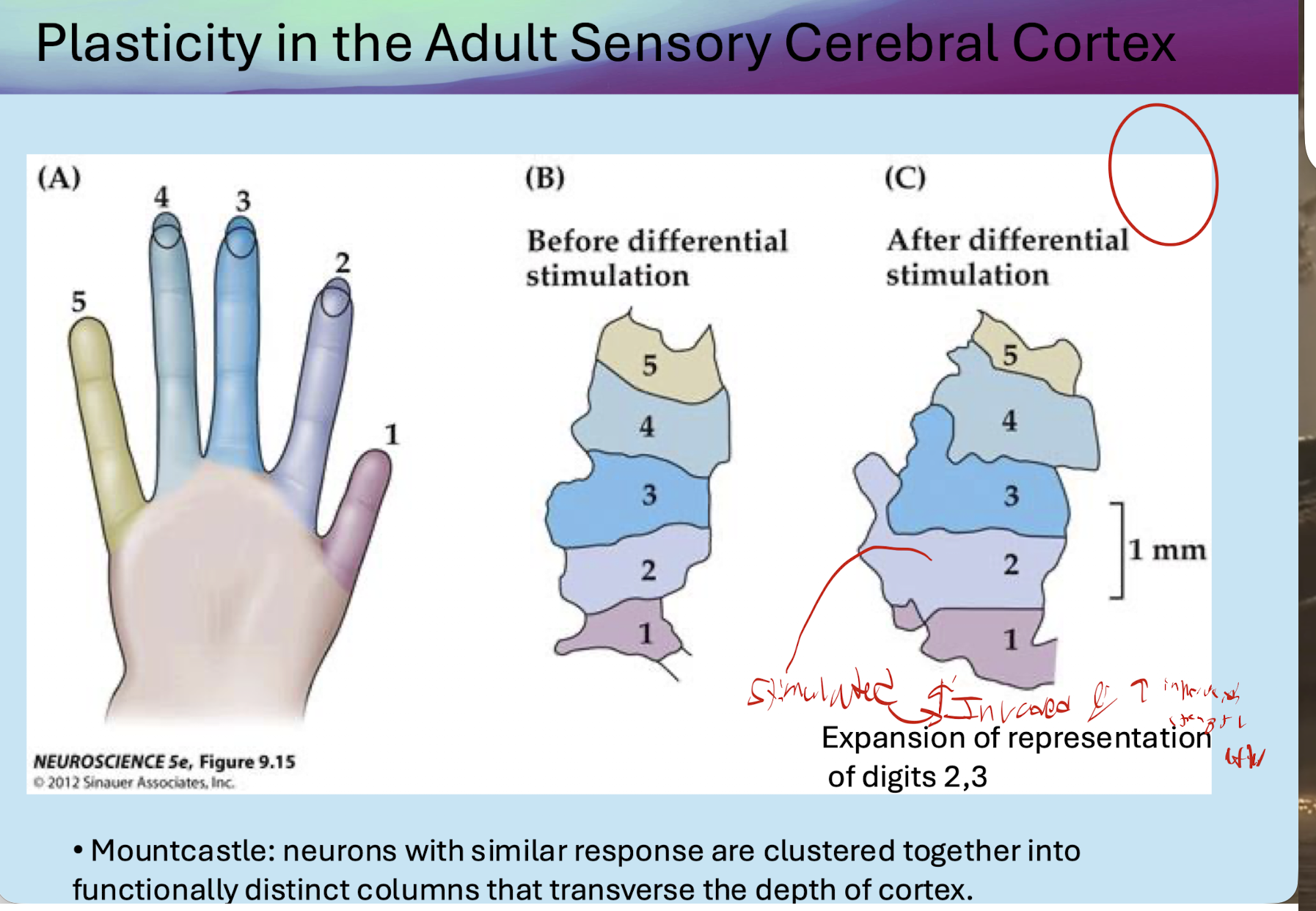
What is differential stimulation and how does it relate to plasticity in adult sensory cerebral cortex?
Differential stimulation → different sensory receptors or neurons respond preferentially to different types or intensities of stimuli.
In sensory physiology, this allows the nervous system to distinguish between different sensations.
Plasticity → After diff stimulation, More is invaded and increased innervated strength for sensation
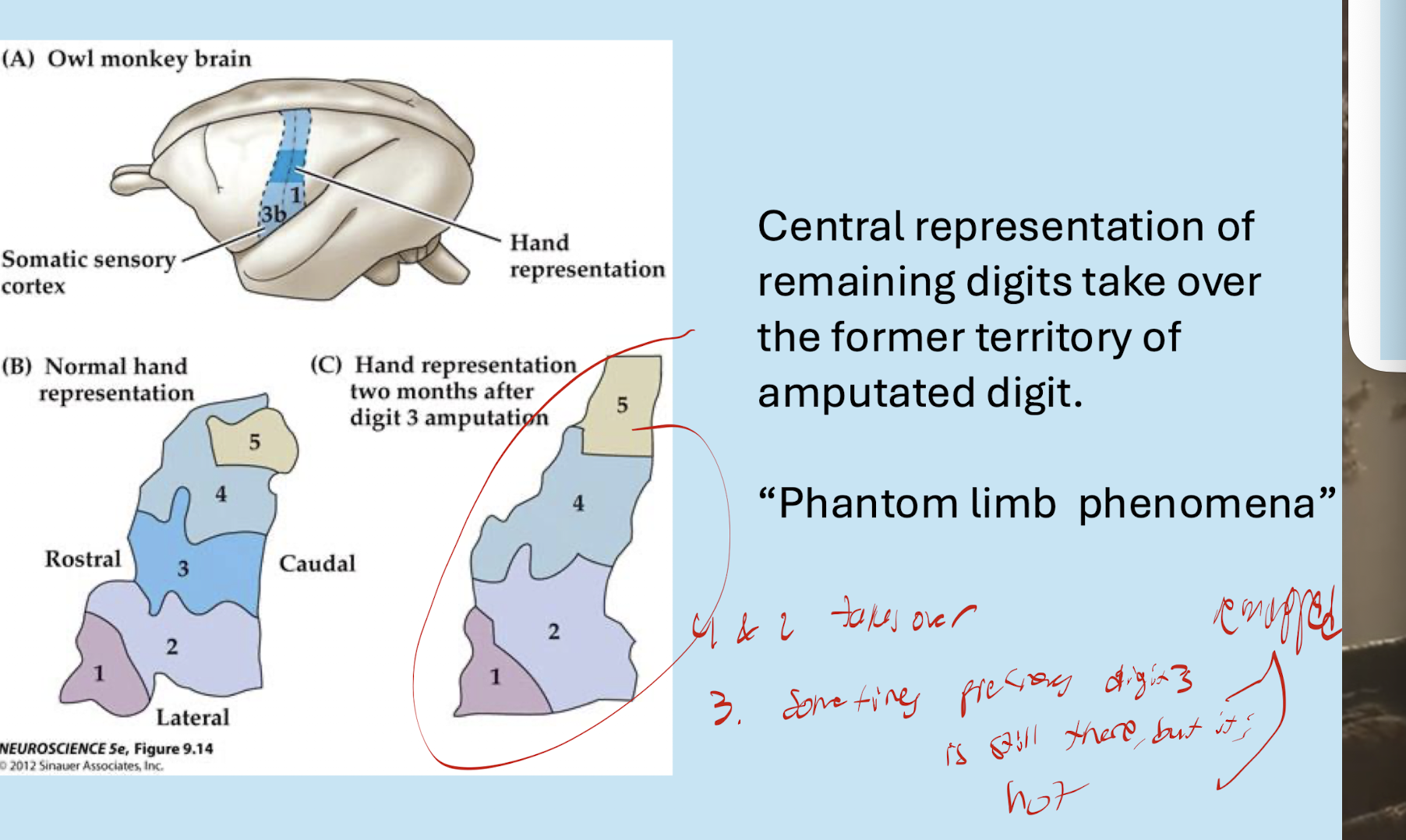
What is remapping in relationto amputaiton of a finger?
Loss of a finger, innervation will take over that part that got amputated, even if that digit is not there anymore.
3 stimuli that induce pain?
mechanical
thermal
chemical
Is MLS or ALS faster?
MLS bu a littl
Is pain contra or ipsi, where is it crossing over?
Crosses over right at dorsal spinal cord, making it contra

What are pain receptors called?
Nociceptors
Types of waves of pain? Characteristics of each (myelination, type of fiber, diamter)
1st. Sharp → Conducted by A delta fibers from Nociceptors, myelinated INC diameter
2nd. Slow → Conducted by C fibers, unmyelinated, DEC diameter
What are A and C fibers detecting
A delta:
Fast, intense mechanical and thermal
B delta:
Slow, thermal, chemical, mechanical stim, cold, acidic
Do nociceptive axnos have a “limit” due to strength of stim
Yes

What is the gate theory of pain?
A painful stimuli can be dampened by rubbing area which activates myelinated fiber that partly inhibits the pain signal being sent to thalamus
A-Beta fiber is stimulated by mecahnoreceptor: A Beta fiber coming from a mechanoreceptor excites an inhibitory interneuron that synapses with a sensory neuron that transmits pain sensation to the brain

What is the phantom limb phenomena?
Amputees have persistent perception of missing limb like touch, movement, and pain that are not controllable.
What is the mechanism behind phantom limb phenomena?
The brain continues to process activity in neural pathways associated with the missing limb, and changes in the somatosensory cortex may contribute to the perception of pain.
Possible treatments for phantom limb?
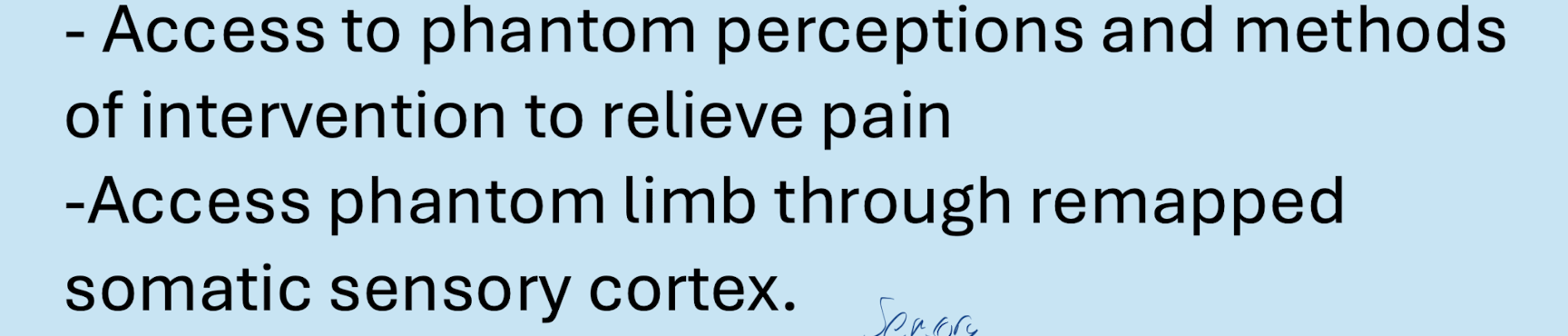
how does phantom limb relate to cortical maps?
Before amputation: The primary somatosensory cortex (S1) has an organized cortical map, where different areas represent different body parts.
After amputation: The cortical area that previously received sensory input from the missing limb no longer receives its normal input.
Cortical remapping: Neighboring cortical areas representing other body parts can expand into or activate the area previously representing the missing limb.
Phantom sensations: Stimulation of these neighboring areas can activate the reorganized cortical region, and the brain may interpret the activity as sensation coming from the missing limb.
Example: The cortical areas representing the face and hand are adjacent. After an arm amputation, stimulating someone's face may produce a sensation that they feel the touch in their missing hand.

draw out ALS Pathway, where is 1st second third synaose. Always ___
always contrlateral
1st neuron- receptor in the periphery
2nd neuron- in spinal cord
3rd neuron- thalamus

what wound an injury to one side of the spinal cord result in for MLS (touch, proprioception) and ALS (temp, pain) lead to for injury. Example: Left spinal cord damage
Left spinal cord damaged →
MLS: Crosses at medulla, so the left side of body is still effected b/c no crossing over occurred yet (reduced touch, vibration, proprioception)
IPSILATERAL
ALS: Crosses at lumbar spine, has crossed over. RIGHT side of body effected for detecting temp and pain
CONTRALATERAL

What are two main aspects of pain and what type of pain do they deal with?
Sensory-discriminative
Location, intensit, quality of pain
Affective-emotional
Location: Fear, anxiety, autonomic activation
Where is sensory discriminative pain and affective-emotional respectively
Sensory-discriminative
VPM/VPL nucleus of thalamus
Affective-emotional
Reticular formation in brainstem
Hypothalamus
Amygdala
Intralaminar nuclei of thalamus
T/F. The brain has endogenous Opiates and their receptors
T
Where do the brain’s endogenous Opiates and their receptors get stimulated to produce analgesia (pain relief)
Stim of the spinal cord and brain stem (medulla + midbrain) produces analgesia (pain relief)
How do the brain’s endogenous opiates work?

T/F does the brain have nociceptors, if not how does it feel pain?
F (does not have nociceptors)
Feels pain through nociceptors in neck, skin, skull around brain which cause headaches
what are some things that damage nervous system and can cause pain?
Periphery neuropathic pain, MS, diabetes, Shingles, Stroke
What is allodynia
A normally nonpainful stimulus causes pain. Example: Lightly touching your skin causes a burning sensation.
What is hyperpathia
An exaggerated pain response to a stimulus, often with delayed onset or persistence. Example: A mild pinprick produces an unusually intense burning sensation.
what is nervous system chronic pain caused by?
Chronic neuropathic pain can result from injured axons developing abnormal electrical activity.
even after the original injury, damaged nerves may continue sending pain signals to the brain.
Who discovered Transient Receptor Potential Channels (TRP, pain and temperature) and Piezo channels (pressure, proprioception)
David Julius
Ardem Patapoutin
What do Piezo2 channels do? Where are they found?
Sense vibrations and touch, help with proprioception
Found in Merkel’s disks in muscle spindles, joints, skin
What are TRP channels, what are they channels for and what open/closes them?
They are temperature gated ion channels, respond to different stimuli
What stimuli does TRP respond to (cold and hot example)
Minty leaves → cold
Chlli pepper CAPSAICIN → hot → increases calcium influx through TRPv1 channels → damages mitochondria + organelles → Nerve fiber reduces production of pain transmitters (ex: Substance P)
How else can capsaicin be used?
Can be used for shingles treatment and other conditions
What is itching (pruritus) caused by, and what helps trasmit that info to spinal cord?
ITching caused by TRPv1 detecting painful/itchy stimuli → NBBP is released and transmits itching sensation to spinal cord and thus brain
What do endorphins bind to to activate pathway to alleviate itching pain? Do they only alleviate?
Endorphins bind to mu-opiod receptors (MORs) → class of protein
DO NOT only alleviate, can cause more itch depending on type of MOR and if endorphine or morphine being used
How can MOR lead to more itching or relief of itching with morphine being used?
Morphine activates MOR1 → Alleviate itching
Morphine activates Mor1D-GRPR → MORE ITCHING
This is why meth users always itch