transformations test
 Call Kai
 Learn
 Practice Test
 Spaced Repetition
 Match
 Flashcards
 Knowt Play
1/43

There's no tags or description
Looks like no tags are added yet.
44 Terms
sine function: even or odd
odd?
sine function shape and point it passes through
The sine function has a wave-like shape that oscillates between -1 and 1. It passes through the origin at the point (0, 0).
sine function domain
The domain of the sine function is all real numbers, represented as (−∞,∞) .
sine function range
The range of the sine function is all real numbers between -1 and 1, represented as [−1,1].
meaning of a periodic function
a function where outputs repeat in regular intervals/over a constant interval
example of a periodic function
sine and cosine functions
cosine function shape and y intercept
W, (0,1)
is a cosine function periodic
yes
domain of cosine function
infinity and neg infinity
range cosine function
[-1, 1]
cosine function odd or even
even
even function meaning
reflected/symmetrical over y axis
even function algebraic rule
f(-x) = f(x)
odd function meaning
symmetrical over the origin, 180 degree rotation
odd function algebraic rule
f(-x) = -f(x)
process to test if even or odd function algebraically
substitute -x for x everywhere in f(x)
simplify the expression
see what it matches
a function is even when after simplifying… (algebraically)
it matches f(x), the original
a function is odd when after simplifying… (algebraically)
it matches -f(x)
greatest integer/step function
f(x)= [x] or int(x), find the greatest integer less than or equal to x
domain of greatest integer/step function
infinity
range of greatest integer/step function
{y: y=EZZ} y such that y is equal to all integers
greatest integer/step function, odd even or neither?
neither
is greatest integer/step function a continuous graph
no, range is only integers
is greatest integer/step function a one to one function
no
what is the opposite of a greatest integer/step function
least integer/ceiling function
constant function
f(x) = any real number
can a constant function be vertical?
no, y needs to be constant
identity function
f(x) = x
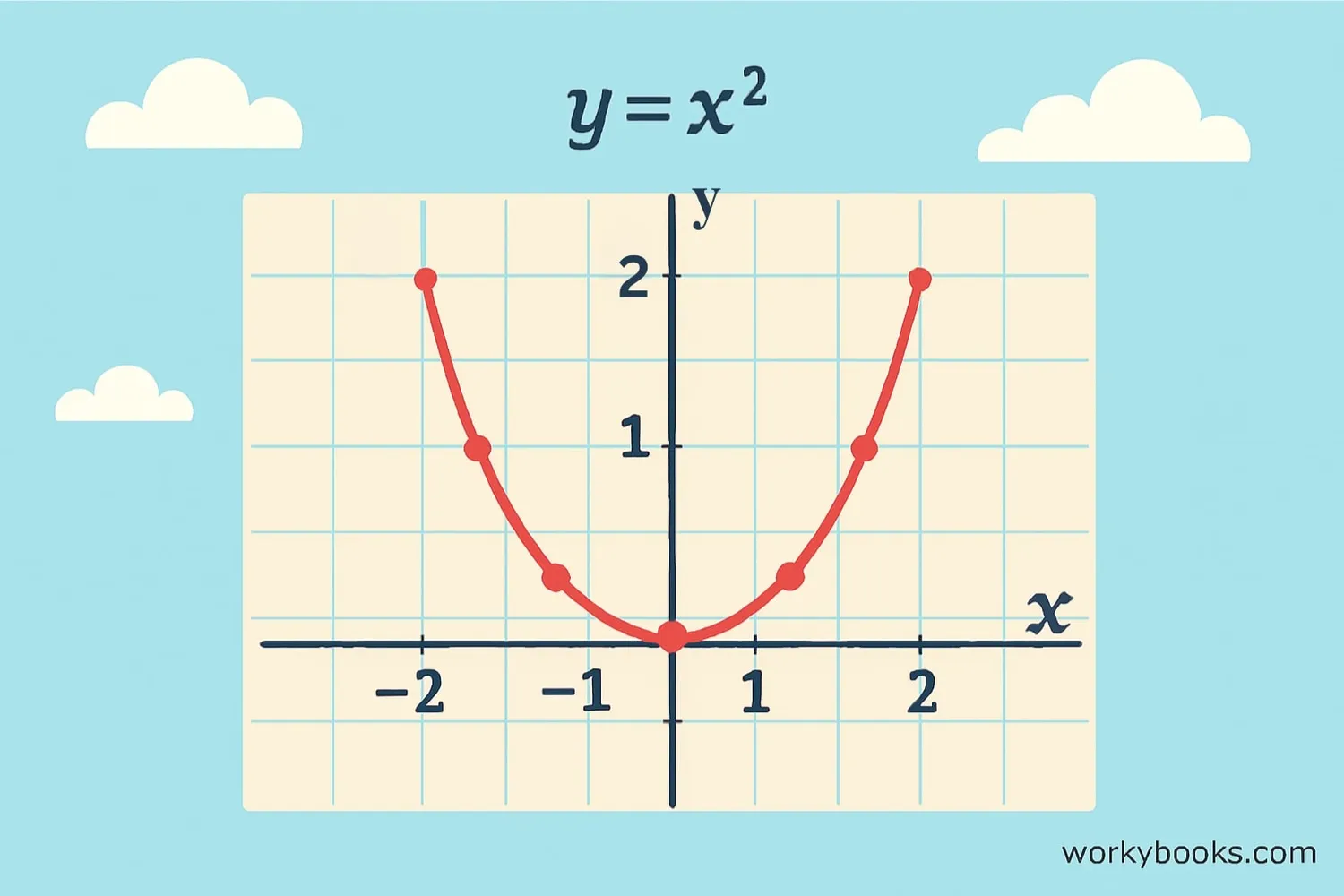
quadratic function
x2
square root function
sq root x

cubic function
x3

cube root func
cubic root x

rational func
1/x

rational square func
1/x²

absolute value func
lxl
exponential func
2x
(any pos base)

expression for transformations of f(x)
af(b(x-h))+k
expression for transformations of f(x): f(x-h)
shift right h
expression for transformations of f(x): f(x)+k
shift up k
expression for transformations of f(x): f(bx)
dilate horizontally b
when b or a is negative in expression for transformations of f(x):
reflect over axes
expression for transformations of f(x): af(x)
dilate vertically by a
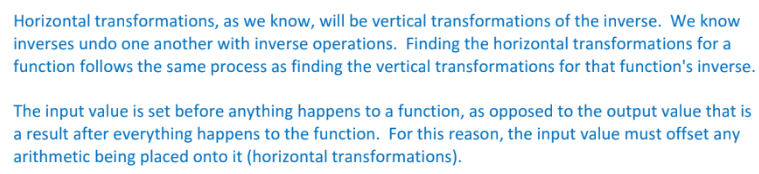
why are horizontal transformations the opposite of what you think?
difference between f(b(x-h)) and f(bx-bh)
