5 - Sterile Dosage Forms
 Call Kai
 Learn
Learn Practice Test
 Spaced Repetition
 Match
Match Flashcards
 Knowt Play
1/100

Earn XP
Description and Tags
Proverbs 16:3
Name | Mastery | Learn | Test | Matching | Spaced | Call with Kai | Chat |
|---|
No analytics yet
Send a link to your students to track their progress
101 Terms
b. Sterile dosage forms
Dosage forms that are required to have an absence of living microorganisms, including their spores.
a. Non-sterile dosage forms
b. Sterile dosage forms
c. Topical preparations
d. Oral solutions
b. Parenterals
Injected through the skin or directly into the body tissues
a. Topicals
b. Parenterals
c. Oral solids
d. Suppositories
b. Parenterals
Must conform to strict requirements for microbiological impurity, particulate matter, pyrogenicity, and isotonicity
a. Topicals
b. Parenterals
c. Oral solids
d. Suppositories
a. Intra-articular
[Perenteral Routes and their Locations]
Into the joint space
a. Intra-articular
b. Intrasynovial
c. Intrathecal
d. Intra-arterial
e. Intracardiac
f. Intravenous
g. Intramuscular
h. Intradermal
i. Subcutaneous
j. Hypodermic
k. Epidural
b. Intrasynovial
[Perenteral Routes and their Locations]
Into the joint fluid
a. Intra-articular
b. Intrasynovial
c. Intrathecal
d. Intra-arterial
e. Intracardiac
f. Intravenous
g. Intramuscular
h. Intradermal
i. Subcutaneous
j. Hypodermic
k. Epidural
c. Intrathecal
[Perenteral Routes and their Locations]
Into the spinal column / cerebrospinal fluid (CSF)
a. Intra-articular
b. Intrasynovial
c. Intrathecal
d. Intra-arterial
e. Intracardiac
f. Intravenous
g. Intramuscular
h. Intradermal
i. Subcutaneous
j. Hypodermic
k. Epidural
d. Intra-arterial
[Perenteral Routes and their Locations]
Into the arteries
a. Intra-articular
b. Intrasynovial
c. Intrathecal
d. Intra-arterial
e. Intracardiac
f. Intravenous
g. Intramuscular
h. Intradermal
i. Subcutaneous
j. Hypodermic
k. Epidural
e. Intracardiac
[Perenteral Routes and their Locations]
Into the heart
a. Intra-articular
b. Intrasynovial
c. Intrathecal
d. Intra-arterial
e. Intracardiac
f. Intravenous
g. Intramuscular
h. Intradermal
i. Subcutaneous
j. Hypodermic
k. Epidural
f. Intravenous
[Perenteral Routes and their Locations]
Into the veins
a. Intra-articular
b. Intrasynovial
c. Intrathecal
d. Intra-arterial
e. Intracardiac
f. Intravenous
g. Intramuscular
h. Intradermal
i. Subcutaneous
j. Hypodermic
k. Epidural
g. Intramuscular
[Perenteral Routes and their Locations]
Into the muscles
a. Intra-articular
b. Intrasynovial
c. Intrathecal
d. Intra-arterial
e. Intracardiac
f. Intravenous
g. Intramuscular
h. Intradermal
i. Subcutaneous
j. Hypodermic
k. Epidural
h. Intradermal
[Perenteral Routes and their Locations]
Into the skin
a. Intra-articular
b. Intrasynovial
c. Intrathecal
d. Intra-arterial
e. Intracardiac
f. Intravenous
g. Intramuscular
h. Intradermal
i. Subcutaneous
j. Hypodermic
k. Epidural
i. Subcutaneous / Hypodermic
[Perenteral Routes and their Locations]
Under the skin
a. Intra-articular
b. Intrasynovial
c. Intrathecal
d. Intra-arterial
e. Intracardiac
f. Intravenous
g. Intramuscular
h. Intradermal
i. Subcutaneous
j. Hypodermic
k. Epidural
j. Hypodermic
Another term for “Subcutaneous”
a. Intra-articular
b. Intrasynovial
c. Intrathecal
d. Intra-arterial
e. Intracardiac
f. Intravenous
g. Intramuscular
h. Intradermal
i. Subcutaneous
j. Hypodermic
k. Epidural
k. Epidural
[Perenteral Routes and their Locations]
Near the dura mater of the CNS (central nervous system)
a. Intra-articular
b. Intrasynovial
c. Intrathecal
d. Intra-arterial
e. Intracardiac
f. Intravenous
g. Intramuscular
h. Intradermal
i. Subcutaneous
j. Hypodermic
k. Epidural
a. Intramuscular
[Parenteral Injection]
Angle of 90 degrees
a. Intramuscular (IM)
b. Subcutaneous (SC/SQ)
c. Intravenous (IV)
d. Intradermal (ID)
b. Subcutaneous
[Parenteral Injection]
Angle of 45 degrees
a. Intramuscular (IM)
b. Subcutaneous (SC/SQ)
c. Intravenous (IV)
d. Intradermal (ID)
c. Intravenous
[Parenteral Injection]
Angle of 25 degrees
a. Intramuscular (IM)
b. Subcutaneous (SC/SQ)
c. Intravenous (IV)
d. Intradermal (ID)
d. Intradermal
[Parenteral Injection]
Angle of 10 to 15 degrees
a. Intramuscular (IM)
b. Subcutaneous (SC/SQ)
c. Intravenous (IV)
d. Intradermal (ID)
c. Intravenous (IV)
[Parenteral Routes]
Directly into the systemic circulation (back of the hand or dorsal forearm)
a. Intramuscular (IM)
b. Subcutaneous (SC/SQ)
c. Intravenous (IV)
d. Intradermal (ID)
c. Intravenous (IV)
[Parenteral Routes]
Can be injected all at once (IV bolus) or gradually over a sustained period of time (IV infusion)
a. Intramuscular (IM)
b. Subcutaneous (SC/SQ)
c. Intravenous (IV)
d. Intradermal (ID)
c. Intravenous (IV)
[Parenteral Routes]
Given at 15-20°
a. Intramuscular (IM)
b. Subcutaneous (SC/SQ)
c. Intravenous (IV)
d. Intradermal (ID)
a. Intramuscular (IM)
[Parenteral Routes]
Deep into the skeletal muscles (gluteal or deltoid muscle)
a. Intramuscular (IM)
b. Subcutaneous (SC/SQ)
c. Intravenous (IV)
d. Intradermal (ID)
a. Intramuscular (IM)
[Parenteral Routes]
Deep into the skeletal muscles (gluteal or deltoid muscle)
a. Intramuscular (IM)
b. Subcutaneous (SC/SQ)
c. Intravenous (IV)
d. Intradermal (ID)
a. Intramuscular (IM)
[Parenteral Routes]
For greater volumes (2 to 5 mL)
a. Intramuscular (IM)
b. Subcutaneous (SC/SQ)
c. Intravenous (IV)
d. Intradermal (ID)
b. 2 mL
[Parenteral Routes]
The volume for intramuscular injection into the deltoid muscle is:
a. 1 mL
b. 2 mL
c. 3 mL
d. 5 mL
d. 5 mL
[Parenteral Routes]
The volume for intramuscular injection into the gluteal muscle is:
a. 2 mL
b. 3 mL
c. 4 mL
d. 5 mL
a. Intramuscular (IM)
[Parenteral Routes]
Given at 90°
a. Intramuscular (IM)
b. Subcutaneous (SC/SQ)
c. Intravenous (IV)
d. Intradermal (ID)
c. Both a and b
Vaccines
Antipsychotics
[Parenteral Routes]
Examples of drugs given via the intramuscular route include:
a. Vaccines
b. Antipsychotics
c. Both a and b
d. Neither a nor b
b. Subcutaneous (SC/SQ)
[Parenteral Routes]
Injected into the loose connective and adipose tissue (lower abdomen, buttocks, thigh, upper arm, anterior thigh)
a. Intramuscular (IM)
b. Subcutaneous (SC/SQ)
c. Intravenous (IV)
d. Intradermal (ID)
b. Subcutaneous (SC/SQ)
[Parenteral Routes]
Uses small volumes only due to nerves (1.3 mL or less)
a. Intramuscular (IM)
b. Subcutaneous (SC/SQ)
c. Intravenous (IV)
d. Intradermal (ID)
a. 1.3 mL or less
[Parenteral Routes]
Subcutaneous (SC/SQ) injection allows only small volumes due to nerves, typically ______
a. 1.3 mL or less
b. 2 to 5 mL
c. 5 to 10 mL
d. 10 to 20 mL
b. Subcutaneous (SC/SQ)
Given at 45°
a. Intramuscular (IM)
b. Subcutaneous (SC/SQ)
c. Intravenous (IV)
d. Intradermal (ID)
c. Insulin
[Parenteral Routes]
Example of a drug given via subcutaneous route.
a. Vaccines
b. Antipsychotics
c. Insulin
d. Chemotherapy
d. Intradermal (ID)
[Parenteral Routes]
Injection given into the corium of the skin.
a. Intramuscular (IM)
b. Subcutaneous (SC/SQ)
c. Intravenous (IV)
d. Intradermal (ID)
d. Intradermal (ID)
[Parenteral Routes]
Uses a minimal volume of 0.1mL
a. Intramuscular (IM)
b. Subcutaneous (SC/SQ)
c. Intravenous (IV)
d. Intradermal (ID)
a. 0.1 mL
[Parenteral Routes]
Intradermal (ID) uses a minimal volume of _____
a. 0.1 mL
b. 0.5 mL
c. 1 mL
d. 1.3 mL
d. 10-15°
[Parenteral Routes]
Intradermal injection is given at which angle?
a. 90°
b. 45°
c. 25°
d. 10-15°
b. Tuberculin skin test
[Parenteral Routes]
Example of a test given via intradermal route.
a. Insulin test
b. Tuberculin skin test
c. Allergy test only
d. Glucose tolerance test
Solvent / Vehicle
Solute
Components of Parenterals [2]
Water for Injection (WFI)
Sterile Water for Injection (SWFI)
Bacteriostatic Water for Injection (BWFI)
Sodium Chloride Injection
Aqueous Solvent / Vehicle [4]
Water for Injection (WFI)
[Components of Parenterals - Aqueous Solvent / Vehicle]
Pyrogen-free water obtained by distillation or reverse osmosis
a. Water for Injection (WFI)
b. Sterile Water for Injection (SWFI)
c. Bacteriostatic Water for Injection (BWFI)
d. Sodium Chloride Injection
c. Both a and b
Distillation
Reverse Osmosis
[Components of Parenterals - Aqueous Solvent / Vehicle]
Water for Injection (WFI) is a pyrogen-free water obtained by:
a. Distillation
b. Reverse osmosis
c. Both a and b
d. Neither a nor b
b. Sterile Water for Injection (SWFI)
[Components of Parenterals - Aqueous Solvent / Vehicle]
WFI that has been sterilized
a. Water for Injection (WFI)
b. Sterile Water for Injection (SWFI)
c. Bacteriostatic Water for Injection (BWFI)
d. Sodium Chloride Injection
c. Bacteriostatic Water for Injection (BWFI)
[Components of Parenterals - Aqueous Solvent / Vehicle]
SWFI with antimicrobial agent (benzyl alcohol)
a. Water for Injection (WFI)
b. Sterile Water for Injection (SWFI)
c. Bacteriostatic Water for Injection (BWFI)
d. Sodium Chloride Injection
d. Sodium Chloride Injection
[Components of Parenterals - Aqueous Solvent / Vehicle]
0.9% NaCl in WFI
a. Water for Injection (WFI)
b. Sterile Water for Injection (SWFI)
c. Bacteriostatic Water for Injection (BWFI)
d. Sodium Chloride Injection
Alcohol
Glycerin
Propylene Glycol
Polyethylene Glycol
Fixed vegetable oils
Non - Aqueous Solvent / Vehicle [5]
APIs
Buffers
Tonicity adjusters
Preservatives
Inert Gas
[Components of Parenterals]
Solutes [4]
b. Buffers
[Components of Parenterals - Solutes]
Maintain the required pH of the solution
a. APIs
b. Buffers
c. Tonicity adjusters
d. Preservatives
Citrate
Acetate
Phosphate
[Components of Parenterals - Solutes]
Example of buffers [3]
Tonicity adjusters
[Components of Parenterals - Solutes]
Reduce the pain of injection
a. APIs
b. Buffers
c. Tonicity adjusters
d. Preservatives
NaCl
Dextrose
[Components of Parenterals - Solutes]
Example of Tonicity adjusters [2]
Preservatives
[Components of Parenterals - Solutes]
Maintain sterility
a. APIs
b. Buffers
c. Tonicity adjusters
d. Preservatives
Thimerosal
Benzyl Alcohol
Benzalkonium Chloride
[Components of Parenterals - Solutes]
Example of Preservatives [3]
e. Inert Gas
[Components of Parenterals - Solutes]
Prevent oxidation of components
a. APIs
b. Buffers
c. Tonicity adjusters
d. Preservatives
e. Inert Gas
Small-volume injection
Large volume injection
Types of Parenteral Injections [2]
a. Small-volume Injection
[Types of Parenteral Injections]
100 mL or less
a. Small-volume Injection
b. Large-volume Injection
Small-volume injection
[Types of Parenteral Injections]
Packaged in ampules, vials, prefilled syringes, or mini bags
a. Small-volume Injection
b. Large-volume Injection
b. Large-volume Injection
[Types of Parenteral Injections]
More than 100 mL
a. Small-volume Injection
b. Large-volume Injection
b. Large-volume Injection
[Types of Parenteral Injections]
Packaged in plastic infusion bags or glass bottles with or without an air vent tube
a. Small-volume Injection
b. Large-volume Injection
a. NaCl Injection
[Types of Parenteral Injections - Fluid and Electrolyte Replenisher]
0.9% NaCl
a. NaCl Injection
b. Ringer’s Injection
c. Na Lactate Injection
d. Lactated Ringer’s Injection
b. Ringer’s Injection
[Types of Parenteral Injections - Fluid and Electrolyte Replenisher]
NaCl + KCl + CaCl2
a. NaCl Injection
b. Ringer’s Injection
c. Na Lactate Injection
d. Lactated Ringer’s Injection
c. Na Lactate Injection
[Types of Parenteral Injections - Fluid and Electrolyte Replenisher]
Systemic alkalinizer
a. NaCl Injection
b. Ringer’s Injection
c. Na Lactate Injection
d. Lactated Ringer’s Injection
d. Lactated Ringer’s Injection
[Types of Parenteral Injections - Fluid and Electrolyte Replenisher]
NaCl+ KCl + CaCl2 + Na lactate
a. NaCl Injection
b. Ringer’s Injection
c. Na Lactate Injection
d. Lactated Ringer’s Injection
a. Dextrose Injection 5% (D5W)
[Types of Parenteral Injections - Fluid and Nutrient Replenisher]
Most common fluid and nutrient replenisher
a. Dextrose Injection 5% (D5W)
b. Invert Sugar Injection
c. Amino Acid Injection
b. Invert Sugar Injection
[Types of Parenteral Injections - Fluid and Nutrient Replenisher]
Dextrose + Fructose
a. Dextrose Injection 5% (D5W)
b. Invert Sugar Injection
c. Amino Acid Injection
c. Amino Acid Injection
[Types of Parenteral Injections - Fluid and Nutrient Replenisher]
For protein synthesis
a. Dextrose Injection 5% (D5W)
b. Invert Sugar Injection
c. Amino Acid Injection
c. Ophthalmic
Designed to be instilled onto the external surface of the eye (topical) or administered inside the eye (intraocular).
a. Otic
b. Nasal
c. Ophthalmic
d. Topical
Solutions
Emulsions
Suspensions
Ointments
OPHTHALMIC may be in the form of _____ [4]
b. Low drug bioavailability
The main problem with ophthalmic preparations is:
a. High cost
b. Low drug bioavailability
c. Short shelf life
d. Difficult administration
b. Increase viscosity
The remedy for low drug bioavailability in ophthalmic preparations is to:
a. Add preservatives
b. Increase viscosity
c. Decrease pH
d. Add flavoring
d. Inhalations
Administered directly into the lungs for local action on the bronchial tree or systemic action.
a. Ophthalmic
b. Otic
c. Nasal
d. Inhalations
Dry powders
Solutions
INHALATIONS may be in the form of ______ [2]
Large area for absorption
Good blood supply
Avoids first pass effect
Advantages of Inhalations [3]
b. Irrigations
Used to wash, soak, or flush wounds, surgical openings, or body tissues.
a. Inhalations
b. Irrigations
c. Ophthalmic
d. Otic
a. Large volume containers
Irrigations are usually packaged in ______
a. Large volume containers
b. Small volume containers
a. NaCl Irrigation
Example of an irrigation solution.
a. NaCl Irrigation
b. Lactated Ringer's
c. Dextrose 5%
d. Water for Injection
c. Aerosols
Pressurized dosage forms designed to deliver drugs systemically or topically with the aid of a liquefied or propelled gas.
a. Irrigations
b. Inhalations
c. Aerosols
d. Ophthalmic
Rapid onset of action
Prevents 1st pass effect
Greater drug stability
Fewer systemic SE
Painless & relatively convenient
Advantages of Aerosols [3]
Environmental concern
Poor inhaler technique
Risk of oropharyngeal deposition
Disadvantages of Aerosols [3]
Space Spray
Surface Spray
Foams
Types of Aerosol [3]
a. Space Spray
[Types of Aerosol]
Remain in the air for prolonged periods
a. Space Spray
b. Surface Spray
c. Foams
b. Surface Spray
[Types of Aerosol]
Carry the API to a surface
a. Space Spray
b. Surface Spray
c. Foams
c. Foams
[Types of Aerosol]
Formed when expansion of propellant within an emulsion result in production of small bubbles
a. Space Spray
b. Surface Spray
c. Foams
Product Concentrate
Propellant
Components for the FORMULATION of AEROSOL [2]
a. Product Concentrate
[Components for the Formulation of Aerosol]
API combined with the required adjuncts:
Antioxidants
Surfactants
Solvents
a. Product Concentrate
b. Propellant
b. Propellant
[Components for the Formulation of Aerosol]
Gas which develops the pressure within an aerosol and expels the product when the valve is opened
a. Product Concentrate
b. Propellant
Liquefied Gas
Compressed Gas
Types of Propellant [2]
a. Liquefied Gas
[Types of Propellant]
Propane
Butane
a. Liquefied Gas
b. Compressed Gas
a. Liquefied Gas
[Types of Propellant]
HFC
Dimethyl ether
a. Liquefied Gas
b. Compressed Gas
b. Compressed Gas
[Types of Propellant]
Carbon dioxide (CO2)
Nitrogen (N2)
Nitrous oxide (N2O)
a. Liquefied Gas
b. Compressed Gas
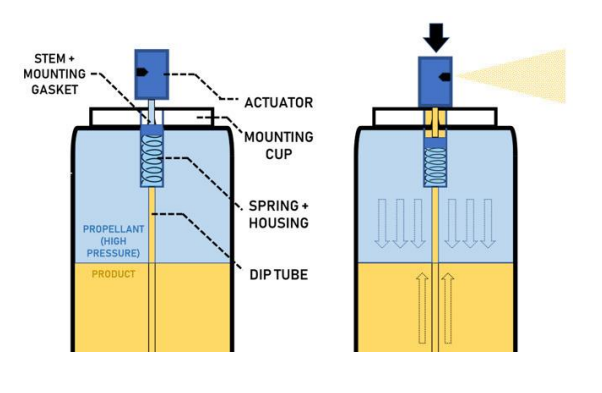
Pressurizable Container
Glass
Tin-plated steel
Aluminum
Valve Assembly
Actuator
Stem
Gasket
Spring
Mounting Cup
Housing
Dip Tube
Parts of Aerosol [2]
a. Glass
[Parts of Aerosol - Pressurizable Container]
Prone to breakage
a. Glass
b. Stem
c. Gasket
![<p>[Parts of Aerosol - Pressurizable Container]</p><p>Prone to breakage</p><p>a. Glass</p><p>b. Stem</p><p>c. Gasket</p>](https://assets.knowt.com/user-attachments/5c0e5de6-8f43-44ae-a5cd-889dcf9142d2.png)
b. Tin-plated steel
[Parts of Aerosol - Pressurizable Container]
Most widely used
a. Actuator
b. Tin-plated steel
c. Gasket
![<p>[Parts of Aerosol - Pressurizable Container]</p><p>Most widely used</p><p>a. Actuator</p><p>b. Tin-plated steel</p><p>c. Gasket</p>](https://assets.knowt.com/user-attachments/392ef977-abd9-4538-8dba-4d9b5a8453aa.png)
c. Aluminum
[Parts of Aerosol - Pressurizable Container]
Seamless and more inert
a. Glass
b. Tin-plated steel
c. Aluminum
![<p>[Parts of Aerosol - Pressurizable Container]</p><p>Seamless and more inert</p><p>a. Glass</p><p>b. Tin-plated steel</p><p>c. Aluminum</p>](https://assets.knowt.com/user-attachments/05487307-b3c6-4f05-b419-adae90e15bf9.png)
Actuator
[Parts of Aerosol - Valve Assembly]
Button pressed to activate the valve for emission of the product
a. Actuator
b. Stem
c. Gasket
d. Spring
e. Mounting Cup
f. Housing
g. Dip Tube
![<p>[Parts of Aerosol - Valve Assembly]</p><p>Button pressed to activate the valve for emission of the product</p><p>a. Actuator</p><p>b. Stem</p><p>c. Gasket</p><p>d. Spring</p><p>e. Mounting Cup</p><p>f. Housing</p><p>g. Dip Tube</p>](https://assets.knowt.com/user-attachments/16008264-7da5-487f-bbdc-cbd6c4f122e0.png)
b. Stem
[Parts of Aerosol - Valve Assembly]
Supports the actuator and delivers the formulation in the proper form
a. Actuator
b. Stem
c. Gasket
d. Spring
e. Mounting Cup
f. Housing
g. Dip Tube
![<p>[Parts of Aerosol - Valve Assembly]</p><p>Supports the actuator and delivers the formulation in the proper form</p><p>a. Actuator</p><p>b. Stem</p><p>c. Gasket</p><p>d. Spring</p><p>e. Mounting Cup</p><p>f. Housing</p><p>g. Dip Tube</p>](https://assets.knowt.com/user-attachments/4a1fb025-c3b9-43ce-95c9-eb9d315c7b3e.png)
c. Gasket
[Parts of Aerosol - Valve Assembly]
Prevents leakage of the formulation when the valve is closed
a. Actuator
b. Stem
c. Gasket
d. Spring
e. Mounting Cup
f. Housing
g. Dip Tube
![<p>[Parts of Aerosol - Valve Assembly]</p><p>Prevents leakage of the formulation when the valve is closed</p><p>a. Actuator</p><p>b. Stem</p><p>c. Gasket</p><p>d. Spring</p><p>e. Mounting Cup</p><p>f. Housing</p><p>g. Dip Tube</p>](https://assets.knowt.com/user-attachments/2571cfc3-cfa7-4727-9827-fde7b9fc9ba2.png)
d. Spring
[Parts of Aerosol - Valve Assembly]
The mechanism by which the actuator retracts
a. Actuator
b. Stem
c. Gasket
d. Spring
e. Mounting Cup
f. Housing
g. Dip Tube
![<p>[Parts of Aerosol - Valve Assembly]</p><p>The mechanism by which the actuator retracts</p><p>a. Actuator</p><p>b. Stem</p><p>c. Gasket</p><p>d. Spring</p><p>e. Mounting Cup</p><p>f. Housing</p><p>g. Dip Tube</p>](https://assets.knowt.com/user-attachments/fb9aeb52-047e-41cc-b807-4dadf0c66e5d.png)
e. Mounting Cup
[Parts of Aerosol - Valve Assembly]
Holds the valve in place
a. Actuator
b. Stem
c. Gasket
d. Spring
e. Mounting Cup
f. Housing
g. Dip Tube
![<p>[Parts of Aerosol - Valve Assembly]</p><p>Holds the valve in place</p><p>a. Actuator</p><p>b. Stem</p><p>c. Gasket</p><p>d. Spring</p><p>e. Mounting Cup</p><p>f. Housing</p><p>g. Dip Tube</p>](https://assets.knowt.com/user-attachments/6c01c1bc-fd58-4ab7-97b8-7844441293e3.png)
f. Housing
[Parts of Aerosol - Valve Assembly]
Links the dip tube, stem, and actuator
a. Actuator
b. Stem
c. Gasket
d. Spring
e. Mounting Cup
f. Housing
g. Dip Tube
![<p>[Parts of Aerosol - Valve Assembly]</p><p>Links the dip tube, stem, and actuator</p><p>a. Actuator</p><p>b. Stem</p><p>c. Gasket</p><p>d. Spring</p><p>e. Mounting Cup</p><p>f. Housing</p><p>g. Dip Tube</p>](https://assets.knowt.com/user-attachments/8c2be156-e073-46cd-95b7-883d31f25167.png)