Gen Chem 1: Chapter 7
 Call Kai
 Learn
 Practice Test
 Spaced Repetition
 Match
 Flashcards
 Knowt Play
1/79

There's no tags or description
Looks like no tags are added yet.
80 Terms
electromagnetic radiation
a form of energy
travels in waves of oscilating electric + magnetic fields
electromagnetic spectrum

Classical Model of Describing Waves
wavelength (λ): length of one wave to the next
frequency (v): number of waves per second
speed of light (c
amplitude: height of wave (intensity or brightness)
Blackbody Radiation
energy produced by objects as they are heated
INC temp —> INC intensity, SHORTER wavelength
can be explained onlly IF light exists in discrete units
amplitude tells you _____ _____
light intensity
metals can eject electrons when light shines on them
true

energy & intensity depends on the _____ (size) of the wave
amplitude
BRIGHTER light on metal plate means _____ (INC/DEC) electric current, up to a certain ______ ______
BRIGHTER light on metal plate means INC electric current, up to a certain frequency threshold
kinetic energy of electrons produced depends on ______ (NOT ____)
frequency; NOT intensity
1901: Max Planck
light exists at only _______ _______
1905: Albert Einsten
1901: Max Planck
light exists at only distinct energies
1905: Albert Einstein
light travels in packets called photons
light intensity depends on # of photons
energy of each photon depends on its frequency
Ephoton = hv
an atom can eject an electron IF
it _____ (absorbs/releases) a ____ of light w/ ____ ____ to knock the electron off
an atom can eject an electron IF it absorbs a photon of light w/ enough energy to knock the electron off
BELOW threshold frequency
photons lack the energy to eject e-
ABOVE threshold frequency
# of photons ejected (intensity) depends on # of photons present
flame test
observe colors emitted by different metal ions
wire is dipped in solution containing metal ions
each element gives off a characteristic color when heated
line spectra
flame tests & gas lamps can produce line spectra
each element produces a unique line spectra

Which experimental observation served as key evidence for Niels Bohr's atomic model, and what was a primary limitation of his model?
line spectra provided evidence for discrete energy levels BUT that was only for Hydrogen (1 electron) - his model couldn’t explain electron repulsions in multi-electron atoms
Bohr’s 5 Principles
electrons orbit nucleus
at discrete distances
orbitals CLOSER to nucleus, LOWER energy
only certain orbit energies are “allowed”
electrons can jump btwn levels
light is aborbed or released when electrons jump
electrons ABSORB light: jumps to HIGHER energy level
electrons RELEASE light: jumps to LOWER energy level
Ground State: all electrons in lowest possible energy levels
orbitals CLOSER to nucleus have _____ (higher/lower) energy
orbitals CLOSER to nucleus have LOWER energy
______(excited/relaxed): electrons ABSORB light: jumps to _____ (higher/lower) energy level
______(excited/relaxed): electrons RELEASE light: jumps to _____ (higher/lower) energy level
excited: electrons ABSORB light: jumps to HIGHER energy level
relaxed: electrons RELEASE light: jumps to LOWER energy level
electrons jumping between levels produces _____
colors (light, wavelength)
Louis de Brogile’s waves

Louis de Broigle’s Standing Wave Hypothesis
envisioned standing waves in a circular orbit

Louis de Brogile’s equation
λ = h/mu
u = velocity
True or False: any moving object has a wavelength?
True; Louis de Brogile
diffraction
a change in the direction + momentum of a wave when it encounters an obstacle
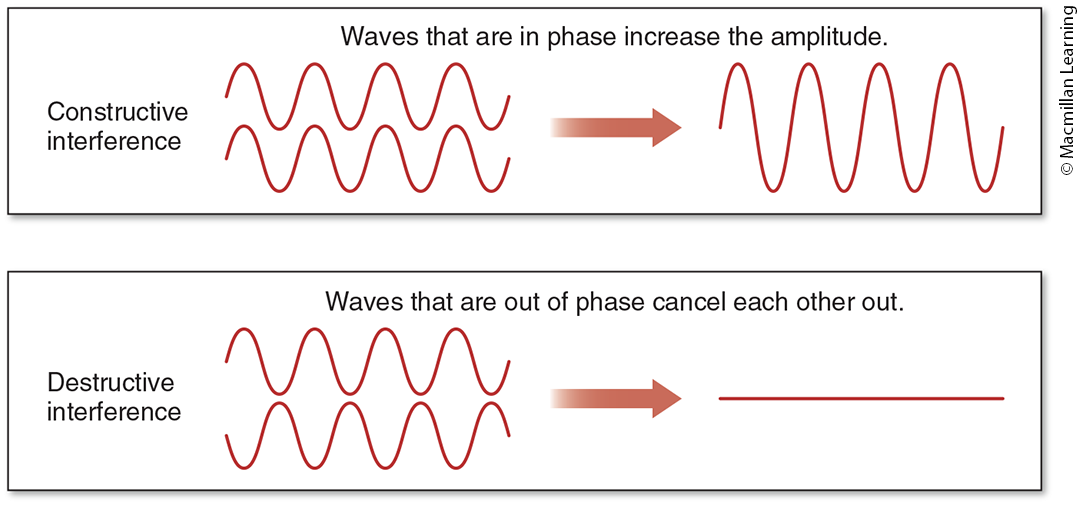
Constructive vs. Destructive Interference
Constructive Interference: two parallel waves in phase (going in same direction) produce a larger amplitude
Destructive interference: two parallele waves out of phase (going opposite directions) cancel each other out, producing dark, flat line
Double-Slit Experiment
single slit: alternating dark + bright regions - interference pattern
double slit: more dramatic interference pattern (dark + bright regions)
***distance between dark + bright regions depends on wavelength

Heinsberg Uncertainty Principle
it’s impossible to know the exact momentum + position of a particle
(Δx)(mΔu) ≥ h/4π
the MORE precise you know LOCATION, LESS precise you know MOMENTUM
Schrodinger Equation
predicts most probable locations of electrons
HΨ = EΨ
Energy Levels & Sublevels
electrons occupy different energy levels (n = 1,2,3…)
each energy level contains 1 or more sublevels (s, p, d, f)
each sublevel contains 1 or more orbitals
each orbital holds up to 2 electrons
energy level 1’s sublevels
s only
s-sublevel has how many orbitals & electrons
1 orbital, 2 electrons
energy level 2’s sublevels
s + p
p-sublevel has how many orbitals and electrons
2 orbitals, 6 electrons
energy level 3’s sublevels
s, p, d
d-sublevel has how many orbitals and electrons
5 orbitals, 10 electrons
energy level 4’s sublevels
s, p, d, f
f-sublevel has how many orbitals and electrons
7 orbitals, 14 electrons
4 Types of Quantum Numbers
Principal Quantum Number: energy level (n = 1, 2, 3…)
Angular Momentum Quantum Number: sublevel (l = 0,1,2,3)
Magnetic Quantum Number: orbital (ml = -1…0…+1)
Spin Quantum Number: spin (ms = -1/2 or -+/2)
first three come from Schrodinger
Pauli Exclusion Principle
in a single atom, no two electrons can have the same 4 quantum numbers
electron configuration for hydrogen & what each mean
1s1
1: n = 1
s: s-sublevel
1: 1 electron
Hund’s Rule
if empy orbitals of the same energy are avialbel, electron singly occupu orbitals rather than pairing together

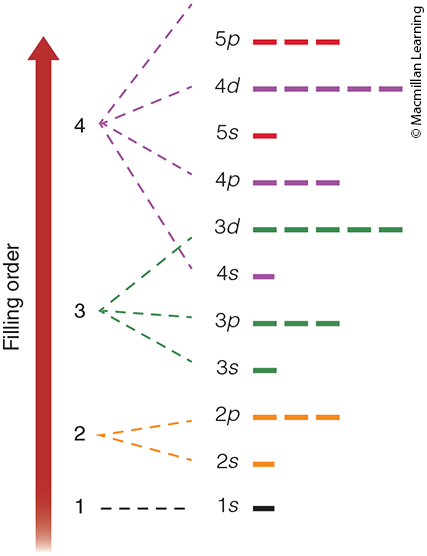
Filing Order (according to PTE)
we always move to the next energy level once the p-sublevel is filled
Valance Level
highest occupied electron energy level (up to 8 electrons)
outer electrons are
anything outside of [noble gas]…
Identify the outer electrons vs. valance electrons for Iodine
[Kr] 5s24d105p5
outer electrons: 5s24d105p5
valance electrons: 5s25p5
all noble gasses have _____ _____ valance shells
completely filled
properties of noble gases
stable
unreactive
don’t bond w/ other atoms to form compounds
Octet Rule
an atom is stablized by having its valance shell filled (all 8 electrons in its valance shell)
rows on PTE tell you…
# of energy levels (n)
groups on PTE tell you…
# of valance electrons
isoelectronic
two species that have the same electron configuration
Ex: Na+, O2-, Ne
are inner electrons or outer electrons involved with bonding
outer electrons are involved with bonding
inner electrons can be replaced using…
Noble Gas Notation
3 Filing Exceptions
Filled & Half-Filled Sublevels
Larger Atoms & f-Block Electrons
Transition & Post-Transition Metal Cations
Filled & Half-Filled Sublevels
d being fully filled (all 10 e-) or being half filled (5 e-) is more stable than full s
Group 11: Cu, Ag, Au
Group 6: Cr, Mo
Larger Atoms & f-Block Electrons
since energy gaps between d & f in higher energy levels is so small, anomolies occur
d will have alwyas 1 electron
ex: La: [Xe] 6s25d1
Ce: [Xe] 6s24f15d1
U: [Rn] 7s25f36d1
Transition & Post-Transition Metal Cations
For cations, tend to lose s-electrons & p-electrons BEFORE d-electrons (in transition & post-transition cations)
atoms are stabilized by ____ or ____-_____ energy levels or sublevels
filled or half-filled
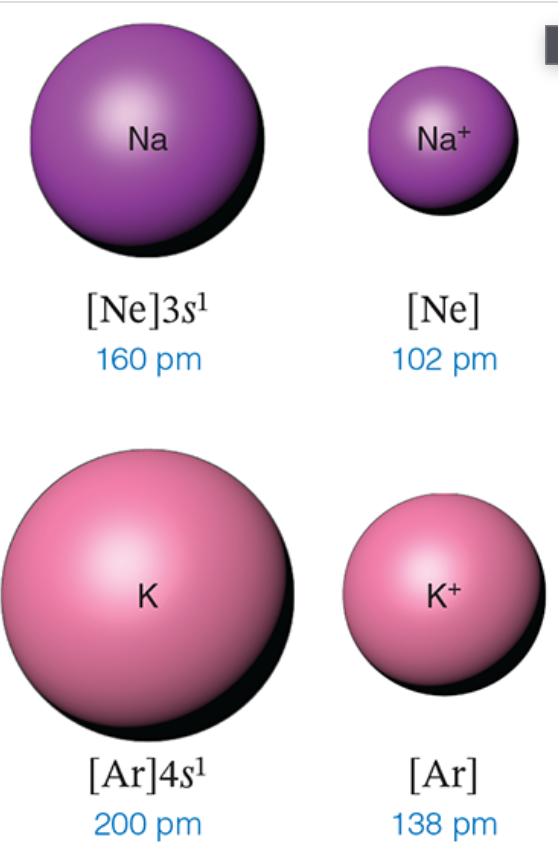
higher POSITIVE charge (losing e-) means ______ (smaller/bigger) radius
smaller radius (e- are held more tightly)
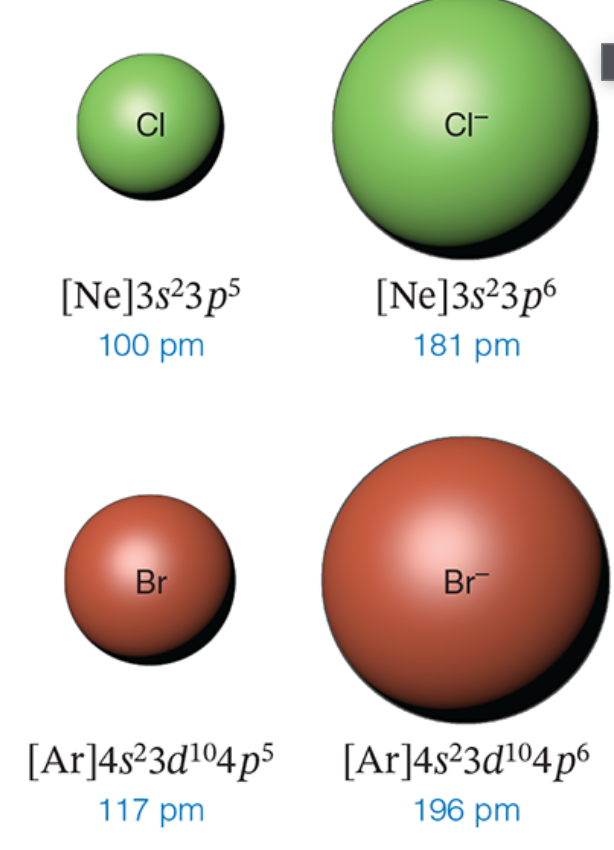
higher NEGATIVE charge (gaining e-) means ______ (smaller/bigger) radius
bigger radius (e- are held more loosely)
electron shielding
inner electrons shield part of nuclear charge/pull on outer electrons
Effective Nuclear Charge (Zeff)
Zeff = # of protons - # of electrons
Zeff trend
Zeff INC going right across a period
elements on right hold their electrons more tightly
nonbonding radius
half the distance btwn non-bonded nuclei in a tightly packed solid

bonding radius
radius of an atom in chemical bonds

is bonding radius or nonbonding radius smaller? why?
bonding radius < nonbonding radius
because electron clouds overlap in bonding radius, so bonding radius is SMALLER
atomic radius trend
atomic radius INC going left, going down
ionization energy (IE)
energy required to LOSE an electron from a gas-phase atom (cation)
ionization energies reflecting octet rule
ex: Na’s 1st IE is 400 while 2nd IE is 4,000
because it takes more energy to take 2 e- from sodium since after losing 1 e- (Na+) it’s stable so it wants to stay stable and not lose another e-
ionization energy (IE) trend
INC going right, going up
Electron Affinity (EA)
energy change when a gas-phase atom GAINS an electron (anion)
______ energy changes are more favorable
negative
endothermic or exothermic: when Cl gains an electron
exothermic (electron affinity)
What reflects halogens’ stability?
large neg values
What 2 factors causes Cl’s EA to be HIGHER than F’s and Br’s
attraction of nucleus
repulsion of electrons
Cl is a middle ground
F- is smaller; stronger attraction to nucleus; greater electron repulsions
Br- is larger; weaker attraction to nucleus; less electron repulsions
Why do noble gases have >0 EAs?
they have fully filled valance levels
if you add an e-, it’ll spontaneously eject from atom
electron affinity trend
INC going to the right (across the period)
Metallic Character tr
INC going left, going down
groups going down behave similarly EXCEPT for Period ___
Period 2 because they don’t have d-sublevel