UNIT 4: NUCLEIC ACID ISOLATION
 Call Kai
 Learn
 Practice Test
 Spaced Repetition
 Match
 Flashcards
 Knowt Play
1/94

There's no tags or description
Looks like no tags are added yet.
95 Terms
Lysis
Removal of unneeded biomolecules
Precipitation of nucleic acids
General flow of NA Isolation (3 Parts)
Lysis
General flow of NA Isolation (3 Parts):
Opening of the cells, exposing the DNA or RNA to the reagents
Break open cell membranes or protein capsids
Chemical, physical and means are used to destroy the structure of these membranes
Removal of unneeded biomolecules
General flow of NA Isolation (3 Parts):
Remove lipids, carbohydrates, proteins
Some add enzymes to selectively remove DNA/RNA
If doing DNA isolation, we remove RNA
If doing RNA isolation, we remove DNA
Precipitation of Nucleic Acids
General flow of NA Isolation (3 Parts):
Done by treatment with alcohol
They are washed several times before dried and resuspended in water of buffer
Sample Preparation
Samples have to be prepped before starting the experiment:
Ensure that the cells are exposed to lysis solution.
Removing unwanted tissue.
Weighing the proper amount of tissue.
Pre-treating the cells if needed.
Suspension cells
Tissue samples
Microorganisms/Cultured animal cells
samples you can use in DNA preparation and extraction
Suspension Cells (e.g., Blood)
Only nucleated cells are useful (e.g., white blood cells, not red blood cells).
Cells are separated using centrifugation, differential gradient centrifugation, or differential lysis.
Differential gradient centrifugation (e.g., through Ficoll)
Sample Preparation:
_______________________________________ separates cells based on density.
Differential lysis
Sample Preparation:
______________ using hypotonic solutions can selectively lyse unwanted cells while preserving target cells.
Tissue Samples
Dissociate cells (l.e. homogenization in liquid nitrogen, using a tissue homogenizer, maceration, enzymatic separation)
Paraffin-embedded tissues;
xylene;
alcohol
Sample Preparation:
__________________________ have to be deparaffinized using ______ and rehydrated using decreasing concentrations of _______
lysozyme;
Proteinase K;
mechanically lysed (using grinders, homogenizers, sonicators)
Sample Preparation: Microorganism/Cultured animal cells:
Cells can be enzymatically lysed using enzymes like __________ or ___________ or can be _______________________________________
detergent (1% sodium dodecyl sulphate)
strong base (0.2M NaOH)
Tris Base
EDTA
glucose
Sample Preparation: Microorganism/Cultured animal cells:
needed treatment to break down bacterial cell walls.
8% sucrose, 8% Triton X-100 detergent, Tris buffer, and EDTA
Boiling in ________________________________________________ after lysozyme treatment releases DNA.
denatured DNA;
downstream processes
Microorganism sample preparation
Procedures using strong bases and boiling result in ______________ which cannot be used for some applications like ____________
Organic Isolation Methods
DNA Extraction Methods:
A combination of high salt, low pH, and an organic mixture of phenol and chloroform helps in the removal of lipids, carbohydrates and proteins.
Phenol-Chloroform
DNA Extraction Methods:
dissolves hydrophobic contaminants (lipids, lipoproteins)
collects cell debris
removes most DNA-associated proteins.
RNase (Ribonuclease)
enzyme to remove RNA contaminants.
lower phase = organic phase; hydrophobic cells (lipids & membranes)
Addition of phenol and chloroform causes the formation of 2 phases upon centrifugation.
lower phase = ______________________
upper phase = aqueous phase; hydrophilic molecules; DNA & RNA
Addition of phenol and chloroform causes the formation of 2 phases upon centrifugation.
upper phase = ______________________
interphase = amphiphilic components; cell debris & proteins
Addition of phenol and chloroform causes the formation of 2 phases upon centrifugation.
interphase = ___________________________
DNA Precipitation
Organic Isolation Methods:
Add high concentration of salt (e.g., NaCl, KCl, ammonium acetate).
2:1 ethanol
1:1 isopropanol
Add ________ or _________ to precipitate DNA to the upper phase.
pellet
Organic Isolation Methods:
Centrifuge to collect DNA as a _______.
70% ethanol
Organic Isolation Methods:
Washing with ____________ removes excess salt.
TE buffer (10mM Tris, 1mM EDTA);
nuclease-free water.
DNA is then resuspended in ________________________ or _________________
Tris base
Maintains a stable pH (usually ~8.0), preventing DNA degradation.
EDTA
Binds divalent cations like Mg²⁺ and Ca²⁺. These ions are required by nucleases (DNases), so removing them prevents DNA breakdown.
TE Buffer
Best for long-term storage because it protects DNA from degradation.
Nuclease-free water
Free from DNases and RNases.
Does not contain EDTA, so it won’t interfere with downstream reactions like PCR (since PCR requires Mg²⁺).
Best for immediate use, especially for PCR or enzymatic reactions.
Inorganic Isolation Methods
'“salting out”
Tries to remove the use of organic solvents and chemicals like phenol
Safer and simpler for routine DNA extraction.
Low pH and high salt conditions selectively precipitate proteins while leaving DNA in solution.
DNA is then precipitated, washed and resuspended using similar ways asin organic extraction
Low pH;
high salt
Inorganic Isolation Methods:
_______ and ________ conditions selectively precipitate proteins while leaving DNA in solution.
SDS
an ionic detergent which can break apart the cell by interfering with the interactions of membrane molecules, the phospholipids
Solid-Phase Extraction
DNA binds to a solid matrix, usually silica, under certain conditions (often high salt).
Other cellular components (proteins, lipids) do not bind and are washed away
silica column or beads
Solid-Phase Extraction:
Lysate is applied to a _____________________ —- are usually small spin columns that fit inside microcentrifuge tubes.
viral and bacterial DNA
Solid-Phase Extraction:
Used to isolate ________________ from serum, plasma, CSF, etc.
genetics;
molecular diagnostics;
oncology
Solid-Phase Extraction:
Commonly used to isolate DNA from cells for use in _________, ___________ and __________ applications
string columns
term used for silica columns
silica spin column
SOLID-PHASE EXTRACTION:
The cell lysate is placed in a ____________ which adsorbs/adheres DNA.
elusion
SOLID-PHASE EXTRACTION:
last step
separating DNA from the matrix so that it gets resuspended in the solution
uses elusion solution
QIAGEN spin column
spin column for plasmid extraction
Crude lysis procedure
Proteolytic lysis of Fixed material
Extraction using chelating resin
Extraction through PCR
3 Other Isolation Methods:
Crude Lysis Procedures
4 Other Isolation Methods:
Used when there are too many sample to process and you dont need clean DNA
Having lysed cells releases enough DNA for the experiment
Proteolytic Lysis of Fixed Material
4 Other Isolation Methods:
Example of crude lysis extraction
Used for paraffin-embedded tissues.
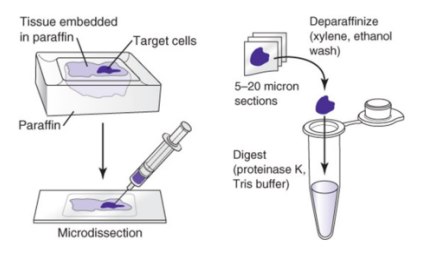
decreasing concentrations of alcohols
proteases
Proteolytic Lysis of Fixed Material:
Rehydrate the tissue using ____________________
Use ____________ to lyse cells embedded in paraffin
Microdissection
Proteolytic Lysis of Fixed Material:
_______________ is done to collect DNA straight from the tissues
usses very small needle made of tungsten to cut the nucleus of the cell
the nuclear components are then sucked up using an injection
Extraction using Chelating Resin
4 Other Isolation Methods:
addition of resin (chelex)
boiling (lysing)
centrifuge
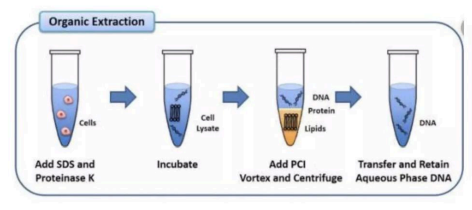
Chelex
attracts everything to the bottom, except DNA
10% solution of resin (chelex) beads ;
boiling;
supernatant;
chelex and cell debris
Extraction using Chelating Resin:
__________________________ is mixed with the specimen and then lysed through ______.
Solution is centrifuged and DNA remains in the ____________.
at the bottom, you will find the _________________
Extraction through PCR;
cells;
bacterial cells;
lysed;
4 Other Isolation Methods:
makes use of _____ as the sample instead of DNA
Instead of loading DNA into a PCR run, we would load __________ instead
Microorganisms no longer have to be ______ beforehand
thermocycler
Extraction through PCR:
Heat and buffers in the ____________ lyse cells and release DNA for amplification.
pick colony > replicate plate > add to SapphireAmp Fast PCR Master Mix (+ primers & H2O) > PCR > load 5 microliter directly to agarose gel wells > electrophoresis
steps in DNA extraction through PCR
PCR colony hybridization
4 Other Isolation Methods:
used when you have a lot of sample to assay
to save time and effort
usually for determining if sample has plasmids
Selective Collection of Mitochondria
Total Genomic DNA Extraction
2 ways in isolating mitochondrial DNA
Selective Collection of Mitochondria
Isolating mitochondrial DNA:
Enrich for mitochondria before extracting DNA.
Methods:
Differential centrifugation – spins samples at different speeds to separate mitochondria from nuclei and other cell components.
Density gradient centrifugation – separates mitochondria based on their density.
Once isolated, DNA is extracted directly from the mitochondria, giving mostly mtDNA.
Total Genomic DNA Extraction
Isolating mitochondrial DNA:
Simpler approach: extract all DNA from the cell.
The resulting DNA mixture contains:
Nuclear DNA
Mitochondrial DNA (present in high copy numbers)
mtDNA can then be analyzed from the genomic DNA extract, often using PCR or sequencing methods that target mtDNA specifically.
RNAse
EXTRACTION OF TOTAL RNA
Before extracting RNA, _________ must first be eliminated
ice or 4°C
EXTRACTION OF TOTAL RNA
RNA extraction should mostly be done on ______ tempeature
T
RNA are way more easy to degrade than DNA
4 Ways to eliminate RNases
RNase eliminating sprays (e.g. RNase Away, RNase Zap)
Treament with DEPC (Diethyl Pyrocarbonate)
Baking
Nuclease-free disposable supplies are preferred
RNase eliminating sprays (e.g. RNase Away, RNase Zap)
4 Ways to eliminate RNases
For the area, glassware sometimes, for the equipment
Treament with DEPC (Diethyl Pyrocarbonate)
4 Ways to eliminate RNases
We do this with the reagents We’ll also do this when rinsing glassware
Baking;
200 C;
300 C for three (3) to five (5) hours
4 Ways to eliminate RNases
If you have glassware, you have to bake them usually this at temperatures of above ___ for very long amount of time
so the one being used is ___________________________
Nuclease-free disposable supplies
4 Ways to eliminate RNases
There are commercially available nuclease – free disposable supplies
However, if you are a laboratory that does not have a lot of money, it is expensive to do RNA work with disposable all the time
RNAses
Sweat, tears, any other fluids
________ can come from many sources in the body
______________, etc., there’s a lot of sources and so, we always wear gloves that are fit and then we would always wear a mask as well
Lysis
EXTRACTION OF TOTAL RNA
____ is the first step in RNA extraction – just like DNA extraction (opens up the cell to expose RNA molecules)
osmosis ;
centrifugation
EXTRACTION OF TOTAL RNA
Reticulocytes in blood and bone marrow samples are lysed by ______ or
separated from WBCs (leukocytes) by ________.
liquid nitrogen;
buffer
EXTRACTION OF TOTAL RNA
Sample can be frozen in ______ or
kept in a ______ that inactivates RNases.
chemical or mechanical lysis.
EXTRACTION OF TOTAL RNA
Microbes are lysed using ______________
serum;
no need
EXTRACTION OF TOTAL RNA
Viral RNA can be directly taken from _______ or other biological samples.
There is ________ to separate viral RNA
Pathogenic microbes
EXTRACTION OF TOTAL RNA
___________ are best isolated from host cells before extraction.
detergent;
high salt (0.2–0.5 M NaCl);
RNAse inhibitors
LYSIS FOR EXTRACTION OF RNA
The cell lysis step for RNA isolation is done in _______ or phenol in the presence of _________ or _______
Guanidine thiocyanate
LYSIS FOR EXTRACTION OF RNA
___________ is a strong denaturant of RNAses and can be used instead of high salt buffers.
and RNase inhibitor
2-mercaptoethanol
LYSIS FOR EXTRACTION OF RNA
Strong reducing agents such as ____________ can also be added during this step.
phenol;
chloroform;
isoamyl alcohol
EXTRACTION OF RNA
After lysis
proteins are extracted by —→
proteins are denaturated by and promotes phase separation —→
prevents foaming —→
acidic (ph 4–5).
EXTRACTION OF RNA
The organic phase must be ________
DNase
EXTRACTION OF RNA
_____ may be added at the lysis step or directly to extracted RNA to eliminate contaminating DNA.
This is you will destroy DNA fragments so you don’t contaminate your RNA
Centrifugation;
upper aqueous layer
EXTRACTION OF RNA
_________ facilitates phase separation and the __________ contains the RNA.
microcentrifuge tube;
1:1 isopropanol or 2:1 ethanol;
EXTRACTION OF RNA
The upper aqueous layer is transferred into a _______and then precipitated with ____
Centrifugation;
70-75% ethanol
EXTRACTION OF RNA
_________ pellets the RNA and the pellet is subsequently washed with _______ to remove any other impurities
nuclease-free water;
buffer (usually DEPC-TE)
EXTRACTION OF RNA
The RNA is then dried and resuspended in ________ or ________
acidification that pellets cell debris
which step in DNA extraction is absent in RNA extraction
Trizol
EXTRACTION OF RNA
a chemical that promotes cell lysis
already contains phenol
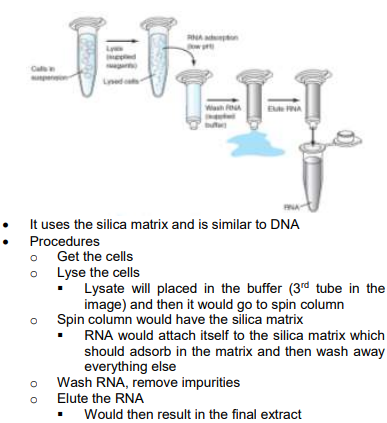
SOLID PHASE EXTRACTION OF RNA
80-90%
% of rRNA from the total RNA
2%
% of mRNA from the total RNA
EXTRACTION OF MRNA
columns
EXTRACTION OF MRNA
Around 80%–90% of total RNA is rRNA to extract mRNA which makes up roughly 2% of total RNA, the use of ________ is employed.
polyT or polyU
EXTRACTION OF MRNA
Column has _____ in order to attach to the tails, sometimes they also use _____ which also works
ologomers of thymine or uracil
EXTRACTION OF MRNA
To enrich mRNA yield especially if there are transcripts that are low copy numbers, etc., we have different protocols where would use_________ in the matrix so these are all on the column described earlier
polyA
EXTRACTION OF MRNA
The polyT or polyU oligomers will bind the ______ tail found exclusively on mRNA.
warmed, low-salt
EXTRACTION OF MRNA
After washing away residual RNA, polyA RNA is eluted by washing the column with _________
RT PCR/ Reverse Transcription PCR
MRNA EXTRACTION THROUGH PCR
This is a schematic for mRNA extraction protocol where we go straight to the __________
Step 1: MIx sample with lysis buffer
Step 2: Add biotin attached to polyDT or oligoDT, which would then attach to mRNA, then incubate
Step 3: Add 50 microleter of mix to Streptavidin-coated PCR tube (immobilization occurs)
Step 4: Wash 3 times with buffer
MRNA EXTRACTION THROUGH PCR
4 steps
Streptavidin
_____ has a very high affinity to biotin so the moment you have both, they would attach to each other
Since streptavidin is basically attached to the wall of the tube, mRNA also becomes attach to it