Chapter 9: Pathways That Harvest Chemical Energy
 Call Kai
 Learn
 Practice Test
 Spaced Repetition
 Match
 Flashcards
 Knowt Play
1/25

There's no tags or description
Looks like no tags are added yet.
26 Terms
ATP
A carrier molecule for high-energy phosphate that releases ~12 kcal/mol free energy to drive cellular work.

NADH
An electron carrier molecule storing electrons, yielding ~50 kcal/mol of free energy.

Glucose Oxidation
Exergonic breakdown of glucose coupled to the endergonic reduction of ADP to ATP.

Oxidation
The loss of electrons or loss of hydrogen atoms in a chemical reaction.

Reduction
The gain of electrons or gain of hydrogen atoms in a chemical reaction.
Oxidizing Agent
A substance that gains electrons and becomes reduced in a redox reaction.
Reducing Agent
A substance that donates electrons and becomes oxidized in a redox reaction.
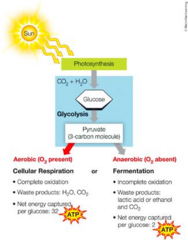
Glycolysis
Anaerobic cytosol pathway converting 1 glucose into 2 pyruvate, 2 net ATP, and 2 NADH.
Energy-Investing Reactions
Glycolysis steps 1-5 that require an input of 2 ATP molecules.
Energy-Harvesting Reactions
Glycolysis steps 6-10 that yield 4 ATP (2 net) and 2 NADH.
Pyruvate Oxidation
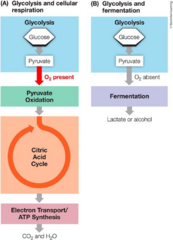
Mitochondrial matrix process converting pyruvate to acetyl CoA, producing CO2 and NADH.
Citric Acid Cycle
Eight-reaction cyclic pathway in matrix producing CO2, GTP/ATP, NADH, and FADH2 from acetyl CoA.
Electron Transport Chain
Series of mitochondrial membrane protein complexes that transfer electrons from NADH/FADH2 to O2.
Final Electron Acceptor
Molecular oxygen (O2), which accepts electrons and protons to form water.
Chemiosmosis
Coupling of the proton-motive force across the inner membrane to ATP synthesis via ATP synthase.

ATP Synthase
Membrane enzyme complex that uses kinetic energy of diffusion H+ to synthesize ATP.
Aerobic ATP Yield
Complete respiration of one glucose molecule yields approximately 30 to 32 ATP.
Fermentation
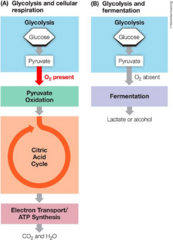
Anaerobic pathway in cytosol that oxidizes NADH back to NAD+ to keep glycolysis functioning.
Phosphofructokinase
Main control enzyme of glycolysis, allosterically inhibited by high levels of ATP.
Isocitrate Dehydrogenase
Main control point in the citric acid cycle, inhibited by ATP and NADH.
Complex I and II Entry Points
NADH donates electrons to Complex I, while FADH2 donates electrons to Complex II in the ETC.

Chemiosmotic Yield per Coenzyme
Each NADH generates ~2.5 ATP, while each FADH2 generates ~1.5 ATP via ATP synthase.

Acetylation of Coenzyme A
In pyruvate oxidation, pyruvate is oxidized to acetate, which binds Coenzyme A to form acetyl CoA.
Citric Acid Cycle Inputs
Acetyl CoA, water, and oxidized electron carriers (NAD+, FAD, GDP).
Anaerobic NAD+ Regeneration
Fermentation reduces pyruvate or acetaldehyde using NADH, recycling NAD+ for glycolysis.
Anabolic Role of Acetyl CoA
Serves as a key starting precursor for synthesizing fatty acids when ATP demand is low.