Chapter 2 - Anatomy of Respiration
 Call Kai
 Learn
Learn Practice Test
 Spaced Repetition
 Match
Match Flashcards
 Knowt Play
1/36

There's no tags or description
Looks like no tags are added yet.
Name | Mastery | Learn | Test | Matching | Spaced | Call with Kai | Chat |
|---|
No analytics yet
Send a link to your students to track their progress
37 Terms
Pectoral girdle
scapula & clavicle
function: support upper extremities & attach to sternum at manubrum
Ribs
7 true ribs
3 false ribs
2 floating ribs
functions: protection and aiding respiration


Parts of sternum
manubrium sterni, corpus, xiphoid or ensiform process

Cervical vertebrae
7
transmit spinal cord (vertebral foramen), veins and arteries (transverse foramina), attach to other vertebrae (articular facets)
Thoracic vertebrae
12
hold spinal cord (vertebral foramen), attach to other vertebrae (articular facets), articulate with ribs (costal facets)
Lumbar vertebrae
5
hold spinal cord (vertebral foramen), attach to other vertebrae (articular facets), support entire weight
Sacral vertebrae
5
inferior to lumbar vertebrae, structural support, pelvic stability
Coccyx
4 vertebrae fused together
Pelvic girdle
Ilium, sacrum, pubic bone, ischium
Functions: support lower extremities, carries weight, provides stability, point of attachment for muscles

How does a rib connect to vertebrae?

What is pleurae
surround important structures in the thoracic cavity
Visceral pleura
cover each kung
Parietal pleurae
inside thoracic cavity
Mediastinal pleura
Diaphragmic pleura
Costal pleurae
Apical pleurae: superior-most region of rib cage
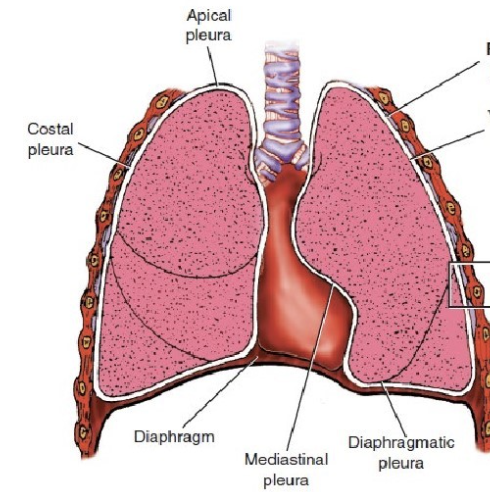
How does the pleural lining keep lungs attached?
The space between the visceral and parietal pleura provides a sealed connection between the lungs and rib cage to support breathing. This space contains pleural fluid that allows pleura to slide against each other as the lungs and rib cage expand, mechanical coupling creates like a vacuum sealed pleural linkage.
Diaphragm
Main inspiratory muscle
Origin: xiphoid process, inferior margin of ribs 7-12, L1-L5 traverse process
Insertion: central tendon (broad flat sheet, crescent shaped provides floor for the heart)
Openings: vena cava (foramen vena cava), esophagus (esophageal hiatus), abdominal aorta (aortic hiatus)

Anterior thoracic muscles of inspiration
Structure: external intercostals, internal intercostals (interCHONDRAL portion)
Functions: run between the ribs to elevate the ribs
Accessory muscles of neck
Structure: Sternocleidomastoid muscle, scalene muscles
Functions: stability, control neck flexion and extension, clavicular breathing

Muscles of forced expiration
Internal intercostal (interOSSEOUS portion)
transverse abdominis, internal oblique abdominis, external oblique abdominis, rectus abdominis
Abdominal muscles of respiration
Structure: transverse abdominis, internal oblique abdominis, external oblique abdominis, rectus abdominis
Function: contraction of abdominal muscles, squeezing of the abdomen, compression/elevation of viscera

Boyle’s Law
for gas in an enclosed sealed space and at a constant temperature, pressure is inversely proportional to volume (more volume = less pressure, less volume = more pressure)