Anthropology Exam 1
 Call Kai
 Learn
Learn Practice Test
 Spaced Repetition
 Match
Match Flashcards
 Knowt Play
1/92

Earn XP
Description and Tags
Bolded words from in-class slides
Name | Mastery | Learn | Test | Matching | Spaced | Call with Kai | Chat |
|---|
No analytics yet
Send a link to your students to track their progress
93 Terms
Anthropology
The holistic study of humanity using Cultural and biological perspectives, Past and Present.
Anthropology is comprised of four primary subfields
Cultural Anthropology
Linguistic Anthropology
Archaeology
Biological Anthropology
Cultural Anthropology
study of patterns of culture found in modern & historical groups
Culture
Learned behaiors transmitted from one generation to the next by nonbiological means
Aspects of Human Culture
Ex: technology, social roles, language, traditions, religion, art, music. etc.
Tangible and non-tangible aspects
Biocultural Evolution
The mutal, interactive evolution of human biology and culture.
Linguistic Anthropology
Focuses on the relationship between language and culture (identity, beliefs, ideology). Language is a unique human trait.
Archaeology
Study of past cultures through their material remains
Artifacts: objects made by humens and their ancestors
Biological Anthropology
human biology from an evolutionary perspective.
Subdisciplines of biological anthropology
o Molecular: genetics, for evolutionary relationships.
o Primatology: nonhuman primates.
o Paleoanthropology: human evolution.
o Human osteology: skeletal material.
o Bioarcheology: skeletons from archaeological contexts.
o Forensic: human remains in legal matters.
Evolution:
a change in the genetic structure of a population from one generation to the next.
Adaptation
environment.
Natural selection:
adaptation via genetic change. It is only one of four forces of evolution (the others are mutation, genetic drift, and gene flow).
Hypothesis
is an educated guess with little or no testing yet.
theory
is a tested body of knowledge supported by repeated observation and experimentation.
Scientific method:
observation → hypothesis → experiment → test predictions → new hypothesis, or a theory after repeated tests.
Key People
o Linnaeus: Systema Naturae (1735); binomial nomenclature (Genus species).
o John Ray: concept of species.
o Buffon: dynamic relationship between environment and life.
o Malthus: populations grow faster than resources, so there is competition.
o Lyell: uniformitarianism and deep time (processes operating today operated in the past).
o Lamarck: inheritance of acquired characteristics.
o Darwin and Wallace: natural selection. Darwin sailed on the HMS Beagle and studied Galápagos finches; On the Origin of Species (1859).
Lamarck vs. Darwin:
o Lamarck: traits acquired during life are passed on (stretching neck → longer-necked offspring).
o Darwin: pre-existing genetic variation. Individuals with favorable variants survive and reproduce more.
· Natural selection, 8 processes (short form):
1. Offspring are produced faster than food supply grows.
2. There is variation within species.
3. More are born than can survive, so there is competition.
4. Favorable variants have a survival and reproduction advantage.
5. The environment (selective pressures) decides what is favorable.
6. Traits are inherited, so favorable ones leave more offspring (fitness).
7. Variations accumulate over long time periods.
8. Geographic isolation helps form new species.
Fitness:
relative reproductive success.
relative reproductive success. Reproductive success
· the number of offspring an individual produces and rears to reproductive age.
Mean / median / mode:
mean is the average, median is the middle value, and mode is the most frequent value.
·
Why 19th-century theory was limited:
no understanding of the source of variation or how traits are inherited. Genes and DNA later filled this gap.
Eukaryotic
cells have a nucleus and organelles.
Prokaryotic
cells are simple and have no nucleus.
Somatic cells
are body tissues.
Gametes
are sex cells (egg and sperm).
Organelles:
o Nucleus: holds DNA and controls the cell.
o Ribosomes: build proteins (in cytoplasm and on the ER).
o Mitochondria: the "powerhouse"; they have their own mtDNA.
o Cell membrane: a barrier that regulates what moves in and out.
o Cytoplasm: a gel that houses the organelles.
DNA
double strands base pairs = A-T, G-C Holds the genetic code
RNA
Single Strands, A-U, G-C, Protein Synthesis
Nucleotide
· phosphate + sugar + one of four bases (A, T, G, C).
DNA replication:
DNA replication:
1. Enzymes "unzip" the two strands.
2. Each strand is a template.
3. Free nucleotides pair up (A–T, G–C).
4. The result is two identical molecules.
o DNA is chromatin (uncoiled) normally and coils into chromosomes during division.
Mutation:
· any change in DNA. It can be a base error in replication or a chromosome error in cell division.
Gene:
· a DNA sequence specifying the order of amino acids in a protein (or an RNA). Exons are the coding segments (~2% of DNA).
Amino acids
build polypeptide chains, which fold into proteins.
Protein synthesis:
1. Transcription (in the nucleus): DNA is unzipped and mRNA copies the gene. The mRNA moves to a ribosome.
2. Translation (at the ribosome): the ribosome reads mRNA in triplets called codons. tRNA carries an amino acid and has an anticodon complementary to the codon. The ribosome links the amino acids into a chain.
Practice (Lab 2.3): original strand T-G-G-A-C-G-T-A → new DNA strand
Chromatin
= uncoiled DNA (normal function).
Chromosome
= coiled DNA (during division).
A replicated ("double") chromosome
· = 2 identical chromatids joined at the centromere.
How many chromosomes does a human have
· Humans have 46 chromosomes = 23 homologous pairs (one maternal, one paternal per pair).
Autosomes
pairs 1–22.
Sex chromosomes:
· pair 23. Female = XX; male = XY.
Gene
= a DNA segment coding for a trait
Allele
= an alternate form of a gene.
·
Mitosis (somatic cells):
· 1 division → 2 identical diploid daughter cells (46).
1. Chromatin replicates (46 single strands).
2. It coils into 46 double chromosomes.
3. Chromosomes align at the center.
4. Chromosomes split at the centromere and strands move to opposite ends (46 single strands).
5. The membrane pinches in and chromosomes start to uncoil.
6. Two identical daughter cells result, with 46 single strands as chromatin.
· Meiosis (gametes):
2 divisions → 4 haploid cells (23), all different.
1. Replication.
2. Coiling into 46 double chromosomes.
3. Homologous pairs attach, and recombination (crossover) swaps genetic material.
4. Pairs line up at the center.
5. Division 1 (reduction division): homologous pairs separate → 2 cells with 23 double-stranded chromosomes. Maternal and paternal copies are distributed randomly.
6. Division 2: chromosomes separate at the centromere → 4 cells with 23 single strands.
o Sperm: 4 viable cells. Egg: 1 viable egg + 3 polar bodies.
· Zygote: the fertilized egg (sperm + egg), diploid (46).
· 4 sources of genetic variability:
1. Mutation: the only source of new alleles.
2. Crossover/recombination (meiosis).
3. Random sorting of homologous pairs (reduction division).
4. Sexual reproduction (random egg + random sperm).
Karyotype:
an ordered picture of chromosomes.
o Read the sex from pair 23 (XX = female, XY = male).
o Count each pair.
o Monosomy = only 1 copy of a chromosome (e.g., Turner syndrome, XO).
o Trisomy = 3 copies (e.g., Down syndrome, trisomy 21).
o The monosomy/trisomy examples come from general knowledge, not the slides. Check them against your Lab 2 manual.
Monosomy
only 1 copy of a chromosome (e.g., Turner syndrome, XO).
Trisomy
= 3 copies (e.g., Down syndrome, trisomy 21).
Mendel:
a monk who crossed pea plants. He found discrete traits that appear in predictable proportions and are inherited independently. He didn't know about genes or DNA.
Allele
= an alternate form of a gene.
Locus
= the gene's position on a chromosome. We inherit 2 alleles per gene (1 maternal, 1 paternal).
Law of Segregation:
allele pairs separate in meiosis, so each gamete gets one allele.
Law of Independent Assortment:
genes for different traits are inherited independently (random sorting of chromosomes).
Homozygous
= same alleles (TT, tt).
Heterozygous
= different alleles (Tt).
Dominant (CAPITAL):
: expressed even in heterozygotes.
Recessive (lowercase)
expressed only in homozygotes.
Co-dominance:
both alleles are expressed in heterozygotes.
Genotype
= genetic makeup (Tt).
Phenotype
= observable trait (tall).
Mendelian vs. polygenic traits (Mendelian)
One gene |
Rarely affected by environment |
A few discrete categories |
Examples: PTC tasting, earwax, albinism |
Mendelian vs. polygenic traits (polygenic)
Two or more genes |
Often affected by environment |
Continuous distribution |
Examples: skin/hair/eye color, height |
Mitochondrial inheritance:
o mtDNA is inherited only from the mother (in both sexes).
o It is copied by binary division, not mitosis or meiosis.
o Any variation comes from mutation, which makes it useful as a molecular clock for estimating when species last shared an ancestor.
Pedigree reasoning:
two non-albino parents with an albino child must both be heterozygous (Aa).
Sex-linked traits
· (color blindness is on X; Y has no counterpart):
o Females: X^C X^C, X^C X^c (carrier, normal vision), X^c X^c (color blind).
o Males: X^C Y (normal), X^c Y (color blind). A male needs just one recessive copy to express it.
o Carrier mother (X^C X^c) × normal father (X^C Y): ¼ normal female, ¼ carrier female, ¼ normal male, ¼ color-blind male.
· ABO blood groups:
o 3 alleles (A, B, O) on chromosome 9. A and B are co-dominant; O is recessive.
Genotype | Phenotype |
AA, AO | A |
BB, BO | B |
AB | AB |
OO | O |
Anitgens and antibodies
· Blood type is set by the antigens on red blood cells. Antibodies in plasma are the opposite of the antigens (type A has anti-B, type B has anti-A, AB has none, O has both).
Transfusion:
· Transfusion: O is the universal donor and AB is the universal recipient. In the lab, antibody serum causes agglutination (clumping) with the matching antigen.
Rhesus factor:
· 2 alleles (D = positive, d = negative). DD and Dd are Rh+, and dd is Rh−. That makes 3 genotypes and 2 phenotypes.
· The two-trait square (cleft chin × tongue rolling, 16 boxes) was covered in lecture, but the exam only lists one-trait squares.
Modern synthesis
· combines Darwin/Wallace (natural selection), Mendel (inheritance), chromosomes and meiosis, and DNA.
Current definition of evolution:
a change in allele frequency between generations in a population (a group sharing a gene pool).
Microevolution:
small genetic changes within a species.
Macroevolution:
large-scale change over many generations, including speciation.
· Evolution is a two-stage process:
1. Production and redistribution of variation (random): mutation, drift, gene flow.
2. Natural selection (directional) acting on that variation.
· The 4 forces and what they do to allele frequencies:
Force | Effect |
Mutation | The only source of new alleles. It matters evolutionarily only if it occurs in a gamete. It can be beneficial, harmful, or neutral. |
Genetic drift | Random change in allele frequency. It is strongest in small populations. |
Gene flow | Exchange of genes between populations. It makes populations more similar and prevents speciation. |
Natural selection | Directional change driven by selective pressures. A stable environment limits it, and a changed environment changes it. |
· Drift subtypes:
Bottleneck and founder effect
Bottleneck:
a large random population reduction. Rare alleles are most affected and variation is often lost.
Founder effect:
a small group leaves and starts a genetically isolated colony.
Sexual selection
(non-random mating): mate preference for certain traits (which signal fitness), plus differential access to mates.
· Hardy-Weinberg (you don't need to calculate, but know what the terms mean):
o It estimates allele frequencies if the population is in equilibrium (no evolutionary forces acting). If frequencies differ from equilibrium, evolution is happening.
o p + q = 1 (allele frequencies). p = dominant allele, q = recessive allele.
o p² + 2pq + q² = 1 (genotype frequencies). p² = homozygous dominant, 2pq = heterozygous, q² = homozygous recessive.
o Steps: start from q² (the recessive phenotype), take √ to get q, then p = 1 − q.
Macroevolution:
large-scale change over many generations. Speciation is its most basic process.
Biological species concept:
· a species is a group that can interbreed and produce fertile offspring, and is reproductively isolated from other groups.
· Speciation:
o Allopatric (different place): geographic isolation.
o Sympatric (same place): temporal isolation (active at different times) or behavioral isolation (no longer recognize each other as mates, e.g., different calls or rituals).
· Speciation using the 4 forces (brown bear example):
1. Reproductive isolation stops gene flow.
2. Mutation and drift (random) cause divergence.
3. Natural selection (non-random) adds divergence if selective pressures differ.
4. Eventually the genomes are too different to interbreed. Speciation.
Adaptive radiation:
rapid speciation into many new types as an organism exploits newly available niches.
Ecological niche:
a species' unique position in its physical and biological environment.
o It is triggered by mass extinction, colonization of a new land mass, or a lack of competition.
o It depends on (1) the number and difference of available niches and (2) the organism's adaptive potential.
o Generalized traits serve many functions, so adaptive potential is high. Specialized traits are limited to a narrow niche, so adaptive potential is low (risky if the niche changes quickly).
Extinction:
a species no longer exists. This happens when a lineage dies out, in a mass extinction (catastrophic, many species, rare), or when a species evolves into a new one.
· Geologic eras (Mesozoic → Cenozoic):
o Triassic: dinosaurs and mammals first evolve.
o Jurassic: birds first evolve and dinosaurs diversify. Reptiles dominate.
o Cretaceous: primates and flowering plants first evolve. A mass extinction ends the period (dinosaurs die out).
o Cenozoic: the empty niches allow an adaptive radiation of mammals. Mammals have generalized traits with high adaptive potential, such as larger brains, heterodont teeth, and endothermy.

Label the chromosome
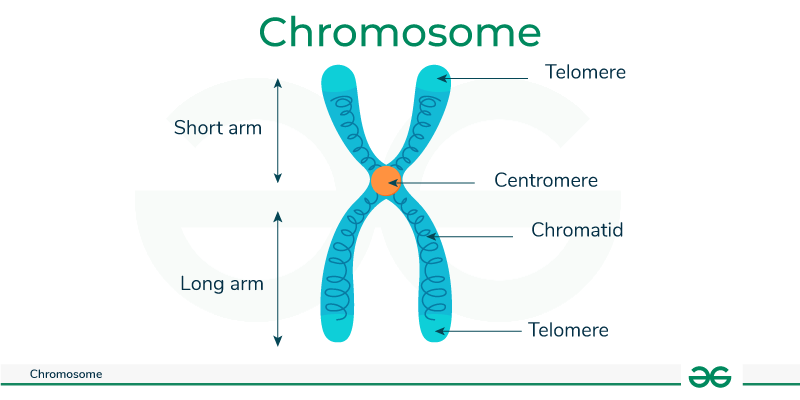

Label Cell divison fr mitosis and meiosis

Karyotype given
