The Rate and Extent of Chemical Change
 Call Kai
 Learn
 Practice Test
 Spaced Repetition
 Match
 Flashcards
 Knowt Play
1/39

There's no tags or description
Looks like no tags are added yet.
40 Terms
How to calculate mean rate?
quantity of reactant used / time OR
quantity of products formed / time
40cm3 of product was produced in 10 seconds.
Calculate the mean rate of reaction
40 / 10
4cm3 /s
How do you calculate the rate of reaction for a specific time?
Change in amount / change in time
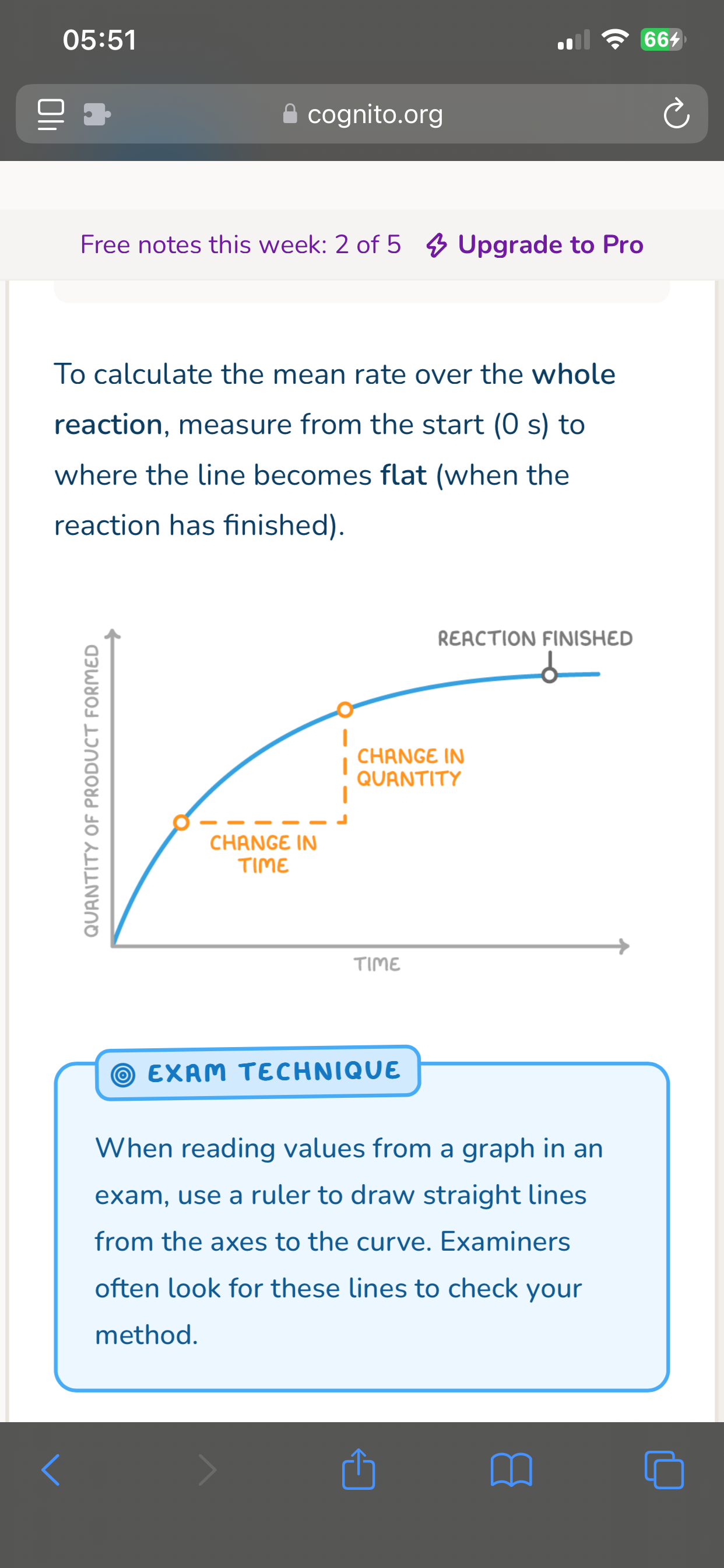
How do you draw a tangent?
Draw a straight line that touches the curve
How do you find the gradient of a tangent?
change in y / change in x
What is collision theory?
Chemical reactions can occur only when reacting particles collide with each other and with sufficient energy. The minimum amount of energy that particles must react is called the activation energy.
Explain why many collisions do not lead to a reaction
Do not have enough energy
What happens if you increase the amount of collisions in a certain time?
Increases the rate of reaction
What happens if you decrease the energy of collision?
Decreases the rate of reaction
What are the factors that affect the rate of reaction ?
Concentration, Surface Area, Pressure(Gas), Temperature, Catalyst
Why does increasing temperature increase the rate of reaction?
particles have more energy and move faster
Particles move frequently
Particles collide with more energy (more collisions are successful - achieve activation energy)
Why does decreasing temperature decrease the rate of reaction?
particles have less energy and move slower
Particles move less frequently
Particles collide with less energy (less collisions are successful - don’t achieve activation energy)
Why does increasing concentration (or pressure) increases the rate of reaction?
More particles in the same volume
Particles collide more frequently
Why does decreasing concentration (or pressure) decrease the rate of reaction?
Fewer particles in the same volume
Particles collide less frequently
Why does increasing surface area (small pieces) increase the rate of reaction?
more particles are exposed
Particles collide more frequently
Why does decreasing surface area (large pieces) decrease the rate of reaction?
Fewer particles are exposed
Particles collide less frequently

Label the rate of reaction graph
Reaction fastest, slows down, stops

the steeper the line…
… the faster the reaction
In terms of particles explain why the rate of reaction is the fastest at the beginning ?
highest concentration (most reactant particles in the volume), so most frequent successoul collision between reactants particles.
In terms of particles explain why the rate of reaction slows down ?
less reactant particles in the same volume (lower concentration , so less frequent successful collision between reactant particles.
In terms of particles explain why the rate of reaction stops at the end?
no reactant particles, so no reaction.
Graphs:
Concentration practical : Method
measure 50cm3 of sodium thiosulfate using a measuring cylinder and pour it into a conical flask.
Place the flask on top of a piece paper marked with a black cross
Measure 10cm3 of dilute hydrochloric acid using a measuring cylinder and pour into the flask
Start the timer when you add the acid and swirl the mixture
Look down the flask and stop the timer when you can no longer soo the cross
Repeat using different concentration of sodium thiosulfate but keep the acid concentration the same
Concentration Practical : Equation
sodium thiosulfate + hydrochloric acid → sodium chloride + water + sulfur dioxide + sulfur
Concentration Practical : Balanced equation
Na2S2O3(s) + 2HCl(aq) → 2NaCl(aq) + H2O(l) + SO2(g) + S(s)
Concentration Practical : Why does the solution become cloudy?
sulfur is formed as a product
Sulfur is an insoluble solid
Concentration Practical : Variables
Control - same concentration of hydrochloric acid
Independent - concentration of sodium thiosulfate
Dependent - time taken for cross to disappear
Concentration Practical : Conclusion
The higher the concentration of a dissolved reactant the faster the rate of reaction
WHY : At nigher concentration, there are more particles in the same volume. This means that the particles collide more frequently and are therefore more likely to react.
Surface Area Practical : What are marble chips made out of?
Calcium carbonate
Surface Area Practical : What is the product when calcium carbonate react with acid?
Carbon dioxide gas
Surface Area Practical : Equation
calcium carbonate + hydrochloric acid → calcium chloride + water + carbon dioxide
Surface Area Practical : Balanced equation
CaCO3(s) + 2HCl(aq) → CaCl2(aq) + H2O(l) + CO2(g)
Surface Area Practical : Method
Using a measuring cylinder, add 50 cm3 of dilute hydrochloric acid to a conical flask.
Add 0.4 g of calcium carbonate to the flask. Immediately connect the gas syringe and start a stop clock.
Every 10 seconds, record the volume of gas produced.
When the reaction is complete, clean the apparatus as directed by a teacher.
Repeat steps 1 to 5 with different concentrations of hydrochloric acid.
Surface Area Practical : Conclusion
smaller marble chips with greater surface area, produced 100cm3 gas is less time than the large marble chips showing they reached faster with more frequent collisions with acid particles.
What is a catalyst?
speeds up à chemical reaction without being used up.
It does this by providing an alternative pathway with a lower activation energy
What are advantages of a catalyst?
Reaction is faster
Reduces the amount of energy needed for a reaction to occur
Reaction can be done at lower temperatures and pressure
Can be reused over and over again
What are disadvantages of a catalyst?
Expensive to buy
May need to buy / design specific catalysts for each reaction
May become poisoned and have to be cleaned before the will work again
May be hazardous to the environment
What is a reversible reaction?
The products of the reaction can react to produce the original reaction.
We represent this using the arrow ⇌
A + B ⇌ C + D
What is the word equation for the reversible reaction of Ammonium Chloride?
ammonium chloride ⇌ ammonia+hydrogen chloride