Biology Unit 7: Evolution and Classification
 Call Kai
 Learn
Learn Practice Test
 Spaced Repetition
 Match
Match Flashcards
 Knowt Play
1/47

Earn XP
Description and Tags
Name | Mastery | Learn | Test | Matching | Spaced | Call with Kai | Chat |
|---|
No analytics yet
Send a link to your students to track their progress
48 Terms
Define Species
A group of similar organisms capable of breeding and producing fertile offspring.
Define Morphological concept
The classification of organisms into species based upon shared morphological (physical) characteristics.
Define binomial nomenclature
Naming system for living organisms using two names for each species; the genus followed by the species.
Define genus
The taxonomic group below family and above species. It is used in binomial nomenclature along with species, as the first of the two names.
Define sexual dimorphism
When the male and female of a species look significantly different. Often having completely different features and appearance.
Define interbreeding
Breeding between species. Produces infertile hybrid offspring.
Examples of interbreeding
Ligers are hybrids that challenge the biological species concept as
They are fertile
They can interbreed with other lions, tigers or ligers leading to a blurring of species boundaries
Define speciation
The formation of new species by the splitting of one pre-existing species into two or more new species.
Describe how speciation could occur
Reproductive barriers could prevent or limit interbreeding between two populations.
Physical barriers might exist between two populations preventing interbreeding,
Change in behaviour or timing around reproductive cycles
sudden event that changes the chromosome number can occur and this sometimes results in the creation of a new species. (due to errors in cell division)
Define a genome
The total of all genetic information of an organism.
Define SNPs
Replacement of a single nucleotide with another, producing variation within a species. These are often found in non-coding regions of DNA
What causes SNPs to occur?
when a single building block of DNA (a nucleotide) is changed, swapped, or altered during DNA copying
Define Genome sequencing
The process of determining the order of the bases in an organism’s genetic code.
Explain how prokaryotes are capable of horizontal gene transfer
a phenomenon where genetic material is exchanged between individuals rather than passed on from one generation to the next.
Explain what a dichotomous key is and how it is used to identify organisms
A tool used to identify species found in the field based on observations. A series of questions with two possible answers that leads to the correct identification of a species. Usually stating whether a feature or characteristic is present in the organism or not.
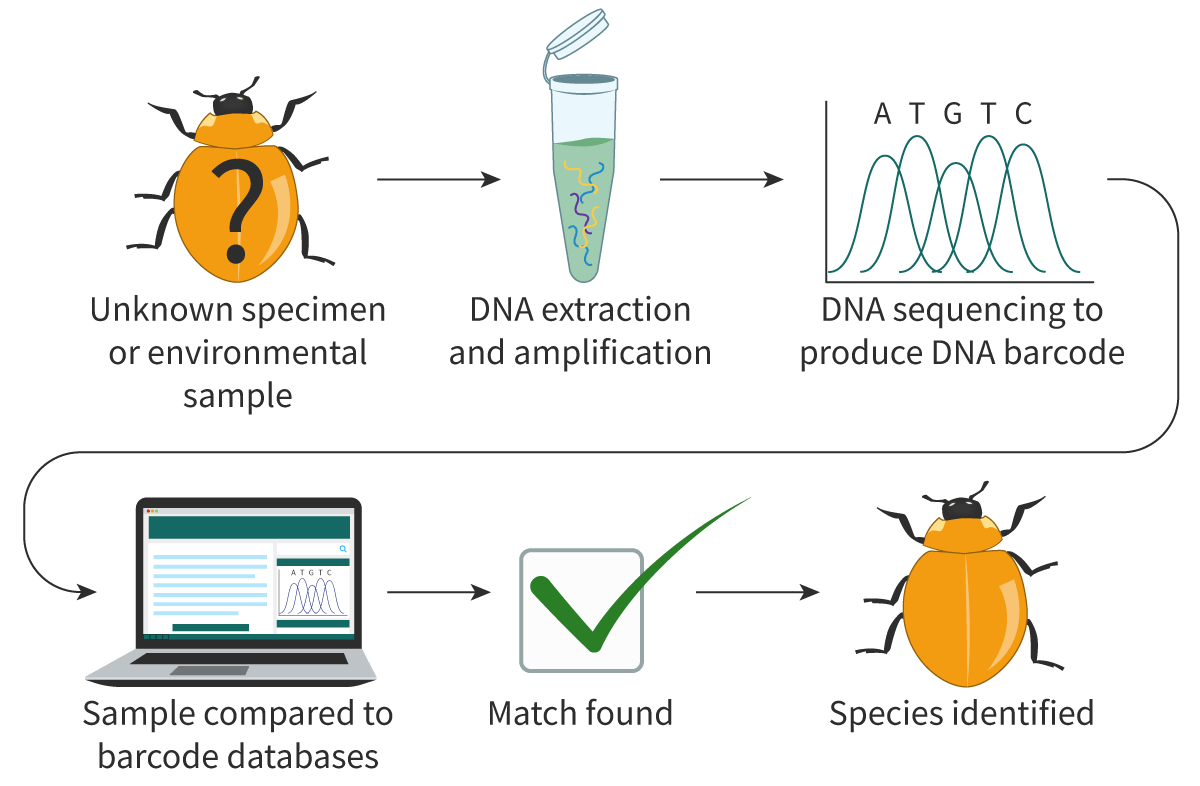
Define DNA barcoding
A method of environmental sampling, often soil or water, that allows for the identification of species and the determination of biodiversity from traces of DNA. The sequences used have been selected because they show much more variation between species than they do within species.
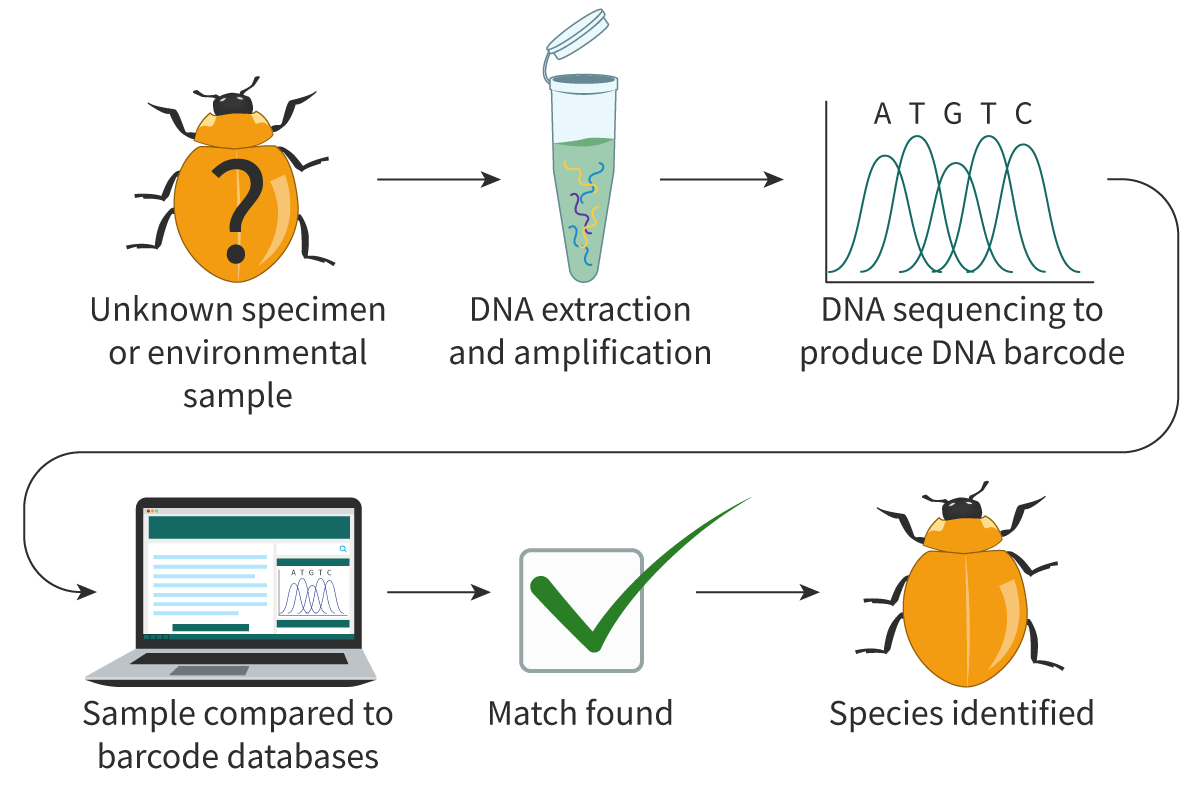
Explain why DNA barcoding is used to determine if a species is present.
Using this method, environmental assessments which are concerned with particular species are able to determine whether that species is present without having to observe the organism itself.
In the case of elusive, endangered species, this is quite significant. DNA barcoding can also assist in the measuring of biodiversity, a key environmental indicator of ecosystem health and sustainability.
Explain the potential uses for DNA barcoding
Including testing food for microorganism contamination, identifying species in different stages of their life cycle, identifying species from partial specimens and even analysing stomach contents to see what organisms have been consumed.
Define evolution
the cumulative change in the heritable characteristics of a population over generations
Describe what studies can act as evidence for evolution
The study of fossils, selective breeding of domesticated plants and animals, comparative anatomy of animals, nucleotide and amino acid sequences, and the geographical distribution of organisms act as evidence for evolution.
Define natural selection
The process in which different environments influences the survival and reproduction of organisms due to the presence of variations or adaptations.
Describe the 5 points of natural selection
‘overproduction’ eventually leads to competition for natural resources such as food and water,
Individuals within a population are not identical but exhibit variations in their characteristics.
Individuals with less favourable variations are less likely to survive. This ‘selection’ by nature is called natural selection.
Individuals with the more favourable variations will form a larger proportion of the population.
Natural selection leads to populations adapted for specific environments.
Describe the 3 points of Lamackrian’s theory
Change in the environment led to the use of certain organs and disuse of others among organisms.
Organs that were used more would increase in size over the lifetime of the organisms. Similarly, organs that were not used over the lifetime of the organism would shrink.
These changes acquired over the lifetime of an individual would be passed on to the offspring.
Define molecular phylogeny
Comparative analysis of the nucleotide sequences of DNA and RNA and the amino acid sequences of proteins. More similarity in genes and proteins indicates more closely related species.
Define molecular clock
The technique that uses the mutation rate of biomolecules to deduce the time since two species shared a common ancestor.
For example, species with fewer differences in their genomes (and amino acids) would have recently split or diverged from each other.
Define selective breeding
Also known as artificial selection where humans select individuals from a species to breed together based on desirable characteristics.
Define what a homologous structure is
have the same basic structural plan, indicating a common ancestry. One typical example is the pentadactyl (five-fingered) limb of vertebrates
Explain what homologous structures indicate
They indicate a divergent evolution, a pattern of evolution where organisms arising from the same ancestral species adapt to different environmental conditions according to the pressures of natural selection.
Define analogous structures.
body parts that have the same or similar function in different groups of organisms but have different structures. I.E, wings of birds and insects.
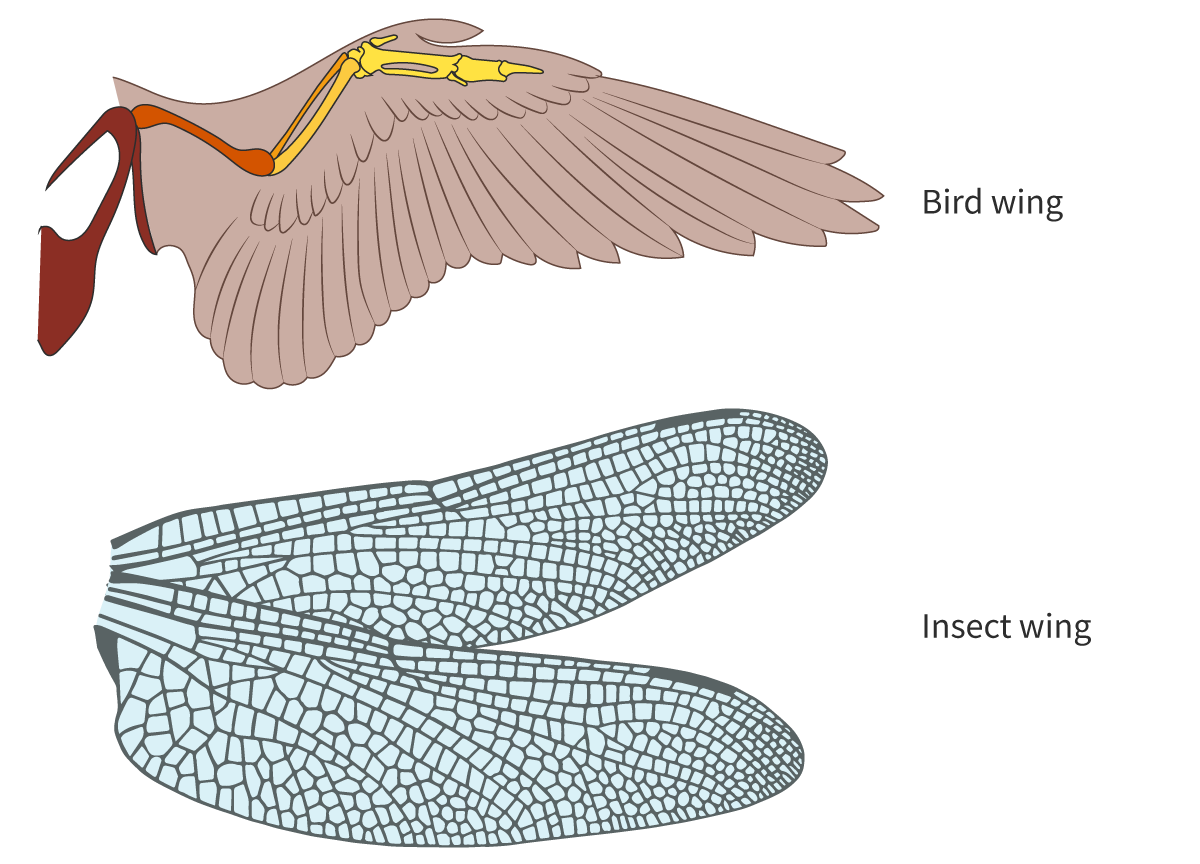
Define convergent evolution and explain how it relates to analogous structures
Occurs when distantly related groups of organisms face similar environmental conditions and adapt in similar ways. Insect wings and bird wings evolved when their different ancestors independently adapted to a similar mode of life, that is, flight

Explain how speciation leads to a genetic separation
Speciation results in modifying the original gene pool into separate gene pools in a way that interbreeding is prevented, that is, speciation leads to genetic separation.
Explain how gradual evolutionary changes is not the only formation of a new species
There could be evolutionary changes in the gene pool prior to speciation. In speciation the make-up of the gene pool must change sufficiently to define a new species. Changes should be such that it is impossible for the members of the two or more descendant populations to interbreed.
Define reproductive isolation
Refers to barriers that prevent populations of the same species from interbreeding and/or producing fertile offspring.
Explain how reproductive isolation could occur from geographical barriers
Reproductive isolation could result from geographical barriers such as:
physical barriers like mountain ranges or river
large distances between populations
human-made barriers like large roads or dams.
Define allopatric speciation
Evolution of one or more new species from an ancestral species due to a geographical barrier.
Define sympatric speciation
Evolution of one or more new species from an ancestral species while living in the same geographical area.
What factors contribute to reproductive isolation
Reproductive isolation can occur due to:
geographical isolation
temporal isolation
behavioural isolation.
Define geographical isolation
separation of species by natural or human-made physical barriers
Define temporal isolation
result of differences in the timing of the reproductive cycle like mating seasons or gamete production. This prevents interbreeding even though the species may share the same geographical location.
Define behavioural isolation
Due to environmental factors, organisms of the same species may develop different mating rituals over a period of time. When their potential mates do not recognise these mating rituals, this results in behavioural isolation and the individuals do not interbreed
Define adaptive radiation
mechanism describes the rapid evolution of an ancestral species in different lines to utilise the available ecological niches.
Define ecological niches
The position of a species within an ecosystem or community and its interrelationships with both biotic and abiotic factors.
Define hybridisation
refers to interbreeding between two different species producing offspring known as hybrids.
Explain why hybridisation rarely leads to speciation
Hybridisation rarely leads to speciation because:
The hybrids could be infertile like mules, or
The hybrids are not reproductively isolated from the parent species like ligers
Define polyploidy
A condition where an organism possesses more than two sets of chromosomes.
Explain how polyploidy can occur
A rapid and relatively simple form of speciation, polyploidy is caused due to non-disjunction of chromosomes during mitosis or meiosis. This results in the formation of gametes with additional sets of chromosomes.
Explain how polyploids differ from haploids
Polyploid organisms have more than two sets of chromosomes. Polyploid organisms can be triploid (3n), tetraploid (4n), pentaploid (5n) and so on
Define allopolyploidy
a special case of polyploidy. An allopolyploid is a hybrid and has multiple chromosome sets that are derived from the different parental species.