Art 201A Exam 1
 Call Kai
 Learn
Learn Practice Test
 Spaced Repetition
 Match
Match Flashcards
 Knowt Play
1/13

There's no tags or description
Looks like no tags are added yet.
Name | Mastery | Learn | Test | Matching | Spaced | Call with Kai | Chat |
|---|
No analytics yet
Send a link to your students to track their progress
14 Terms
Psychostasis / Judgement of Hunefer Before Osiris
Time period: Late Egyptian art period - 19th Dynasty
-Osiris (God of underworld).
-Sun god has 2 sisters Isis and Nephthys, marries Isis.
-Jealous brother (Seth hippopotamus) cuts him up and scatters his remains.
-falcon, and Anubis (god of embalming) help find body parts
-horus battles seth, kills seth, and horus becomes earthly god
-green = dead, embalmed
-goddesses are depicted a little lighter
-Thoth stays consist (god of record keeping)
-Maat (cat or feather) goddess of truth and justice
-Besset - cat, protector of followers of RAA (sun god)
-sun circle disk above head - contribute to sun god
-amnit (looks like a lamassu) crocodile head, lion body, hippo butt
eater of the dead
-Believed the afterlife was like earth.

Temple of Ramses ll
Time period: New Kingdom - 19th Dynasty
Media: limestone carving
carved out of stone
4 very large ramses
Rahh sun did in middle with Horus
on each side of leg was his wife (Nefatari), in between his leg was Raa
figures on top are baboons, represented rising sun, tribute to Raa
entryway was very elaborate, wife was not as elaborate
Tomb was looted quickly.

Funetary Mask of Tutanklamun
Time period: Middle Kingdom - 18th Dynasty
Media: gold, lapis lazuli
His tomb wasn’t looted and found by a british man.
Unhappy and unhealthy throughout his life (clubfoot, overbite, inbreeding).
Ruled little over 10 years.
He died from hippo hunt
general is fighting 100 miles away, and priest rushed mummification - he was damaged
priest possibly took items from other tombs, and had things engraved tut over other names, so that priest could become ruler
nobody liked him - end of 18th dynasty
Tut and his wife tomb wall -> style looks just like his fathers

Akhenaten and his family
Time period: Middle Kingdom - 18th Dynasty
Media: sunken relief
Him and his wife Nefertiti are holding their children.
still using Heirarichal scale
wanted to be seen as human and caring
Sun god showering sun rays like a blessing to them (end are ankhs).

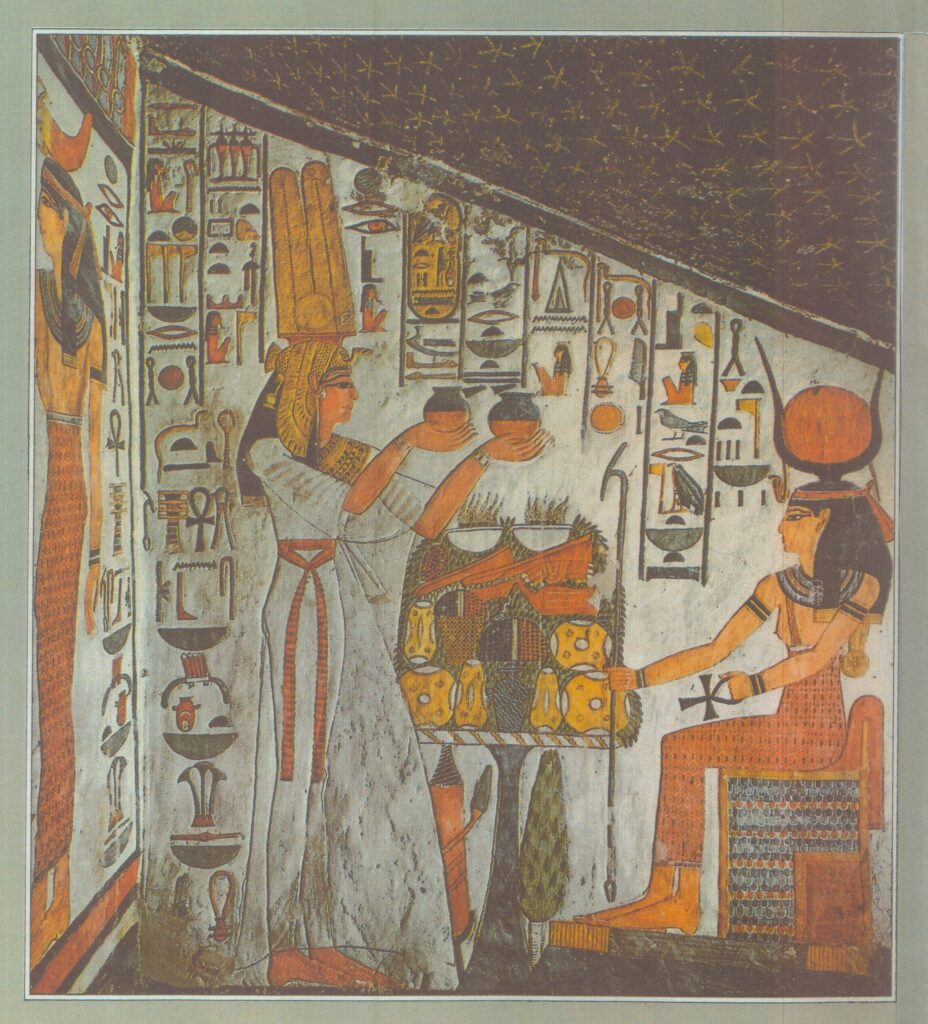
Queen Nefertiti making an offering to Isis
Time period: 19th Dynasty
19th dynasty is the strongest, afterwards not so much.
Isis, sister, and wife.
Hathor seated and holding antiquity and ankh, wearing sun disk and headdress.
Afterlife belief shifted, believed now you had to be judged before going to the afterlife.
Colossal Figure of Akhenaten
Time period: New Kingdom / Armana period
Media: Pillar statue
firm believer in the Sun God, Raa
Akhenaten changes religion, culture, and how artworks depcited rulers.
he looked human, while others were not and looked Godly
faced the city, to make him and sun god the focus
took the priest out of power

Narmer Palette
Time period: Pre-Dynastic
Media: shist (green stone) carvi
Representation of Narmer depicted the tallest, wearing crown of upper Egypt at time.
Symbols highly engraved in their lives/tombs.
TOP - cow god of protection named harthor, his name in hieroglyphics
middle : huge one is also him, the bowling pin is crown of upper egypt, getting ready to behead man
horus (falcon) sitting on symbols of papyrus (symbol of lower egypt)
Opposing army at the bottom
Narmer takes control of lower, then upper Egypt.
Upper and lower Egypt was ruled by 2 people before him, he combined both.
Not much was known about him
Pre-dynastic era.
Made of pigment, more ceremonial
Pigment was needed for dyes, makeup (used to prevent eye infections).
Palettes were common.

Hatshepsut Kneeling
Time period: 18th Dynasty
2 sculptures found in mortuary complex.
Wore male ruler attire to be seen as powerful.
wearing false beard, headdress, kilted skirt, was wearing this in public
Holding offering jars.
Rules 12-15 years
her stepson comes into power when she dies, despises her and tries to erase existence of her
on tomb wall, her name and figure was chipped from wall
her tomb was moved in an attempt to protect her

Butcher
Time period: 5th Dynasty / Old Kingdom
Media: limestone
normal everyday
realistic looking
Emphasized it was more important for rulers to not look human
Found in a tomb of scribe

Seated Scribe
Time period: 5th Dynasty / Old Kingdom
Media: limestone
normal everyday, made of limestone, realistic looking
it was more important for rulers to not look human
Found in a tomb of scribe

Funerary Temple of Queen Hatshepsut
Time period: 18th Dynasty / New Kingdom
Media:
she was deemed ruler, well liked, and presented in a male persona
dedicated temple to her, Amun, Tutmos (father), Raah sun god and other gods
3 entrances/walkways
becomes known as valley of kings and queens, and majority buried here
Anubis (jackal embalming god) and Hathor (cow headed god of protection)

Khafre
Time period: Old kingdom / 4th Dynasty
Media: Diorite imported from Africa
Diorite statue of Khafre (Chephren) from Giza
rulers were made to look immortal or less realistic
The side of the chair has lotus (upper) and papyrus (lower Egypt)
wearing headdress symbol of Ocyrus
The back of his head and neck has HORUS - protecting Khafre from evil
wasn't painted because stone was pretty, imported from Africa

Great Sphinx, Funerary Complex of Khafre
Time period: Old Kingdom, 4th Dynasty

The Pyramids of Giza, from left to right
Media: limestone
3 pyramids of Kings.
Grandfather-Khufu (biggest)
Father-Khafre (middle)
Son-Menkure (Smallest)
Temples surrounding them of family members
Long walkway to Nile river.
Pyramids were basically giant headstones (tombs were underneath).
