Chapter 9 - Mendel, Genes, and Inheritance
 Call Kai
 Learn
 Practice Test
 Spaced Repetition
 Match
 Flashcards
 Knowt Play
1/36

There's no tags or description
Looks like no tags are added yet.
37 Terms
Blending Theory of Inheritance (pre-1900’s)
Hereditary traits blend evenly in offspring through mixing of parents’ blood
Does not explain why:
Extremes do not gradually disappear
Offspring sometimes have traits that differ from both parent
Proven False
What role did Gregor Mendel play in the study of inheritance
First to use the scientific method to study inheritance
The Beginnings of Genetics
Mendel had four hypotheses which he tested
His experimental results were used to support two principles:
Principle of Segregation
Principle of independent Assortment
Mendel & Pea Plant Experiments (1860’s)
Why the Garden pea
Easy to grow
Clearly defined characters
Variation in a character - traits
Characters are passed onto offspring as discrete hereditary factors = Genes
True-Breeding garden Peas
True-breeding varieties
Self-fertilized plants
→same trait in each generation
Cross-pollination
Between different parent plants
→ same and different traits in each generation
Terminology
P generation (Parents)
Plants used in the initial cross
Each pea produced contains an embryo
F1 generation (Filial)
First generation
F2 generation
Second generation
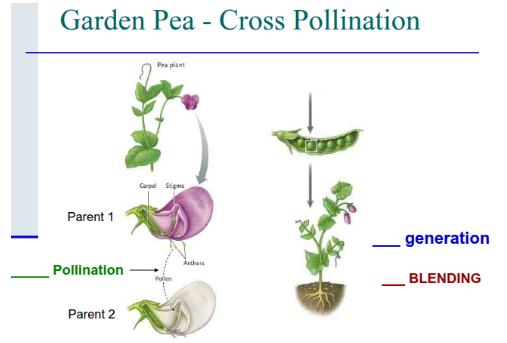
Garden Pea - Cross Pollination
The purple garden pea and the white garden pea cross pollinate with each other to create the F1 Generation no blending occurs
Flower Colour Cross (Mendels Experiment)
P generation
Purple flowers crossed with white flowers
F1 generation
All F1 seeds formed purple flowers
Purple flower offspring crossed
F2 generation
Purple flowers - 75%
White flowers reappeared - 25%
3:1 ratio
No Blending
Mendel’s First Hypothesis
Genes for genetic characters occur in pairs
One gene inherited from each parent
Alleles are different versions of a gene
Diploid: two copies of each gene
Mendel’s Second Hypothesis
If two alleles of a gene are different, one allele is over the other
Dominant Allele is expressed
Recessive Allele is masked
Recessive alleles only expressed when two copies of the allele present
Mendel’s third hypothesis
Two alleles of a gene segregate (separate and enter gametes singly
Half the gametes carry one allele, half carry the other allele (haploid)
Principle of Segregation
Two gametes fuse to produce a zygote that contains two alleles (diploid)

Monohybrid Cross - Single Character
Since the trait purple is dominant in peas and the white trait is recessive if both are homozygous dominant and homozygous recessive then the resulting F1 offspring will always have the purple trait
Results Support Mendel’s Third Hypothesis
Terminology (Types of allele pairings)
Homozygous
Both alleles the same
PP (dominant)
Pp (recessive)
Heterozygous
Two different alleles
Pp
Terminology (Appearance and Genetic Constitution)
Genotype
Genetic Constitution of an organism
PP, Pp, pp
Phenotype
Outward appearance
Purple flowers, white flowers
Product rule in probability
Probability of two independent events occurring in succession
Individual probabilities multiplied
Coin flip probabilities
Heads = ½
Tails = ½
Two heads = ½ x ½ = ¼
Two tails = ½ x ½ = ¼
Mendel’s Predictions, Mendel could predict:
Classes of offspring
Proportions of those offspring
Sum Rule in Probability
Probability of two different events producing the same outcome
Individual probabilities added
Ex. Probability of a heads and a tails in two tosses:
First possibility: heads then tails
Heads = ½, Tails = ½ ( ½ × ½ = ¼ ) —> Product Rule
Tails = ½, Heads = ½ ( ½ × ½ = ¼ ) —> Product Rule
Total probability: ¼ + ¼ = ½ —> Sum Rule

Probability in Mendel’s Crosses
Heterozygous cross (Pp x Pp):
Genotype probabilities
PP zygote = ½ × ½ = ¼
pp zygote = ½ × ½ = ¼
Pp zygote = ¼ + ¼ = ½
Phenotype probabilities
Purple flowers = PP + Pp = ¼ + ½ = ¾
White flowers = pp = ¼
3:1 ratio
Validating Mendel’s Hypothesis using a testcross
Testcross - Cross of an unknown genotype with a homozygous recessive individual
Determines if the unknown is a heterozygote or homozygote
If Purple flower is PP ratio is 1:0 as the resultant with a white flower will always be purple Pp

Mendel’s Fourth Hypothesis
Alleles of genes that govern two different characters during formation of gametes
Principle of Independent Assortment
Due to independent assortment during meiosis
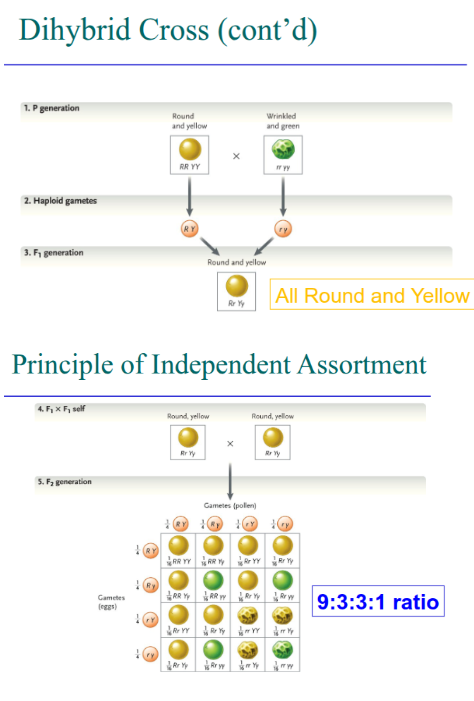
Dihybrid Cross - Two characters Pea Shape Pea Colour
R= round Y= yellow
r = wrinkled y = Green
P generation RR YY x RR yy
What is produced in P generation and F1 Generation
Pea Shape Pea Colour
R= round Y= yellow
r = wrinkled y = Green
P generation RR YY x RR yy
RR YY parent produces R Y gametes
RR YY parent produces r y gametes
F1 Generation
All offspring Rr Yy genotype
All offspring round yellow phenotype
Dihybrid Cross - Two characters Pea Shape Pea Colour
R= round Y= yellow
r = wrinkled y = Green
F1 generation Rr Yy x Rr Yy
What is produced in P generation and F2 Generation
Two heterozygotes crossed
F1 cross: Rr Yy x Rr Yy
Rr Yy parents produce 4 kinds of gametes
¼ R Y, ¼ R y, ¼ r Y, ¼ r y
F2 generation
Offspring have four phenotypes
9/16 = round yellow
3/16 = wrinkled yellow
3/16 = round green
1/16 = wrinkled green
Ration: 9:3:3:1
Dihybrid Testcross that supports Mendel’s Hyotheses
F1 x Homozygous Reccessive
Rr Yy x Rr yy
Testcross Generation
¼ = round yellow
¼ = round green
¼ = wrinkled yellow
¼ = wrinkled green
1:1:1:1 ratio
Supported Mendel’s Hypotheses
Chromosome Theory of Inheritance Walter Sutton what does he parallel?
Walter Sutton - Parallels between genes and chromosomes in meiosis and fertilization
Chromosomes occur in pairs in diploid organisms
Chromosomes of each pair are separated and delivered singly to gametes
Independent Assortment of chromosomes
Each chromosome of each pair is derived from each parent
All similar characteristics Mendel observed about alleles (genes)
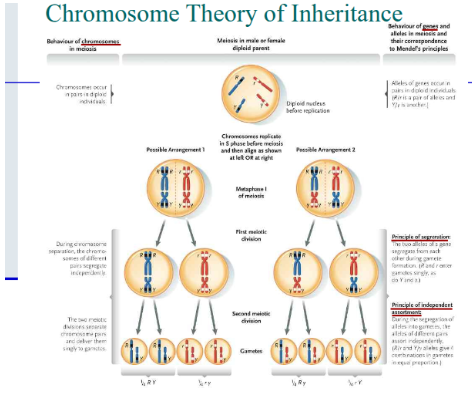

Chromosome Theory of Inheritance
Chromosomes occur in pairs in diploid individually, Alleles of genes occur in pair in diploid individuals [R/r is a pair of alleles and Y/y is another}
Chromosomes replicated in S phase before meiosis and then align as shown at left OR at right
During chromosome separation the chromosomes of different pairs segregate independently
Principle of segregation
The two alleles of a gene segregate from each other during gamete formation. [R and r enter gametes singly as do Y and y
The two meiotic division separate chromosome pairs and deliver them singly to gametes
Principle of independent assortment
During the segregation of alleles into gametes the alleles of different pairs the alleles of different pairs assorted independently {R/r and Y/y alleles give 4 combinations in gametes in equal proportion}
Homologous Chromosomes
Homologous Chromosomes name the types and specific parts
Locus
Site occupied by a gene on a chromosome
Alleles on different homologous chromosomes have same loci
Later Modifications and Additions to Mendel’s Hypotheses
In incomplete dominance, dominant alleles do not completely mask recessive alleles
In codominance, the effects of different alleles are equally detectable in heterozygotes
In multiple alleles, more than two alleles of a gene are present in a population
In epistasis, genes interact, with the activity of one gene influencing the activity of another gene
In polygenic inheritance, a character is controlled by the common effects of severa; genes
In pleiotropy, two or more characters are affected by a single gene
Incomplete Dominance
Dominant allele is not completely dominant over recessive
Phenotype
Different from either homozygote phenotype
Incomplete dominance if P generation is red flowered C^R C^R and white flowered C^W C^W
P Generation
Red flowered
x
White flowered
C^R C^R x C^W C^W
F1 generation
All offspring C^RC^W
All pink flowered
Incomplete dominance if F1 generation is Pink flowered C^R C^W x C^R C^W
F2 generation
¼ red flowered
¼ white flowered
½ pink flowered
1:2:1 ratio
Not Blending
Incomplete Dominance in Human recessive recessive form of disease Traits
Sickle-cell disease
Homozygous recessive recessive has sickle-cell disease
Heterozygote has milder sickle-cell trait
Familial hyperchloesterolemia
Homozygous recessive has severe form of disease
Heterozygote has mild form of disease
Tay-Sachs disease
Homozygous recessive has serious symptoms
Heterozygote has no symptoms but has detectable biochemical effects

Codominace
Different alleles of gene have effects in heterozygotes
Both alleles are expressed
Similar inheritance, 1:2:1
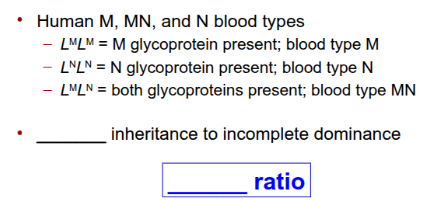
Multiple Alleles
More than two types of alleles for a gene
Found among all individuals in a population
Diploid individuals only have two of the alleles
Phenotype depends on relationship between different pairs of alleles
Still follows Mendel’s principles
Small differences in DNA sequences result in multiple alleles

Human ABO Blood Group
Antigens
Glycoproteins on surface of red blood cells
I^A allele produces A antigen (dominant)
I^B allele produces B antigen (dominant)
i allele produces neither A nor B (recessive)
Blood types (phenotypes)
I^A I^A or I^Ai = type A blood
I^B I^ B or I^Bi = type B blood
ii = type O blood
I^A I^B = type AB blood
Immune system produces antibodies against antigens not found on its own red blood cells

Epistasis
Genes interact:
Allele of one locus inhibits or masks effects of allele at a different locus
Some expected phenotypes do not appear among offspring
Epistasis (Labrador Retrievers)
Melanin pigment gene
B allele: black fur colour (dominant)
B allele: brown fur colour (recessive)
Pigment deposition gene
E allele: pigment deposition normal (dominant)
E allele: pigment deposition blocked (recessive)
Phenotypes
Black fur: BB EE, BB Ee, Bb EE, Bb Ee
Brown fur: bb EE, bb Ee
Yellow fur: BB ee, Bb ee, bb ee

Epistasis (Labrador Retrievers)
Black Fur dog and Blonde Fur dog
9:3:4 ratio,
Yes independent assortment,
E gene is epistatic to B gene (E gene controls expression of B gene)
Polygenic Inheritance
Several genes at different loci interact to control same character
Produces continuous variation
Phenotypic distribution: Bell-shaped curve
Often modified by environmental effects
Quantitative Traits

Pleiotropy
One gene affects more than
Sickle-cell disease
Recessive allele affects hemoglobin structure and function
Leads to blood vessel damage
Damages many tissues, organs, and functions
Many different symptoms result
