Genetics Lecture 5: Epigenetics I
 Call Kai
 Learn
 Practice Test
 Spaced Repetition
 Match
 Flashcards
 Knowt Play
1/33

Earn XP
Description and Tags
Comprehensive vocabulary flashcards covering the fundamental concepts, mechanisms, biological roles, and clinical/phenotypic examples of epigenetics based on lecture notes by Dr. Catherine Mansfield.
34 Terms
Epigenetics (Dupont et al., 2009 Definition)
The study of changes in gene function that are mitotically and/or meiotically heritable and that do not entail a change in DNA sequence.
Epigenetics (Waddington, 1942 Definition)
The branch of biology which studies the causal interactions between genes and their products, which bring the phenotype into being.
Epigenetics (Bird, 2007 Definition)
The structural adaptation of chromosomal regions so as to register, signal, or perpetuate altered activity states.
Chromatin
The complex of genomic DNA and packaging proteins found within the eukaryotic nucleus.
Heterochromatin
Highly condensed, transcriptionally inactive chromatin localized in patches against the nuclear envelope, centromeres, and telomeres where genes are silenced.

Euchromatin
Open, decondensed chromatin containing transcriptionally active genes accessible to transcriptional machinery.
Nucleosome
The basic repeating unit of chromatin packaging, consisting of approximately 147bp of DNA wrapped around an octamer of histone proteins (two copies each of H2A, H2B, H3, and H4).

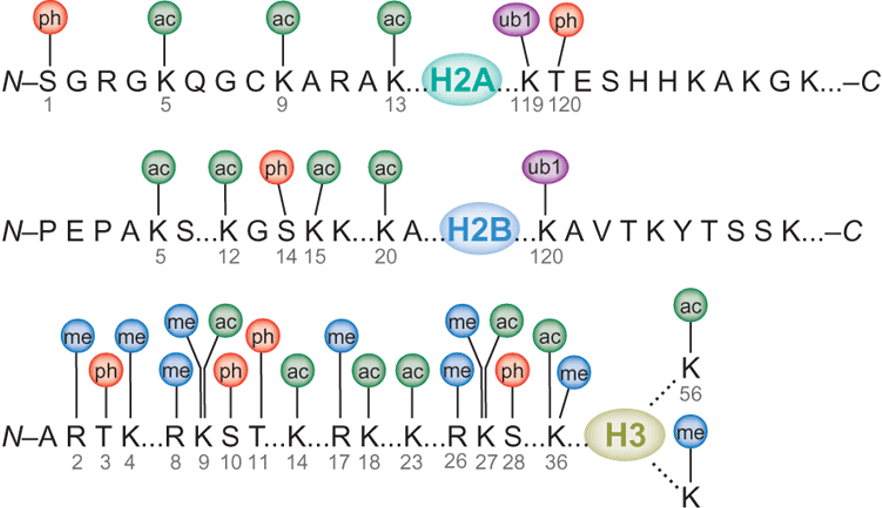
Histone Tails
Flexible amino-terminal projections extending from nucleosomal histone proteins that serve as primary templates for post-translational covalent modifications.
Histone Code
The functional hypothesis that specific combinations and locations of covalent marks on histone tails recruit effector complexes to determine whether chromatin is active or repressed.
Writers
Enzymes that catalyze the addition of covalent epigenetic chemical modifications, such as methyl or acetyl groups, directly to histone tails or DNA.
Erasers
Enzymes responsible for removing covalent epigenetic marks from histone tails or nucleic acids, ensuring epigenetic states are reversible.
Readers
Proteins containing specialized recognition domains (such as chromodomains, bromodomains, or Tudor domains) that bind specific epigenetic marks to recruit chromatin-remodeling and regulatory complexes.
DNA Methylation
An epigenetic modification involving the covalent transfer of a methyl group to the fifth carbon position of a cytosine ring, primarily at CG sites in mammals and CG, CHG, or CHH sites in plants.
5-Methylcytosine
The pyrimidine base product formed when a methyltransferase enzyme attaches a methyl group (−CH3) to the carbon-5 position of cytosine.
CpG Islands
Genomic regions characterized by a high frequency of cytosine-phosphate-guanine dinucleotides (numbering approximately 30,000 in the human genome) often found within gene promoters.

Promoter Methylation
DNA methylation localized within gene promoter regions, which typically correlates with transcriptional silencing and gene repression.
Gene Body Methylation
DNA methylation occurring within the transcribed coding region of a gene, which frequently correlates with active gene transcription.
5-Hydroxymethylcytosine
A modified cytosine derivative produced by altering 5-methylcytosine, representing a potential intermediate pathway for active DNA demethylation.
X-Chromosome Inactivation (Lyonisation)
An irreversible dosage compensation mechanism discovered by Mary Lyon wherein female mammalian embryonic cells randomly silence one of their two X chromosomes so that only one functionally active X chromosome exists per cell.
Barr Body
A dense, condensed structure of heterochromatin located at the nuclear periphery of female mammalian cells, representing the transcriptionally silent inactive X chromosome (Xi).

Xist RNA
A non-coding RNA produced from the X-inactivation centre (Xic) that coats and condenses the chromosome from which it is transcribed, excluding RNA Polymerase II to mediate chromosome-wide silencing.
Cellular Mosaicism (XCI)
The presence of two genetically identical cell populations in female mammals expressing different alleles due to random X-chromosome inactivation, visibly illustrated by the patchy coat colors of calico and tortoiseshell cats.

Vernalization
The requirement of prolonged exposure to low, non-freezing winter temperatures that confers competence for plants to flower in the spring via epigenetic silencing mechanisms.
FLC (Flowering Locus C)
A floral repressor gene in plants whose expression is quantitatively down-regulated by cold exposure via Polycomb-based epigenetic silencing, allowing flowering upon the arrival of spring.

VIN3 (Vernalization Insensitive 3)
A plant gene induced specifically during cold temperatures that facilitates the nucleation and accumulation of repressive histone modifications and Polycomb complexes at the FLC locus.
ICF Syndrome
A rare genetic disorder (Immunodeficiency, Centromeric region instability, Facial anomalies) linked to aberrant DNA methylation and defective epigenetic regulation.
ILO 1- Define what Epigenetics is
Epi: on top of
Epigenetics: a change in gene expression without a change in the DNA sequence itself
Waddington: the branch of biology which studies the causal interactions between genes and their products, which bring the phenotype into being (1942)
Bird: the structural adaptation of chromosomal regions so as to register, signal or perpetuate altered activity states (2007)
“…the study of changes in gene function that are mitotically and/or meiotically heritable and that do not entail a change in DNA sequence.”
ILO 2- Explain the main pathways of epigenetic modifications and common epigenetic changes
Epigenetic modifications refer to heritable changes in gene expression that do not involve alterations to the underlying DNA sequence. Main pathways include DNA methylation, histone modification, and non-coding RNA interactions, which can influence gene activity and affect cellular functions.
WHAT’S EPIGENETICS FOR?
DNA IS IDENTICAL, BUT DIFFERENT PHENOTYPES
Epigenetics:
Regulates gene expression
Recruits protein complexes (e.g. DNA repair)
Maintains structure (chromosomal stability/ organisation)
Which cell types in the body don’t have the same DNA blueprint? Reproductive cells (gametes), mature red blood cells, and immune cells (B and T lymphocytes) don’t have the same DNA blueprint
EPIGENETICS MECHANISMS
Epigenetics creates effects in different ways:
• Histone Modification
• DNA Methylation
• microRNAs
e.g. - methyl group, DNA, epigenetic factor, histone, histone tails, chromatin, chromosome

ILO 3- Explain how epigenetics can affect gene expression & ultimately the phenotype using examples
Epigenetics can influence gene expression by modifying how genes are activated or silenced through mechanisms like DNA methylation and histone modification. For example, environmental factors can lead to changes in epigenetic markers, ultimately affecting traits such as flower color in plants or susceptibility to diseases in humans.
CHROMATIN
What is chromatin?
- DNA + packaging proteins
Heterochromatin
- Centromeres, telomeres
- Condensed
- Inactive genes
Heterochromatin lies against the nuclear envelope in patches and is broken up at the site of the nuclear pore
Euchromatin
- Active genes
- Open
‘Beads-on-a-string’
Challenge of fitting all human DNA into a tiny cell nucleus:
Equivalent to packing 40 km (24 miles) of extremely fine thread into a tennis ball!
WHAT ARE NUCLEOSOMES?
147 bp of DNA wrapped around an octamer of histone proteins
Histone tails protrude from the nucleosome
These can serve as templates for epigenetic modifications
Linker DNA- short, unwrapped stretch of double-stranded DNA that connects two adjacent nucleosome cores, forming the "string" in the "beads-on-a-string" chromatin model. It typically measures between 10 and 100 base pairs in length, depending on the species, cell type, and specific region of the genome.

HISTONE MODIFICATIONS
Epigenetic modifications occur on the histone tails
E.g.- methylation, acetylation, phosphorylation, ubiquitination
These are covalent modifications of amino acids (post-translational)
Specific enzymes to:
Write – add the mark
Erase – remove the mark
Read – recognise the mark
Location is significant-
Where in the gene a mark is
What epigenetic marks are nearby
We can use this information to learn the histone code