physiology Dar. Butcher quiz 2
 Call Kai
 Learn
 Practice Test
 Spaced Repetition
 Match
 Flashcards
 Knowt Play
1/99

There's no tags or description
Looks like no tags are added yet.
100 Terms
how many circulations do the lung have?
2
bronchial and pulmonary circulation
bronchial artery circulation
high pressure, low flow circulation
gives arterial blood to the tracheal and bronchial tree
contains oxygenated blood, empties out to the pulmonary veins
1-2% greater blood volume enters left ventricle

pulmonary artery
low pressure, high flow circulation
has the pulmonary artery
its where deoxygenated blood from body to alveolar capillaries for gas exchange, returned by pulmonary veins to the heart

special characteristics of pulmonary vessels
pulmonary arteries and lymphatics
pulmonary arteries
typically slightly smaller than aorta and shorter than most arteries
arterioles are also typically larger than what are seen systematically
thin walled and distensible
large compliance- accommodates the stroke of right ventricle
whats complaince
how easily the lungs stretch/expand when pressure is applied
lymphatics
found in the supportive tissue of the lungs
empty into the right thoracic lymph duct
removed particulate matter and plasma protein leaking from lung capillaries

how does Oxygen move
diffusion
why s oxygen exchange necessary
O2 is the final electron acceptor in cellular respiration
Food + oxygen →ATP
rates of diffusion are dictated by the size of the __________ ___________
concentration gradient
Concentration is typically used to describe diffusion within a single aqueous solution (one phase)
Problem: O2 and CO2 diffuse between a gas mixture and aqueous solution; how do we fix
partial pressure
The partial pressure and the concentration of a gas in an aqueous solution are
proportional to each other
3 important characteristics to know about partial pressure
solubilities of different gases are different, specifically CO2 is higher than O2 and N2
solubilities of gases in aqueous solutions decrease strongly with increasing water temp
solubilities of gases in aqueous solutions decrease with increasing salinity
law of diffusion: what is it, when is it true, when is it not true
gases diffuse from areas of relatively high partial pressure to areas of relatively low partial pressure
This is true within gas mixtures, within aqueous solutions, and across gas–water interfaces
Does NOT necessarily mean that diffusion occurs in the direction of the concentration gradient
so ex.
Beetle has consumed 50% of the oxygen in the bubble
Higher concentration of oxygen compared to water
Lower concentration of partial pressure compared to water
Thus, oxygen diffuses into the bubble
equilibrium is always attained with respect to
any given gas when the partial pressure of the gas is uniform everywhere in a system
Krogh diffusion coefficient describes
gas permeability of the tissue
Diffusion through water can meet O2 requirements of living tissues only if the distance covered is < 1 mm
Gases diffuse easier thru air than________
water
which gas mol. contribute to partial pressure of gas?
Only gas molecules that exist as free gas molecules contribute to the partial pressure of a gas
Pulmonary arterial pressure, Pulmonary capillary pressure, Left atrium/pulmonary vein pressure
Pulmonary arterial pressure < 30 mmHg
Pulmonary capillary pressure is ~ 7 mmHg
Left atrium/pulmonary vein pressure is ~ 2 mmHg
zones of pulmonary blood flow
zone 1: no blood flow- alveolar air pressure > local alveolar capillary pressure during any part of the cardiac cycle
zone 2: intermittent blood flow- alveolar pressure sometimes > local alveolar capillary pressure
During diastole
Zone 3: Continuous blood flow - alveolar air pressure < local alveolar capillary pressure

Capillary Exchange of Fluid in the Lungs:
1. Forces tending to cause movement of fluid outward from the capillaries and into the pulmonary interstitium:
Forces tending to cause absorption of fluid into the capillaries:
alvelolar structure?
how is fluid carried away>
Pulmonary capillary pressure is low (+7)
Interstitial fluid colloid osmotic pressure (+14)
Negative interstitial fluid (-8)
Total = 29 mmHg
• Colloid osmotic pressure (-28)
Alveolar walls extremely thin
Fluid in the alveoli is sucked mechanically into lung interstitium and carried away in lymphatics

exercise does what to the lung?
increases blood flow in all parts of the lung
Pulmonary vascular pressure rise to convert lung apices from zone 2 to zone 3

increased cardiac output does NOT mean
large increases in pulmonary artery pressure
capillary recruitment
distension of capillaries
increasing pulmonary pressure
what are lungs basically
basically a blood reservoir
roughly 9% of blood volume
in normal circumstances (at rest, healthy)
in the lungs why is blood flow at that rate?
its matched for optimal blood exchange
Hypoxia (not enough oxygen to tissues)→ increase in vascular resistance→ diverts blood flow (opposite of systemic vessels)
Lungs are better aerated

Which pulmonary circuit is low-pressure, high flow circulation?
Bronchial arteries
Pulmonary Artery
All of the above
Pulmonary Artery
What characteristic of gases and partial pressure is NOT true?
Solubilities of different gases are different
The solubilities of gases in aqueous solutions decrease strongly with increasing water temperature.
The solubilities of gases in aqueous solutions decrease with increasing salinity.
All of the above are true
All of the above are true
If atmospheric oxygen has a higher concentration and a higher atm than inside the lung, which direction with it diffuse?
It will diffuse into the lungs
It will diffuse out of the lungs
It will not diffuse at all, because it is already at equilibrium
Not enough info given
• It will diffuse into the lungs
What are the force(s) that cause fluid absorption into the capillaries?
Low pulmonary capillary pressure
Negative interstitial fluid
Capillary osmotic pressure
A and B
• Capillary osmotic pressure
The blood vessels of pulmonary and systemic vessels behave in a similar fashion with hypoxia. • True • False
False
Compositions of Alveolar Air and Atmospheric Air are Different: what are they
Alveolar air is only partially replaced by atmospheric air with each breath
Oxygen is constantly being absorbed into pulmonary blood
Carbon dioxide is constantly diffusing from the pulmonary blood
Dry atmospheric air is humidified well before it reaches the alveoli

atmospheric air has almost no water vapor?
Yes
water vapor dilutes________?
other gases
what is alveolar air slowly renewed by?
atmospheric air
15% of alveolar air os replaced with each breath
functional residual capacity of the lungs (the volume of air remaining in the lungs at the end of normal expiration)

why is alveolar air replaced by atmospheric air
Helps Stabilize Respiratory Control
Prevents sudden changes in gas concentrations
Prevent excessive increases and decreases in tissue oxygenation, tissue CO2 concentration, and tissue pH when respiration is temporarily interrupted
• What can you infer about animals with higher respiratory rates?
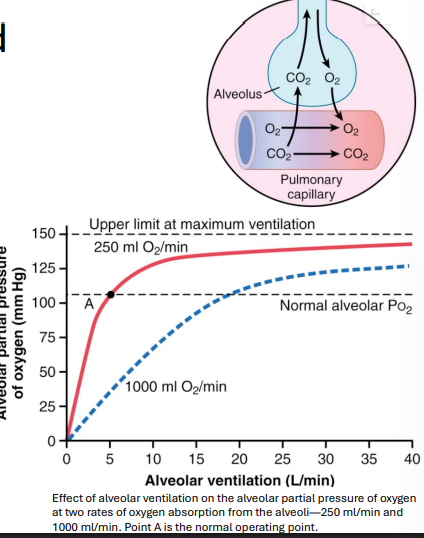
O2 concentration in the alveoli, as well as its partial pressure, is controlled by
The rate of absorption of O2 into the blood
The rate of entry of new O2 into the lungs by the ventilatory process

Take home from graph:
During exercise→ alveolar ventilation must increase by 4-fold to max normal alveolar PO2
Even with extreme alveolar ventilation, alveolar PO2 won’t increase above 149 mmHg in normal atmospheric air at sea level


Respiratory unit or respiratory lobule?
respiratory bronchiole, alveolar ducts, atria, and alveoli
Couple hundred million
alveolus has an average diameter of about 0.2 millimeter
Respiratory plexus described as
sheet of flowing blood
Components of the respiratory membrane
1. A layer of fluid containing surfactant that lines the alveolus and reduces the surface tension of alveolar fluid
2. The alveolar epithelium, composed of thin epithelial cells
3. An epithelial basement membrane
4. A thin interstitial space between the alveolar epithelium and capillary membrane
5. A capillary basement membrane that in many places fuses with the alveolar epithelial basement membrane
6. The capillary endothelial membrane
Average diameter of capillary
5 Um
RBC’s squeeze thru, literally touching capillary wall
Factors Affecting Rate of Gas Diffusion Through the Respiratory Membrane
Thickness of the membrane
Diseases; edema build-up in interstitial space, fibrosis
Surface area of the membrane
Decreased by: lung removal, emphysema
Diffusion coefficient of the gas in the substance of the membrane
Partial pressure difference of the gas between the two sides of the membrane
Alveolar air is diluted compared to atmospheric air • True • False
True
An animal is experiencing hyperventilation, increases respiratory rate. What is this doing to their alveolar air turn-over?
Alveolar air turn-over is not influenced by respiratory rate
Alveolar air turn-over is increased
Alveolar air turn-over is decreased
Not enough information given
• Alveolar air turn-over is increased
What controls O2 concentration and partial pressure in the alveoli?
The rate of absorption of O2 into the blood
The rate of entry of new O2 into the lungs by the ventilatory process
Both A and B
• Both A and B
If you want to measure the alveolar concentration of gases, what part of exhalation would you collect?
• First 25% •
First 50% •
Last portion after forced expiration
All of expiration
• Last portion after forced expiration
Of the 6 components of the respiratory membrane, which one is first on the alveolar side (lowers the surface tension)?
• Surfactant
partial pressure of gaseous O2 in alveolus? in venous blood entering pulmonary capillary at arterial end (lung)?
in venous blood entering pulmonary capillary at arterial end: 40 mmHg
in alveolus: 104mmHg
64 mmHg difference, blood enters lungs with low partial pressure of O2
diffusion moves O2 into blood quickly, before blood has moved 1/3 of the way through the capillary its at 104mmHg
blood stays in blood capillary 3x longer than needed (safety factor)
if something slows down oxygen transfer, we still have extra capillary time

Uptake of oxygen by the pulmonary blood during exercise?
need way more O2, can require up to 20x the normal amount along with increased cardiac output
reduces time blood remains in the blood capillary
safety factor during exercise
capillary recruitment in zone 1 or 2 to increase surface area
capillary distension meaning capillaries become wider and open up
all the above provides bandwidth to allow for full blood oxygen to occur
How much blood passes thru the alveolar capillaries?
98%
what is shunt flow? partial pressure of O2 there?
blood bypassing the gas exchange areas
P O2 of 40 mmHg
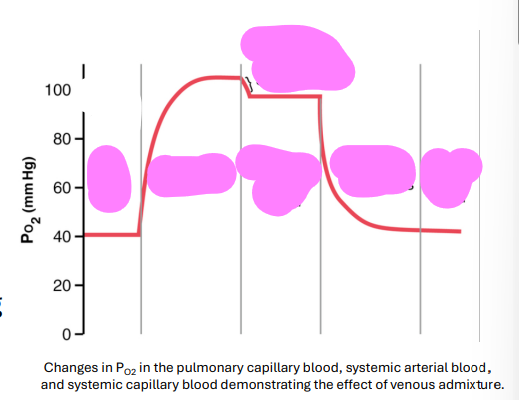
describe graph
Venous admixture of blood causes PO2 to fall to 95 mmHg

How does interstitial PO2 increase?
blood flow
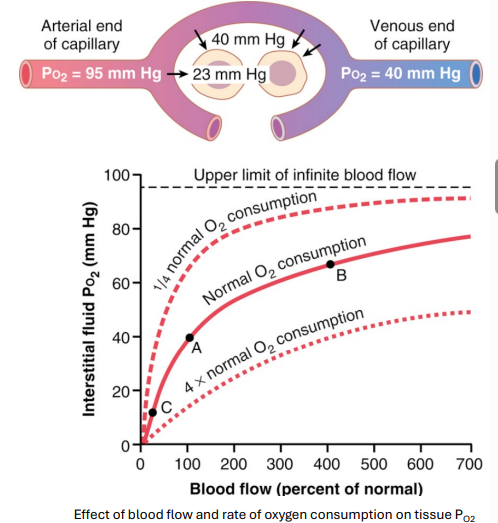
explain this
40 mmHg → 60 mmHg needs 400x blood flow (A →B, red line)
Conversely, if blood flow decreases, PO2 decreases (C) • Increasing tissue metabolism decreases interstitial PO2
why is intracellular P O2 variable? whats the intracellular P O2 range then?
because of the distance between capillaries and tissues
ranges from 5-40 mmHg, averaging 23 mmHg
1-3 mmHg needed for full support of chemical processes
Diffusion of CO2
directly opposite of O2 diffusion
only difference is that CO2 can diffuse


Effect of Tissue Metabolism and Tissue Blood Flow Rate on Interstitial PCO 2
Tissue capillary blood flow and tissue metabolism affect the PCO2 in ways exactly opposite to their effect on tissue PO2
Specific highlights:
25% decrease in blood flow (A →B) results in 15 mmHg elevation of PCO2
Increasing blood flow 6x (A→C) reduces PCO2 to 40 mmHg
10x increase in metabolism elevates interstitial PCO2 at all rates of blood flow
how is oxygen transported under normal circumstances
97% of oxygen is transported by chemical combination with hemoglobin in RBC’s
function of RBC
Primary function is to transport hemoglobin
Some animals and invertebrates use free hemoglobin
4 Heme chains → iron + 4 pyrrole rings
Carbonic anhydrase
Diameter averages 7.8 um, thickness 2.3 um but 1 um in middle
Highly deformable
Iron oxidation state
Ferrous state (Fe2+)
what happens when PO2 is high?
oxygen binds to heme and vise versa- when PO2 is low, oxygen is released
1.34 mL of O2/1 gram of hemoglobin
hemoglobin’s relationship
loosely bond
reversible
percent saturation of hemoglobin
97% leaving the lungs
76% returning from tissue


utilization coefficient
percentage of the blood that gives up its O2 as it passes through the tissue capillaries
Normal value = 25% •
can go up to 75-85%
what causes the graph to shift to the right and down? what does it mean?
increased H+, CO2, temp, BPG (upregulated with high altitude, chronic hypoxia/anemia, pregnancy)
means more O2 is offloaded given the same PO2

hemoglobin as a buffer
is a tissue oxygen buffer
during heavy exercise, extra amounts of O2 (up to 20x) must be delivered from hemoglobin to tissues, but van be achieved with little decrease in tissue PO2 bc steep disassociation curve
Thus, a very small fall in PO 2 causes large amounts of extra O2 to be released from hemoglobin. Hemoglobin in the blood automatically delivers O2 to the tissues at a pressure that is held rather tightly between about 15 and 40 mm Hg.
Consequently, the level of alveolar O2 may vary greatly, from 60 to more than 500 mm Hg PO 2, and still the PO 2 in the peripheral tissues does not vary more than a few milliliters from normal, demonstrating the tissue “oxygen buffer” function of the blood hemoglobin system
high PO2= hemoglobin holds o2
low Po2= hemoglobin lets go of PO2
In a normal resting pulmonary capillary, how long will it take for the blood to be saturated with oxygen?
33%
50 %
75%
All the way thru
33%
Why does the systemic PO2 average 95 mmHg and not the 104 mmHg of atmospheric air?
Diffusion distance is too small
Surface area is too large
Blood flow is too slow thru capillaries
Systemic blood is a venous admixture
• Systemic blood is a venous admixture
What is typical venous PO2 in a dog? •
04 mmHg
95 mmHg
40 mmHg
15 mmHg
• 40 mmHg
CO2 does not need the partial pressure differences of O2 because it diffuse faster
True
False
Capillary osmotic pressure
A and B
True
What is the effect of increased blood flow on PCO2 in interstitial fluid? -
Increases it
Decreases it
Doesn’t change it
Not enough information given
• Decreases it
What are the function(s) of RBC’s?
Transport hemoglobin
Enzymatic action of carbonic anhydrase
Serve as immune cells
A and B
A and B
Given a PO2 of 40 mmHg, what would oxygen saturation be?
90%
75%
20%
None of the above
75%

An animal is heavily exercising but cannot increase their blood flow to those muscles. Assuming everything else is healthy, which statement is correct?
Oxygen delivery would decrease without increased blood flow
Hemoglobin saturation would remain the same
The fall in interstitial PO2 would cause increased offloading of oxygen from hemoglobin
All of the above
The fall in interstitial PO2 would cause increased offloading of oxygen from hemoglobin
What are the force(s) that cause a rightward and downward shift of the hemoglobin/oxygen dissociation curve?
Increased H+
Increased BPG
Increased CO2
Decreased Temperature
everything except Decreased Temperature
Hemoglobin does not act a buffer, which we can derive as the variation in alveolar PO2 is mimicked in the PO2 of the tissues.
True • False
F

interpret
Movement of Carbon Dioxide – RBC’s
Co2 can typically be transported in far greater quantities than O2
Under normal resting conditions, an average of 4 ml of CO 2 are transported from the tissues to the lungs in each 100 ml of blood.
Steps of CO2 removal from tissue
Dissolves easily in molecular form from cells
Upon entering capillaries, most of carbon dioxide undergoes instantaneous physical and chemical reactions
Acetazolamide
is a diuretic and antiglaucoma agent
t is also a carbonic anhydrase inhibitor
Can lead to hyperchloremic metabolic acidosis and potential acidemia in dogs
Movement of Carbon Dioxide – Carbaminohemoglobin
In addition to reacting with water, CO2 reacts directly with amine radicals of the hemoglobin molecule
Forms carbaminohemoglobin (CO2Hgb)
A small amount of CO2 also reacts in the same way with the plasma proteins in tissue capillaries.
Taken together, the RBC’s are generally responsible for CO2 transport, with 70% being via carbonic anhydrase and 23% being Hb itself (bottom right of figure)

interpret

haldane effect
reverse of bohr effect (where increasing CO2 in blood displaces O2 from hemoglobin)
The binding of O2 with hemoglobin tends to displace CO2 from the blood
occurring in the lungs
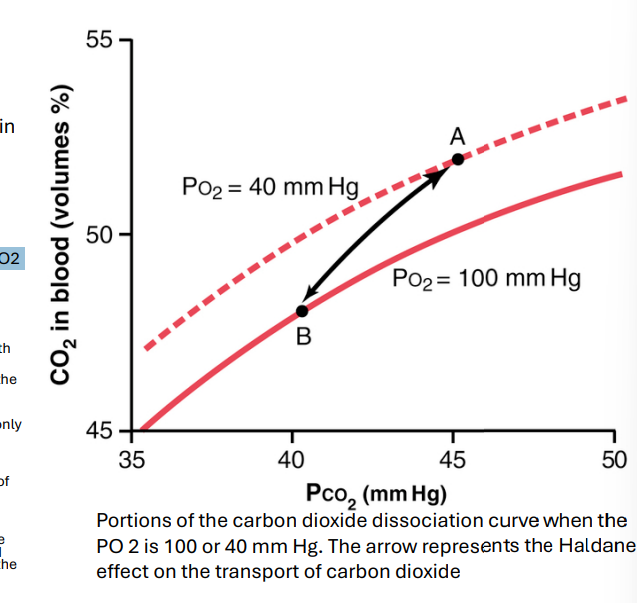
interpret this
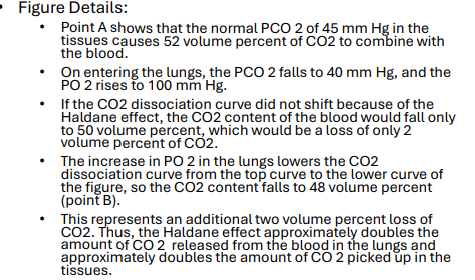
respiratory exchange ratio
The ratio of CO2 output to O2 uptake
aka RER
changes under metabolism conditions
carbs drive RER toward 1
fats drive RER toward 0.7
Diffusion limited
cells are rarely more than 50 um from a capillary to avoid this condition, usually occurs in pathological states
Blood-flow limited
if blood flow rate falls to zero, available o2 also falls to zero

interpret
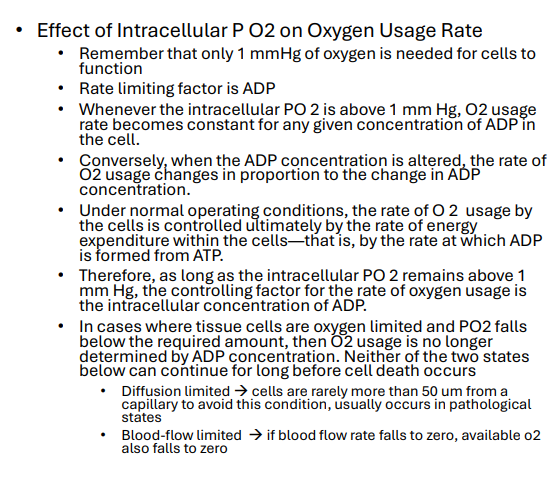

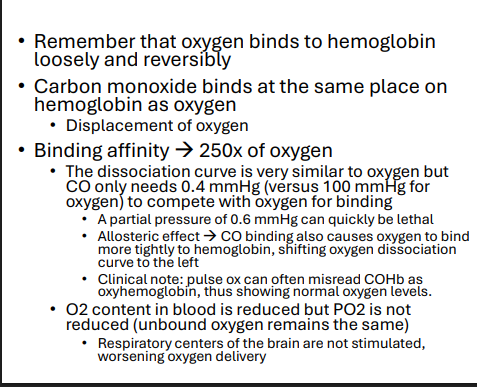
Displacement of Oxygen from Hemoglobin – Carbon Monoxide: Interpret

What is the rate limiting step in healthy animals for rate of oxygen usage?
ATP
ADP
AMP
Carbonic anhydrase
ADP
Why does carbon monoxide displace oxygen from hemoglobin? •
Higher affinity
Loosens oxygen bonds to hemoglobin
Binds to a different binding site than oxygen
All of the above
• Higher affinity
What is the primary mechanism whereby carbon dioxide is transported?
Dissolved in molecular form
Converted by carbonic anhydrase
Bound to hemoglobin
None of the above
• Converted by carbonic anhydrase
What is the term used to describe that binding of O2 with hemoglobin tends to displace CO2 from the blood?
Bohr Effect
Boring effect
Haldane Effect
Shunt effect
• Haldane Effect