106 🥀
 Call Kai
 Learn
 Practice Test
 Spaced Repetition
 Match
 Flashcards
 Knowt Play
1/18

There's no tags or description
Looks like no tags are added yet.
19 Terms
What is the impulse response?
The response to a brief, pulsatile input
What are the three types of stability? Describe them
Stable: oscillations die out over time
Marginally stable: oscillations continue forever
Unstable: oscillations grow over time
How does the transfer function determine stability?
The roots of the denominator of the transfer function are the poles, which directly determine stability depending on their signage and realness
Unstable if positive real and positive imaginary (Q1)
Stable if negative real and positive imaginary (Q2)
No oscillation if on x axis
Becomes increasingly marginally stable as you move closer to y axis
How do you fix the forever-oscillating problem?
Add damping with control law
What are two ways you can sense angular velocity?
Use a tachometer
Use a position sensor (analog or digital) and differentiate it
What is the damping ratio?

What happens as you increase damping ratio?
The system oscillates less. It kind of looks like the system is being squashed a bit

Describe underdamped, critically damped, and overdamped
Underdamped: the amplitude overshoots initially and the amplitude gradually decreases to zero (zeta<1)
Critically damped: returns as quickly as possible to equilibrium (zeta=1)
Overdamped: returns to equilibrium without oscillating (zeta>1)
What does a PD controller do?
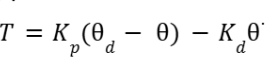
Stabilizes systems by controlling current error (proportional) and the rate of change of that error (derivative).
Acts like a virtual sprint and damper to reduce overshoot and damp oscillations, therefore speed up the settling time.
What are the closed loop dynamics of a PD position controlled mass?

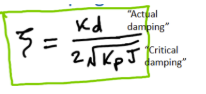
What is the equation for damping ratio?
zeta = actual damping (Kd) / critical damping
What is the equation for natural frequency?
Note: there is no K_d factor because this is natural! No forced damping

What is the equation for damped natural frequency?
Technically the most complicated but we simplify it by just writing zeta instead of the whole equation

What type of damping results in the fastest response?
Critical damping
What is the 5% settling criterion?
A second-order underdamped system settles to within 5% of its final value after a time elapsed of 3 time constants
Which order systems oscillate?
Only second order
A low pass starts __ and ends __.
Starts high and ends low
If you increase Kp, what happens to the rise time?
It decreases
If you increase Kd, what happens to the overshoot?
It decreases