CPSC 253: Lecture 9-10 Malware, Viruses, and Worms
 Call Kai
 Learn
 Practice Test
 Spaced Repetition
 Match
 Flashcards
 Knowt Play
1/62

There's no tags or description
Looks like no tags are added yet.
63 Terms
Mobile Malcode
Malicious programs that spread from machine to machine without the consent of the owners/operators/users
Strains include:
Viruses
Worms
Compromised auto-updates
Trapdoors/Backdoors
Secret entry point into a program
Allows those who know access bypassing usual security procedures, e.g., authentications
Have been commonly used by developers
A threat when left in production programs allowing exploited by attackers
Very hard to block in O/S
Requires good s/w development & update
What types of malicious programs need a host?
Trapdoors
Logic Bombs
Trojan horses
Viruses(can replicate)
Logic Bomb
One of oldest types of malicious software
Code embedded in legitimate program
Activated when specified conditions met
When triggered, typically damages system
Modify/delete files/disk
Viruses
A piece of code that inserts itself into a host, including operating systems, to propagate. It cannot run independently. It requires that its host program be run to activate it.
Only spread when contaminated files are moved from machine to machine
Mature defenses available
Executing viruses
Searches for valid target files
Usually, executable files
Often only infect uninfected files
Insert a copy into targeted files
When the target is executed, the virus starts running
Key Malware Statistics
560,000 new pieces of malware are detected every day.
There are now more than 1 billion malware programs out there.
Every minute, four companies fall victim to ransomware attacks.
Trojans account for 58% of all computer malware.
Virus phases
Dormant – waiting on trigger event
Propagation – replicating to programs/disks
Triggering – by event to execute payload
Execution – of payload
Details of virus operations
Machine/os specific
Based on Instruction set architecture(ISA)
Opcode | Operand
Opcode is stored locally in a register→ memory
Primary components of a Virus
Propagation mechanism
Payload
Propagation
Method by which the virus spreads itself.
Old days: single PC, transferred to other hosts by ways of floppy diskettes or disks.
Nowadays: Internet.

Virus Compression
CV is the virus
t1 shows proprogation
Virus Infectables - Macros
Usually executable files: .com, .exe, .bat
Macro code attached to some data file
Interpreted by program using file
E.g., Word/Excel macros
Especially using auto command & command macros
Code is now platform independent
Is a major source of new viral infections
Blur distinction between data and program files
Classic trade-off: “ease of use” vs “security”
Have improved security in Word etc.
Are no longer dominant virus threat
System sector viruses
Infect control sectors on a disk
DOS boot sectors
Partition (MBR) sectors
Spread easily via disk transfers and infections
Companion viruses
Create a .com files for each .exe files
DOS runs COM files before EXE files
Relatively easy to find and eliminate
Cluster viruses
Change the DOS directory info so that directory entries point to the virus code instead of the real program
Even though every program on the disk may be "infected“, there is only one copy of the virus on the disk
Polymorphic viruses
Change with each infection
Executables virus code changing (macros: var name, line spacing, etc.)
Control flow permutations (rearrange code with goto’s)
Attempt to defeat scanners
Virus writing tool kits
Current ones create viruses that can be detected easily with existing scanner technology
Virus Detection/Evasion
Look for changes in size
Check time stamp on file
Look for bad behavior/do bad thing insidiously
False alarm prone
Look for patterns (byte streams) in virus code that are unique
Look for changes in file check sum
Compression of virus and target code
Modify time stamp to original
Change patterns – polymorphism
Rearrange data in the file
Disable anti-virus programs
Scanning
Virus Detection
Depend on prior knowledge of a virus
Check programs before execution
Need to be regularly updated
Integrity checking
Read entire disk and record integrity data that acts as a signature for the files and system sectors(parity check)
Use cryptographic computation technique instead of simple checksum
Interception
Monitoring for system-level routines that perform destructive acts
Good for detecting logic bomb and Trojan horse
Cannot depend entirely upon behavior monitors as they are easily bypassed
Virus Recovery
Extricate the virus from the infected file to leave the original behind
Remove the redirection(cluster) to the virus code
Recover the file from backup
Delete the files and move on with life
Apple’s 3 wild viruses
1981
Boot sector(where necessary files and drivers are contained to start the operating system) viruses
Floppies of that time had the Disk Operating System (DOS) on them by default
Pakistani Brain Virus(1986)
Written by Pakistani brothers to protect their copyright
Claim: infect only machines that had an unlicensed copy of their software
Boot sector, memory resident
Printed
Chernobyl Virus(1998)
Destructive virus designed to inflict harm
Flash BIOS: would cause permanent hardware damage to vulnerable motherboards
Also overwrote first 2K sectors of each disk
Typically resulted in a loss of data and made it unbootable
Previously believed that being benign was necessary for virus longevity
This provided evidence to the contrary
Melissa(1999)
Microsoft Word 97 Macro virus
Worm
Targeted the first 50 entries in Outlook’s address book
Adjusted subject “Important messages from ______”, ILOVEYOU, Homepage
Points to attachment as a document requested
Contains a list of porn sites
Macro security was greatly increased with Melissa
Virus Detection
Combining scanning, integrity checking, and interception can detect most viruses
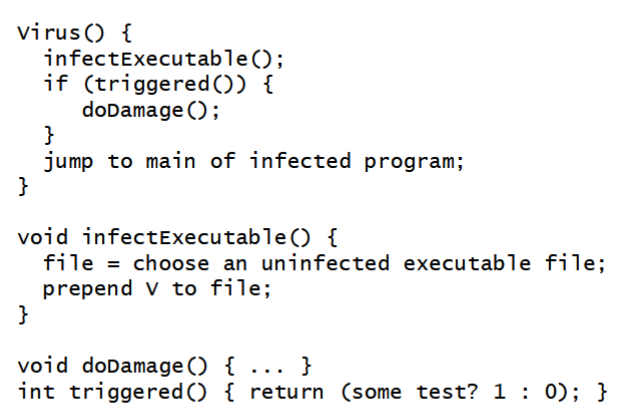
What is this image showing?
Structure of a Virus
Virus Statistics
1988: Less than 10 known viruses
1990: New virus found every day
1993: 10-30 new viruses per week
1999: 45,000 viruses and variants
Possible activation conditions for logic bombs
Presence/absence of some file
Particular date/time
Particular user
Particular series of keystrokes
Trojan Horse
Programs that appear to have one function but actually perform another.
Modern Variant: resembles a program that the user wishes to run - usually superficially attractive
E.g., game, s/w upgrade etc
When run, performs some additional tasks
Allows attacker to indirectly gain access they do not have directly
Often used to propagate a virus/worm or install a backdoor
Or simply to destroy data
Zombie
Program which secretly takes over another networked computer
Then uses it to indirectly launch attacks
Often used to launch distributed denial of service (DDoS) attacks
Exploits known flaws in network systems
Worms
Autonomous, active code that can replicate to remote hosts without any triggering
Replicating but not infecting programs
Because they propagate autonomously, they can spread much more quickly than viruses!
Speed and general lack of user interaction make them the most significant threats
Payload
Executable containing malicious code in malware
Port Scanning
Target discovery method
Sequential: working through an address block
Random
Target lists
Target discovery method
Externally generated through Meta servers
Internal target list
Passive worms
I/O modules
Disk
Network controller
Metaserver Worms
A server for information about other servers
Games: Use as a matchmaker for local servers
Google: Query google to find web servers
Windows Active Directory: Maintains the "Network Neighborhood"
Query types
Select
Action
Self-Carried
Worm transmits itself as a part of the infection
What types of malicious programs are independent(no host program)?
Worms
Zombies
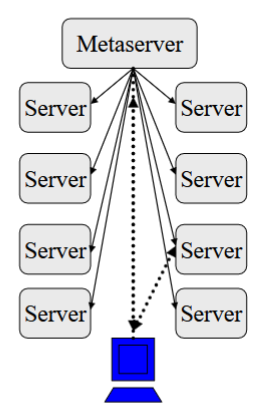
How do worms use metaservers?
Construct a query to find new targets
Each new victim also constructs queries
Creates a divide-and-conquer infection strategy
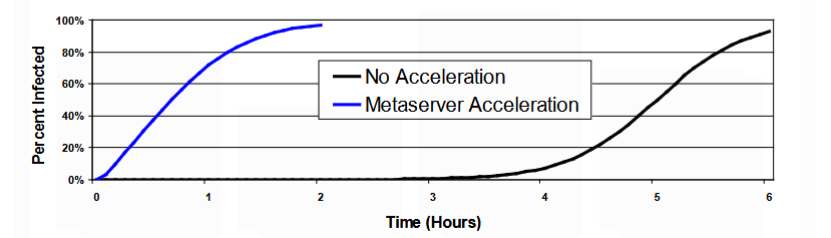
How fast are metaserver worms?
Game Metaserver: Use to attack a small to large population
~1 minute to infect all targets
Google: Use to enhance a scanning type of this program
Each of this program type conducts initial queries to find URLs
Internal Target Lists: Topological Information
Look for local info to find new targets
URLs on disks and caches
Mail addresses
.ssh/known hosts
Ubiquitous in mail worms
New ones are more aggressive with finding new addresses
Basis of the Morris worm(1988)
Address space was too sparse for scanning to work
How fast are topological worms?
Depends on the topology G = (V, E)
Vulnerable machines are vertices, edges are local information
Time to infect is a function of the shortest paths from the initial point of infection
Passive Worms
Waits for info about other targets
E.g., CRclean, Nimda
Speed depends on normal communication traffic, highly variable
High Stealth
Have to detect the act of infection, not target selection
Second Channel
E.g.: A blaster worm using RPC(Remote procedure call) to exploit but use TFTP(Trivial file transfer protocol) to download the whole virus body
Types of worm activation
Human
Human activity-based
Scheduled process
Self
Human Activation
Needs social engineering, especially for email worms
E.g. Melissa – “Attached is an important message for you!”
E.g. Iloveyou – “Open this message to see who loves you!”
Human activity based activation
E.g. logging in, rebooting (Nimda’s secondary propagation)
Scheduled process activation
E.g. updates, backup etc.
Self-activiation
E.g. Code Red exploit the web servers
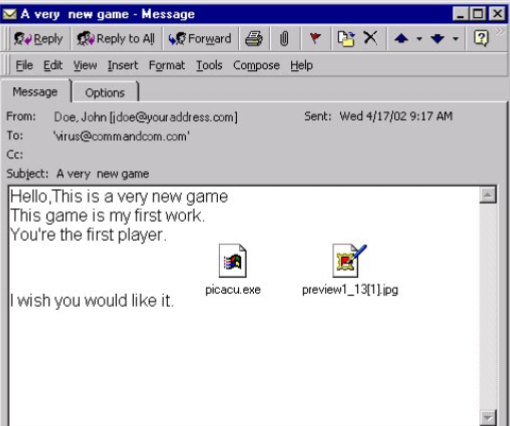
What is this image showing?
Klez worm
Attacker motivations
Experimental Curiosity, e.g., I Love You worm
Pride and Power
Commercial Advantage
Extortion and Criminal Gain
Terrorism
Cyber Warfare
Morris Worm
1988
Strategy: Topological
Victims: 6000
First major autonomous worm. Attacked multiple vulnerabilities.
Code Red worm
2001
Strategy: Scanning
Victims: 300000
First recent "fast" worm, 2nd wave infected 360,000 servers in 14 hours
CRClean Worm
2001
Strategy: Passive
Victims: None
Unreleased Anti-code-red worm
Nimda Worm
2001
Strategy: Scanning IIS, Code Red 2 backdoor, etc
Victims: 200000
Local subnet scanning mixing techniques
Scalper worm
2002
Strategy: Scanning
Victims: 10000
Released 10 days after vulnerability revealed
Slammer Worm
2003
Strategy: Scanning
Victims: 75000
Spread worldwide in 10 minutes

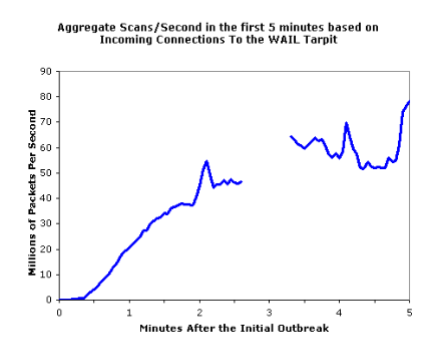
How fast was the slammer worm?
Infected ~75,000 machines in 10 minutes
Full scanning rate in ~3 minutes
>55 Million IPs/s
Initial doubling rate was about every 8.5 seconds
Local saturations occur in <1 minute