Cell Biology Genes and Chromosomes
 Call Kai
 Learn
 Practice Test
 Spaced Repetition
 Match
 Flashcards
 Knowt Play
1/53

There's no tags or description
Looks like no tags are added yet.
54 Terms
Genes
Full DNA sequence required for synthesis of functional protein or RNA
Exons
coding regions of genes
Introns
noncoding regions of genes
Enhancer Sites
region of gene that controls transcription
Single mRNA
transcribed from operon
Beginning of each coding region
ribosomes start translation at
several
how many polypeptides are produced from a single mRNA
Polycistronic
A single mRNA molecule that contains the coding sequence for two or more different proteins
A single mutation can affect expression of several proteins
consequence of polycistronic mRNA
monocistronic
single mRNA encodes a single protein (Eukaryotic)
Alternate Poly (A) Sites
A way that multicellular organisms process mRNA to produce slightly different proteins (Same 5’ exons, different 3’)

Exon Skipping
A way that multicellular organisms process mRNA to produce slightly different proteins (same 5’ and 3’, different internal exon)
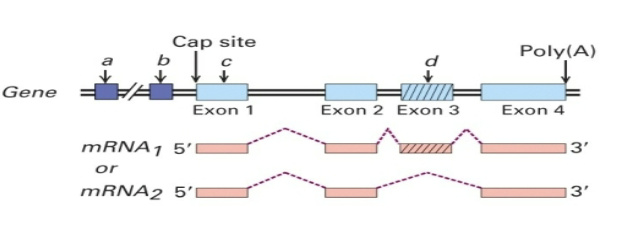
Solitary
When genes are singly represented in the genome
Duplicated
when genes exist as repeats in the genome
Gene Family
type of repeated gene, encode proteins with similar not identical AAs sequence
Kinases and Immunoglobulins
example of gene family
Tandemly Repeated Sequences
type of repeated gene, genes that encode rRNAs, tRNAs, and histones, encodes identical proteins
Repetitious DNA
Type of repeated gene, 2 main types, simple sequence DNA and mobile DNA or moderately repeated.
1-500 bp sequences
simple sequence DNA consists of different set of repeats of
Satellite DNA
Simple sequence DNA repeats that stretch to 100 kb long
Minisatellites
Simple sequence DNA repeats that stretch to 1-5 kb long
Near centromere
most simple sequence DNA is located
particular chromosome
Some simple sequence DNA is specific to a
Basis for DNA fingerprinting technology
the number of repeats for some simple sequence DNA being unique to each individual is the
Simple Sequence DNA
the function of this DNA is unknown
Transposition
when mobile DNA segments can be inserted into new sites in the genome
DNA (Transposon)
Mobile DNA may transpose as
RNA Intermediate
Mobile DNA may also transpose as
Reverse Transcriptase
converts RNA to DNA
Viral
Type of retrotransposon that encodes reverse transcriptase and integrase
Nonviral
type of retrotransposon that’s most common, lines and sines
Lines (L1 Family))
Type of nonverbal retrotransposon, codes for DNA binding proteins and reverse transcriptase.
SINES
Type of nonverbal retrotransposon, Alu sequences, do not code for any protein.
Mobile DNA
Has no known function
Inherited Recessive Diseases
LINE and SINE sequences inserted into exons linked to
Hemophilia
LINE causes
Neurofibroma
SINE causes
Proteins
DNA exists in a highly compact conformation associated with equal mass of … (Chromatin)
Histones
most abundant proteins are … (family of proteins in all eukaryotes)
H1, H2A, H2B, H3, and H4
5 major types of histones
Extended
Form of chromatin, resembles beads on a string, (Bead, nucleosome)
2
Extended chromatin consists of 147bp of DNA wrapped around … copies of H2A, H2b, H3, and H4
Linker DNA
Extended chromatin is connected by
Actively being transcribed
Chromatin that is … assumes extended conformation
Condensed
Form of chromatin, consisted of nucleosomes packing into a spiral conformation.
Solenoid Structure
In condensed chromatin, H1 is bound outside of each nucleosome and it thought to help stabilize the
Scaffold-associated regions (SARs)
In condensed chromatin, 30 nm fiber is looped and attached to protein scaffold at … to produce metaphase
not being transcribed
Chromatin … exists in condensed conformation
Origin
site of initiation of DNA replication, yeast autonomously replicating sequences. Required for replication and stable inheritance of chromosomes.
Centromere
needed for separation of sister chromatids during mitosis. Required for replication and stable inheritance of chromosomes.
Telomere
multiple, tandem repeats of short sequence at end of eukaryotic chromosome.
Telomerase
Telomeres are produced by modified reverse transcriptase called
RNA template that is part of the enzyme
Telomerase adds nucleotides to the 3’ hydroxyl end of lagging strand template directed by a
Telemerase
prevents progressive shortening of lagging strand