Discrete Test 3
 Call Kai
 Learn
 Practice Test
 Spaced Repetition
 Match
 Flashcards
 Knowt Play
1/20

There's no tags or description
Looks like no tags are added yet.
21 Terms
Stars and Bars
(n+k-1 choose k-1)
n = objects
k = types
*think: choosing boundaries, so k-1
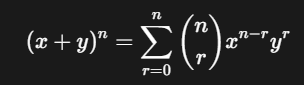
Binomial Theorem
Bayes Theorem
OG Formula, use if P(B) given

Expanded Bayes Theorem
If P(B) not given, then use this one

Total Probability
P(A) = P(A|B)P(B) + P(A|B^c)P(B^c)
Monty Hall Table
Your Choice, Winning Choice, Host Opened, Stick, Switch
1, 1, 2 or 3, win, loose
…
Tip for Injective/Surjective Questions
Injective: Assume f(x)=f(y) and deduce x=y. Factor, simplify, or use properties of the function.
Surjective: Start with an arbitrary y, solve f(x)=y for x, and verify x is in the domain.
Ex: start with x³ = y → x = cbrt(y) the f(x) = (cbrt(y))³ = y
Inverse: Solve y=f(x) for x in terms of y, then swap variables.
Ex: y = x³ → x = cbrt(y) → A-1 = cbrt(x)
[25] \ T
all elements of [25] that aren’t in T
Important Property:
** [n]∖([n]∖T)=T
Ways of Ordering
n!
Automorphism
Just a relabeling of vertices (can’t change edges).
Or a REORDERING if you will, so for a complete graph you permute n! ways.
Set sizes (S and T)
Injective: |S| <= |T|
Surjective: |S| >= |T|
Bijective: |S| = |T|
Permutation Formula
ordered selections of n distinct items from k
P(n,k) = n! / (n-k)!
Combination Formula
(n choose k) = n! / k!(n-k)!
Counting functions formula
|A| = n, |B| = m
so mn ways
Counting Injective Functions
|A| = n, |B| = m
m * (m-1) * (m-2) * … * (m - n + 1) = n! / (m-n)!
or # of permutations (in other words)
!! Make sure |A| < |B| first
Counting Bijection Functions
|A| = |B| = n, so n = m
n! (m - n)! => n!
Counting Surjective Functions
Start with all functions.
Subtract those that miss some particular element.
But functions missing two elements got subtracted twice, so add those back.
Then you've over-corrected for functions missing three, so subtract again...
Inclusion-Exclusion
Formal Definition of Injective
f is injective for all a1, a2 in A if f(a1) = f(a2) then a1 = a2
NOT: f is not injective if there exists an a1, a2 in A such that f(a1) = f(a2) and a1 NOT = a2
Formal Function of Surjective
f is surjective if for all b in B there exists an a in A such that f(a) = b
NOT: if there exists a b in B such that for all a in A, f(a) NOT = b
E[X] = E[x1 + x2 + .. + xn]
= E[x1] + E[x2] + … + E[xn] Fr
Formal Definition of Automorphism
A bijective function such that for all uv, in V(G) {u,v} in E(G) iff {f(u), f(v) in E(G)