Lecture 6 - Ion flux and the resting membrane potential
 Call Kai
 Learn
 Practice Test
 Spaced Repetition
 Match
 Flashcards
 Knowt Play
1/10

There's no tags or description
Looks like no tags are added yet.
11 Terms
How is the neuronal cell membrane set up?
thin clouds of positive and negative ions spread over the outer and inner surface
at rest, extracellular surface of membrane has excess of positive charge and the cytoplasmic surface has an excess of negative charge
charge separation allows for difference in electrical potential or voltage across cell membrane
What is membrane potential?
the difference in voltage across the cell membrane
resting membrane potential = -60 to -70 mV
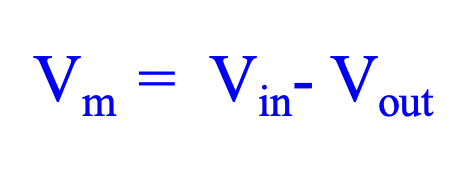
How do you record Vm?
glass micropipettes filled with saline and placed in the same extracellular solution
voltage amplifier and oscilloscope records 0V
then when resting potential is recorded, measure -60Vm
see this because the electrode is moving from the extracellular fluid into the intracellular fluid, crossing a selectively permeable membrane that maintains an unequal distribution of ions
What is the Goldman-Hodgkin-Katz equation?
a modification of the Nernst equation which takes into account that cell membranes are permeable to more than one ion
more accurate calculation of voltage difference across the membrane

What does GHK equation show us relative to NERNST?
Driving force of an ion will try to force Vm towards Eion
thats why Na moves in and K moves out
How do ionic species that cannot cross the membrane (A-) affect Vm?
since charged macromolecules cannot leave cell, cell at danger of influx of positively charged sodium ions, followed by water
can cause swelling and rupture
electrochemical equilibrium must be considered together with osmotic balance because imbalance of impermeant solute can drive water into cell
What is Gibbs-Donnan Equilibrium
when diffusible solutes are separated by membrane that is freely permeable to water and electrolytes but impermeable to one ionic species, causing solutes to be unequally distributed between two compartments to establish new equilibrium
e.g. experiment adding KCl and KA

What are the conditions for Gibbs-Donnan Equilibrium?
concentration of cations should be equal to concentration of anions in the ECF to maintain charge balance (same applies for ICF)
Product of concentration of permeant ions outside the cell must be equal to inside the cell
There is one membrane potential: Em=Ek=ECl
How does Na/K pump prevent osmotic catastrophe of a cell?
prevents water from inundating interior of cell by pumping out Na+ to counter effect of impermeable anions
as a result, maintain osmotic equilibrium
process requires ATP so we refer to cells as being at steady state when there is no net ion flux at equilibrium
How did cyanide result in poisoning in Tylenol scare?
cyanide interrupts sodium potassium pumps ability to maintain cell volume
after deaths, led to reform of packaging of over-the-counter medication
institution of anti-tampering laws

What’s to stop the ionic gradients from dissipating by the diffusion rates of the ions across a cell membrane when the cell is at rest?
Active transport by the sodium-potassium pump is able to counterbalance the rate of leakage across a cell membrane so that the resting membrane potential is maintained at ~ -70 mV
This pump is fueled by ATP to enable a steady state of no net ion flux
so pump prevents dissipation of ionic gradients when cell is at rest AND maintains osmolarity