Flipped Lecture 9: Integrated Rate Laws
 Call Kai
 Learn
 Practice Test
 Spaced Repetition
 Match
 Flashcards
 Knowt Play
1/15

There's no tags or description
Looks like no tags are added yet.
16 Terms
Compare the differential rate law to the integrated rate law.
While the differential rate law relates rate to the concentration of reactants, the integrated rate law expresses concentration as a function of time.
The integrated rate laws are all written in the form of…
a straight line equation y = mx + b
The integrated rate law for a zero-order reaction is:
Describe each variable
[A]t is the concentration of A at time t
[A]0 is the initial concentration of A
k is the first-order rate constant

What kind of plot gives a straight line for a zero-order reaction? Describe axes.
What is the slope and what is the y-intercept?
[A] (y-axis) against time (x-axis)
The slope is -k and the y-intercept is [A]0.
The integrated rate law for a first-order reaction is:
(2 forms of the equation)
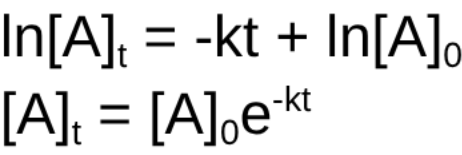
What kind of plot gives a straight line for a first-order reaction? Describe axes.
What is the slope and what is the y-intercept?
ln[A] (y-axis) against time (x-axis)
The slope is -k and the y-intercept is ln[A]0.
The integrated rate law for a second-order reaction is:

What kind of plot gives a straight line for a second-order reaction? Describe axes.
What is the slope and what is the y-intercept?
1/[A] (y-axis) against time (x-axis)
The slope is k and the y-intercept is 1/[A]0.
Describe the relationship between concentration and time for a zero-order reaction, first-order reaction, and second-order reaction.
For a zero-order reaction, concentration decays linearly with time.
For a first-order reaction, concentration decays exponentially with time.
For a second-order reaction, concentration decays along an inverse curve with time.
What is half-life? How is it denoted?
Half-life, t1/2, is the time it takes for concentration to decrease by half its initial value.
What is the general expression for half-life, for zero-order reactions?
t1/2 = [A]0/2k
What is the general expression for half-life, for first-order reactions?
t1/2 = ln(2)/k
or t1/2 = 0.693/k
What is the general expression for half-life, for second-order reactions?
t1/2 = 1/k[A]0
Describe the relationship between concentration and half-life for a zero-order reaction, first-order reaction, and second-order reaction.
For zero-order reactions, half-life decreases as reactant concentration decreases (directly related).
For first-order reactions, half-life is independent (not affected) of reactant concentration.
For second-order reactions, half-life increases as reactant concentration decreases (inversely related).
What is the relationship between half-life and reaction rate?
Inverse relationship
As half-life decreases, reaction rate increases.
Given the reaction 2A → B:
If the rate constant of the overall reaction is k, what is the rate of the disappearance of A?
2k