microbiology chapter 1
 Call Kai
 Learn
Learn Practice Test
 Spaced Repetition
 Match
Match Flashcards
 Knowt Play
1/100

There's no tags or description
Looks like no tags are added yet.
Name | Mastery | Learn | Test | Matching | Spaced | Call with Kai | Chat |
|---|
No analytics yet
Send a link to your students to track their progress
101 Terms
biology
study of living things
bios = life
microbiology
the study of living things that are too small to be seen with our naked eyes (microscopic organisms)
we need microscope to see them!
microbes
AKA germs, bugs, viruses, infectious agents,
not all cause disease
not all of them are harmful
many/some of them are useful or essential for human life
are most of the microorgs that exist in nature considered to be pathogenic + harmful to mankind?
microorganisms - where are they found
they are found EVERYWHERE on earth - THEY ARE "Ubiquitous"
AKA germ, microbes
microbe categories
bacteria
fungi
viruses
protozoa
algae
archae
prions
helminths
fields of microbiology (SKIP)
microbe-centered:
bacteriology
phycology
mycology
protozoology
parasitology
virology
process-centered:
microbial metabolism
microbial genetics
environmental microbiology
use of microorganisms
microorganisms (e.g. bacteria) does what for the environment **
decompose organic material of dead organisms + recycle organic material back into the life cycle
manage waste
—> there is northwest ohio dairy that produce electricity with manure!
bioremediation (a decontamination process)
—→ the remediation of contamination with the use of biological agents
produce oxygen + ethanol
—→ e.g. bacteria in manure produces ethanol
WHAT DO WE USE BIOREMEDIATION FOR? (mainly)
when we have oil spill in water, we use net to get rid of big chunks (of trash, floating debris, or think oil sludges) to prevent mechanical equipment from clogging and protect wild life.
but inside of the water, there is still contamination so we will put oil-eating microbes in the water to decontaminate
—> the crude oil that was spilled contains hydrocarbon - this is mixed with water (which contains oxygen)
the oil-eating microbes will break apart the hydrocarbon and combine it with oxygen to create water and CO2
when we are using biological agent to bioremediate smth that we did wrong we have to have control of it cuz we dont want to release smth bad into nature
if we have another problem in nature, we need to use other living things to put right what we did wrong but we have to keep the biological things that we are using under control!
we have to master how we pour the bacteria into the water
which of the following is an example of bioremediation?
a. application of bacteria to a crop to prevent frost damage
b. fixation of gaseous nitrogen into usable nitrogen
c. bacteria using light energy to convert CO2 into organic compounds
d. application of oil-degrading bacteria to an oil spill
e. all of the above
d.
IT IS NOT C BECAUSE THAT IS A NORMAL ECOLOGICAL PROCESS THAT DOES NOT INVOLVE CLEANING UP ENVIRON CONTAM/ WASTE. - it does not say that we put the CO2 there!
how does making electricity from manure work? - THIS IS EG OF BACTERIA USE IN DAILY LIFE
we collect the manure
it is pumped + goes into a chamber
hot water pipes heat manure so the bacteria in the manure release methane gas
the methane gas is sucked out + we use it to produce electricity!
we use the manure as a fertilizer!
microorganisms do what for energy production (she didnt go over it)
produce chemical products such as ethanol, acetone
—→ e.g. bacteria in manure produces ethanol
microorganisms do what for food industry
produce fermented foods such as vinegar, cheese, yogurt, alcoholic beverages, and bread
e.g, yeast needed to make bread
microorganisms do what for manufacturing
they Produce products used in manufacturing (e.g., cellulose)
microorganisms do what for pharmaceutical industry
we can genetically engineer (manipulate their genes) them to produce what we need e.g. vitamins + disease treatment like insulin
probiotics
help us get healthy
we eat them in yoghurt
antibiotics
against life
they kill ONLY BACTERIA
THEY ARE ONLY EFFECTIVE/EFFICIENT AGAINST BACTERIA
antibiotics kill bad bacteria (infection causing bact) and also the good bacteria that our bodies need!
we must restore the good bacteria afterwards!
prebiotics
nutrients that will help our probiotics to get well
elements that we eat for our gut to be well - it feeds the beneficial microorganisms in our gut
why do physicians give antibiotics when you have flu (a virus)
when you are attacked by virus you dont go to physician yet cuz u try to get rid of it yourself
when you cant get rid of the virus yourself, you go to the physician
the virus you cant get rid of already diminished your immune sys
and then the bacteria (whether bad or not bad) are opportunistic
—> when we healthy, those opportunistic bacteria wont do anything cuz we have strong immune sys
—> but when we weakened by virus, the opportunistic bacteria that were not harmful to u when we healthy will take over
thats why we develop fever etc. cuz we cant get rid of THE OPPORTUNISTIC BACTERIA??
so the physician will prescribe antibiotics in order to fight against the opportunistic bacteria so our immune sys can recover better + fight the virus
WHAT CAUSES VIRAL infection
virus
WHAT IS EFFICIENT AGAINST VIRUS **
ANTIVIRAL ONLY
WE HAVE TO REMEMBER SOME OF HOW MICROORGANISMS ARE USED IN DAILY LIFE!
MICROBIOME DEFINITION
a community of diverse microorganisms (e.g. fungi, bacteria, viruses) that exist in a particular environment (+ interact with each other + their specific environment)
this interaction is not static; its dynamic, they will fight, love each other etc.
—> DYNAMIC NATURE HIGHLIGHTS THE IMPORTANCE OF UNDERSTANDING HOW THESE ECOSYSTEM FUNC + RESPOND TO CHANGES
MICROBIAL ECOSYSTEM DEFINITION **
a microbial ecosystem consists of microbiomes
as microbial ecosystems are all microbial communities interacting together along with the environment they interact with!
microbiomes constitutes what
a microbial ecosystem
e.g. we have different types of microorgs depending on the environment e.g. you would not find some microorgs from the forest in the ocean
little friend =
beneficial microorganisms
bad guy =
harmful microorgs
microbiome in humans
HUMAN MICROBIOME = MICROBIOTA - made up of normal microflora
not all bacteria we have in our microbiomes is harmful; some benefit us
normal microflora: normal microorganism inhabitants of the body they are beneficial + help us to have good health
—> some are transient: come + go whereas some colonize body indefinitely
the microorgs species we have in our mouth are not necessarily the same as the microorgs species we have in the dig sys, skin, or urogentals
—→ this is because all microorgs need a special enviro to grow; they all have different needs
—→ so the microbial ecosys we have in our mouth is probs different from the microbial ecosys we have in other places, but we can find some microbe species that exist in 2 diff places
the normal microflora in human microbiome/microbiota can:
prevent the growth of pathogenic microbes
can help train the immune system to discriminate threats
—> the immune sys is so used to the normal microflora that they will consider the normal microflora as beneficial, so when we have pathogens that do not belong thr, the immune sys will indicate that there is an intruder
normal microflora begins to be acquired before birth, but most of them are acquired after birth when we are delivered
WHAT DOES E. COLI PRODUCE IN THE BODY
VITAMIN K2,
4 different places we could find microbiomes in the body **
mouth
skin
digestive tract
urogenital tract
biofilms
DEF: microbes that attach to solid surfaces + grow into complex masses
__> they are attached to a solid surface cuz they dont want to be gotten rid of!
they grow on rocks, pipes, teeth, medical implants, catheter!
some biofilms are beneficial
—> e.g. a biofilm protect mucous membranes from harmful organisms
—> a biofilm provides food in aquatic ecosystems
some biofilms are harmful
—> clog water pipes
—> cause infections on medical implants
—→ often bacteria in biofilms are resistant to antibiotics!
what biofilm do we have on the teeth? + what is the most common example of biofilm?
dental plaque
normal microflora
normal microorg inhabitants
quorum sensing
cell— cell communication for group collaboration behavior between microorganisms!
father of classification/taxonomy is ***
Karl Linnaeus
taxonomy is
study of classifying living things
classification is
classifying living things
nomenclature is
naming microorganisms
identification is
discovering and recording traits of organisms so they can be named and classified
Order of Classification/taxonomy - need to know from bottom to top and top to bottom
Dear - Domain - biggest (highest?)
King - Kingdom
Philip -Phylum
Come - Class
Over - Order
For - Family
Good - Genus
Spaghetti - Species - smallest
Spaghetti - Species - smallest
Good - genus
For - family
Over - order
come - class
philip - phylum
king- kingdom
Dear - Domain - biggest, highest, includes greatest diversity!
scientific nomenclature is **
universal system for naming and classifying living organisms
binomial nomenclature
Each organism (species) has a two part scientific name. scientific Names are either italicized or underlined.
Genus name: Always capitalized, always a noun. May use initial.
species name: Always lower case, usually an adjective.
Ex:
Panthera pardus
Panthera pardus
binomial nomenclature explained **
Last Name first Name
Genus. species
Panthera. pardus
Streptococcus salivarus
Streptococcus pneumoniae
S. pneumoniae (abbreviated)
either italicise the name or underline
Genus always starts with capital letter
species always starts with lowercase
classification of Panthera pardus
species: Panthera pardus
genus: Panthera
family: Felidaea
order: carnivora (e.g. dog)
class: mammalia
phylum: chordata
kingdom: animalia
domain: eukarya
WHAT ARE THE 3 DOMAINS IN CLASSIFICATION/ TAXONOMY **
ARCHEA
BACTERIA
EUKARYA
6 kingdoms in classification/taxonomy (she didnt go over it)
eubacteria
archaea
protista
fungi
plantae
animalia
difference between prokaryote + eukaryote
their structure!
prokaryotic cell
no nucleus
no membrane bound organelles
unicellular - in order to form organism, only need 1 cell
—> on its own it is alr organism
really simple
smaller
e.g. bacteria + archaea ONLY
PRO RHYMES WITH NO
eukaryotic cell
main difference: has nucleus
has membrane bound organelles (structures inside eukaryotic cell that accomplish different functions)
is uni or multicellular
—>multicellular: for humans + plants to exist, we need multiple cells
—→ unicellular: protozoa (e.g. amoeba + paramecium) is a unicellular eukaryotic cell
more complex (has lots of things inside of em)
larger
e.g. human cell
EU IS FOR TRUE!
prokaryotic cell + eukaryotic cell both have
hereditary material: DNA
enclosed by a membrane
cytoplasm
bacteria is a what? does it have nucleus?
prokaryotic cell
it has no nucleus
we need lots of bacteria to contaminate 1 eukaryotic cell
kary/o- means
nucleus
bacteria
reproduce through asexual reproduction called binary fission
they have flagella that helps them to move/swim to invade your cells or get to proper environment or escape our immunity cell or move to food
has cell wall w/ peptidoglycan
Prokaryotes (Unicellular and lack
nuclei
peptidoglycan is what
protein + carbohydrate
archaea
has cell wall with no peptidoglycan, is composed of polymers other than peptidoglycan
is a microorganism survives/found in extreme/harsh environment
e.g. volcano, bottom of ocean, permafrost, hot spring, desert,
is a type of bacteria but has differences that separate from bacteria
Prokaryotes (Unicellular and lack
nuclei)
Reproduce asexually (binary fission
Flagella : Motility. They can “swim”
bacteria vs archaea - diffs + similarities
bacteria has cell wall w/ peptidoglycan
archaea has cell wall w/ no peptidoglycan - composed of other polymers
archaea mostly found in extreme environments (are extremophiles)
however, both are prokaryotes - unicellular + lack nuclei
both reproduce asexually thru binary fission
they both have flagella for moving/swimming
microbiome vs microbial ecosystem
microbiome is a community of diverse microorganisms interacting with each other + interacting with their specific environment!
microbial ecosystem is all microbial communities interacting with each other and the environment they interact with
microbiomes constitute microbial ecosystem
2 examples of protozoa + characteristics of protozoa
e.g. amoeba
e.g. paramecium
they are eukaryote but they are also unicellular
have asexual reproduction or sexual reproduction
live freely in the water (some live in animal hosts)
similar to animals in nutrient needs + cellulat structure
most are capable of movement by having:
— pseudopodia/pseudopods - extensions of cytoplasmic membrane that allow protozoa to engulf other organisms ; celll extensions that flow in direction of travel
—> flagella: extensions of a cell that are fewer, longer, and more
whiplike than cilia ; allow them to swim
—→ cilia: numerous, short, hairlike protrusions that propel organisms
through environment ; shorter than flagella
pfc
one human cell that has flagella
sperm cell
fungi
eukaryotic cell - has nucleus + membrane bound organelles
can be multicellular or unicellular dependinding on the type
may have spores (lil dust-like fluffy things we see in air when open fridge w/ moldy smth in it!)
obtain food from other organisms
spores: help fungi to reproduce
has cell walls!
2 different types of fungi:
—> molds: multicellular eukaryote; have
hyphae; reproduce by sexual and asexual spores
—→ yeasts: unicellular eukaryote; reproduce
asexually by budding; some
produce sexual spores
algae **
multi or unicellular
ARE EUKARYOTIC
able to do photosynthesis cuz they have chloroplasts
ALSO HAVE CELL WALL, are rigid
Simple reproductive
structures
◦ Categorized on the basis of
pigmentation, storage
products, and composition
of cell wall
helminths
are worm-like parasites
e.g. parasitic flatworm + roundworm
—> Some microscopic stages in
their life cycles
are eukaryotes
ARE MULTICELLULAR ANIMALS
Not strictly microorganisms
viruses
they do not have any classification cuz they are Not independently living cellular
organisms ; they are not cells
similarity w/ eukaryotic + prokaryotic cell- they have genetic material: DNA or RNA
they are obligate parasite: they cannot survive without the host
Much simpler than cells- basically a small amount of DNA or RNA
wrapped in protein and sometimes by a lipid membrane
Depend on the infected cell’s
machinery to multiply and disperse
Individuals are called a virus
particle or virion
CLASSIFICATION MINDMAP - DRAW IT
FUNGI CAN BE SINGLE OR MULTICELLULAR
- PROTIST IS PROTOZOA - is single celled eukaryote
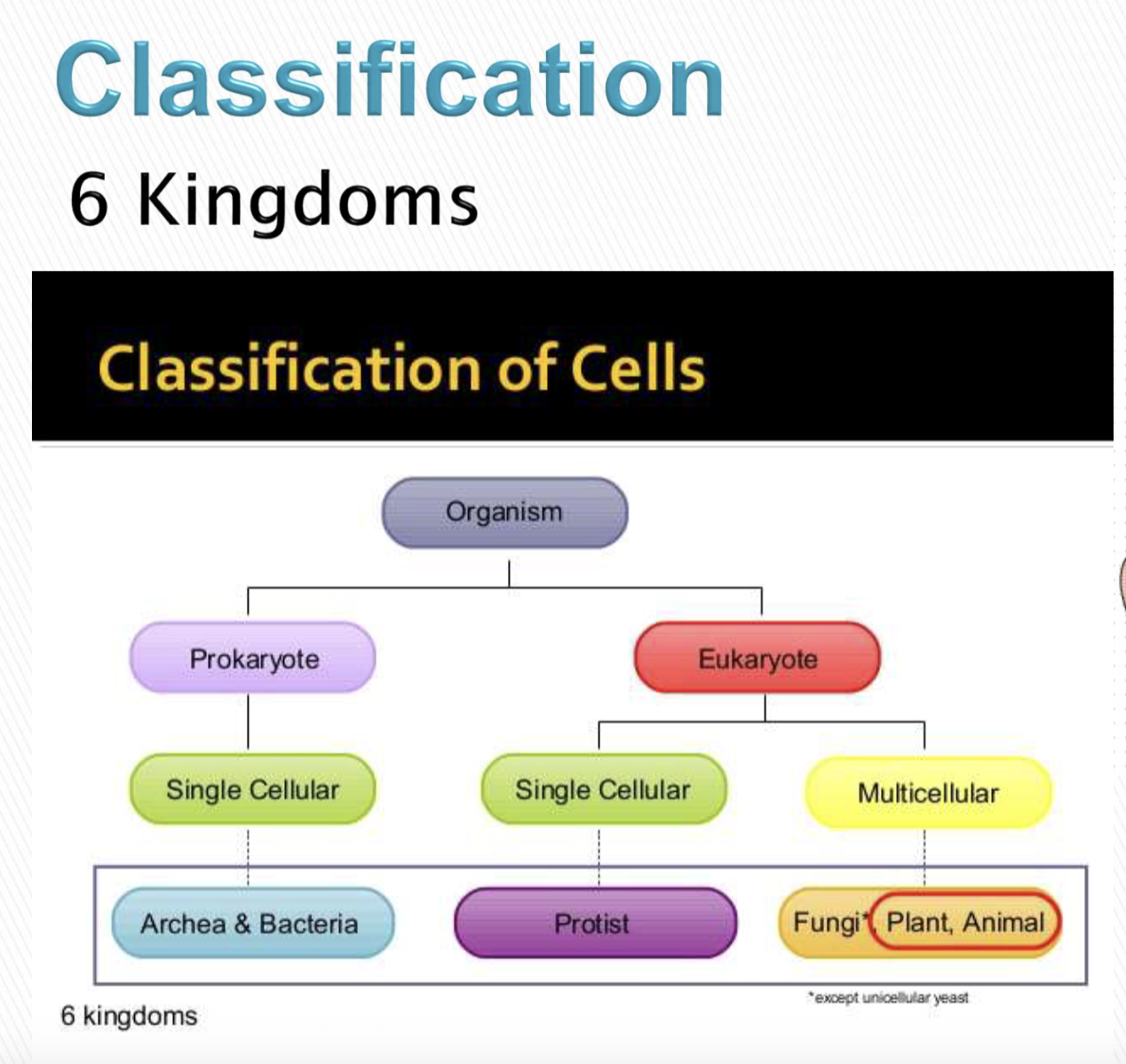
6 KINGDOMS

HISTORY OF MICROBIO - title
Robert Hooke
- built first microscope
came up with the cell theory: all living things are composed of cells
Anton van Leeuwenhoek **
first who observed microbes ( with another type of microscope) + documented them with detailed drawings
he did not identify bacteria at this point cuz it was too small
he discovered protozoa (like the amoeba + the paramecium) and called them “animalcules”
IS THE FATHER OF MICROBIOLOGY
spontaneous generation theory **
nonliving matter gives rise to living organisms!
by Aristotle
francisco redi’s experiments
with the use of microscope, we discovered that there are lil things we can’t see with out naked eye!
2 scientists proved that microorganisms didn’t spawn from nowhere; they alr existed.
—→ one of them is francisco redi: he disproved the theory of spontaneous generation - that microorganisms spawn from nowhere - through his experiement
REDI’s experiment:
- in 1 flask, he took meat, put it in the flask, and then the flies were attracted by the meat and then they laid their maggots on the meat inside the flask
in the 2nd flask, he put meat inside the flask and he sealed it so flies did not come in, and he did not see any maggots forming on top of the meat
in the 3rd flask, he put meat inside the flask and sealed it with gauze (a plastic with holes not big enough for the flies to come in)
—> the flies were attracted to the meat by the smell, but there was still no maggots on top of the 3rd flask
CONCLUSION: maggots come from flies laying them; they do not spontaneously generate; so the spontaneous generation theory is disproved
2 scientists that disproved spontaneous generation theory SCIENTIFICALLY
Louis Pasteur + Francisco Redi
pasteur’s experiments
his experiment also disproved the spontaneous generation theory
broth is TSB
- he took the swan-necked flask + put broth in it, heated it up to sterilize it (destroy any living things in the broth)
the swan-necked flask has a tube with opening connected to the flask that allows air to move in and out of the flask, but his broth was still not contaminated
however, some particles coming from the air (dust, which has microbes) settles in the bend of the swan-necked flask’s tube
as long as the dust stays separated from the sterile broth, the broth stayed sterile
pasteur tilted the swan-necked flask so that the sterile broth came into contact with the dust in the tube of the swan-necked flask
the broth becomes contaminated because it came into contact with the dust
THE CONTAMINATION CAME FROM THE DUST, AND THE DUST CAME FROM THE AIR
the microbes that he observed at the end did not come from nowhere; they existed already.
through this experiment, he disproved spontaneous generation theory
—> this experiment supports the biogenesis theory
—> BIOGENESIS THEORY: LIVING THINGS COME FROM PRE-EXISTING LIVING THINGS
biogenesis theory **
Louis Pasteur’s swan-necked flask experiment supports it
LIVING THINGS COME FROM PRE-EXISTING LIVING THINGS
(Rudolf Virchow)
more things pasteur did
he developed pasteurization: high pressure + high temperature to kill microbes
he is the father of zymology (fermentation); he used microorganisms to develop wine/beer
he discovered vaccinations against anthrax + rabies
provided foundational evidence for germ theory of disease: the theory that stated disease is mainly due to germs
is father of bacteriology
germ theory of disease
Pasteur provided foundational evidence for the germ theory of disease
the theory that stated disease is mainly due to germs
different foods made by microbes

robert koch
FATHER OF MODERN MEDICINE
he STUDIED) causative agents of deadly disease:
anthrax (bacillus anthracis), tuberculosis (mycobacterium tuberculosis), cholera (vibrio cholerae)
expanded upon germ theory of disease + demonstrate it
Koch’s postulates:
—>4 generalized medical principles to ascertain the relationship of pathogens
with specific diseases
- (is designed to confirm 1 infectious agent is responsible for 1 type of disease)
e.g. these criteria must be met to prove mycobacterium tuberculosis causes tuberculosis disease.
koch’s postulates
Koch’s Postulates
1-The suspected causative agent must
be found in every case of the disease
and be absent from healthy hosts.
2. The agent must be isolated and
grown outside the host.
3. When the agent is introduced to a
healthy, susceptible host, the host must
get the disease.
4. The same agent must be found in the
diseased experimental host
if all these met, then you can conclude the infectious agent is responsible for the specific disease!
alexander fleming **
DISCOVERED THE FIRST ANTIBIOTICS
the antibiotics is penicillin
Semmelweis
importance of handwashing
Joseph Lister
used phenol to control wound infections
antiseptic technique (Listering)
John Snow
infection control and
epidemiology
Edward Jenner
introduced technique of vaccination for smallpox
field of
immunology
Paul Ehrlich
“magic bullets” – field of
chemotherapy/ Gram staining
we are in modern age of microbiology!
molecular biology
the study of how genetic information is carried in molecules of D N A
microbial genetics
the study of how microbes inherit traits
JAMES WATSON + FRANCIS CRICK
discovered double helix structure of DNA!
biotechnology
the use of microbes for practical applications, such
as producing foods and chemicals (e.g. produce insulin)
Recombinant D N A technology
enables bacteria and fungi to
produce a variety of proteins, vaccines, and enzymes
Missing or defective genes in human cells can be replaced in
gene therapy
◦ Ex: Production of human blood-clotting factor by
E. coli to aid hemophiliacs
◦ Agricultural applications: Genetically modified bacteria are used
to protect crops from insects and from freezing
gene therapy
if have missing/ defective genes in human, we can use microbes to produce the missing/defective genes!
infectious disease
disease that results when a pathogen invades a
host and overcomes the host's resistance.
pathogen
microbes that can make you sick!
emerging infectious diseases (EIDs) **
new diseases and diseases increasing in incidence
e.g. COVID-19, ebola virus disease, marburg virus!
Factors contributing to emergence of diseases include:
◦ Evolutionary changes such as antibiotic resistance
—> e.g. if you dont finish the full course of antibiotics, some bacteria will still be left + they will develop resistance cuz of adaptation + not be killed by the same antibiotic anymore
◦ Modern transportation enabling rapid dispersal of diseases
◦ Increased human exposure to infectious agents due to
deforestation and construction
epidemic
An outbreak of a disease that affects a specific
population or region in a relatively short period
pandemic
A global outbreak of a disease that spreads widely
across multiple continents or countries
e.g. COVID-19
epidemiology
is the study and analysis of the distribution,
patterns and determinants of health and disease conditions in
a defined population, and application of this knowledge to
prevent diseases.
epidemic vs pandemic - write!
Epidemic: An outbreak of a disease that affects a specific
population or region in a relatively short period.
Pandemic: A global outbreak of a disease that spreads widely
across multiple continents or countries
multidrug resistant bacteria + C. diff
MRSA Methicillin Resistant
Staphylococcus aureus
VRE Vancomycin Resistant
Enterococcus
VRSA Vancomycin Resistant
Staphylococcus aureus
MDR-TB Multidrug Resistant
Tuberculosis
TOP 4 are best!
Clostridium difficile (2004) - is emerging infectious bacterium
—> Increasing number of drug resistant strains
including Nosocomial and Community Acquired
microorganisms