MCB 2000 CH9: Enzyme Mechanisms + Inhibitors
 Call Kai
 Learn
Learn Practice Test
 Spaced Repetition
 Match
Match Flashcards
 Knowt Play
1/55

There's no tags or description
Looks like no tags are added yet.
Name | Mastery | Learn | Test | Matching | Spaced | Call with Kai | Chat |
|---|
No analytics yet
Send a link to your students to track their progress
56 Terms
What are enzyme catalytic strategies?
What are the 4?
Enzyme catalytic strategies = specific enzymatic chemical + physical methods → ↓Ea + ↑Rate
Covalent catalysis
General acid-base
Metal ion catalysis
Approximation + Orientation
How many catalytic strategies do enzymes typically use?
Usually 2-3
What is covalent catalysis?
Covalent catalysis = residue nucleophilic side chain in active site → covalent intermediate → product
What is general acid-base?
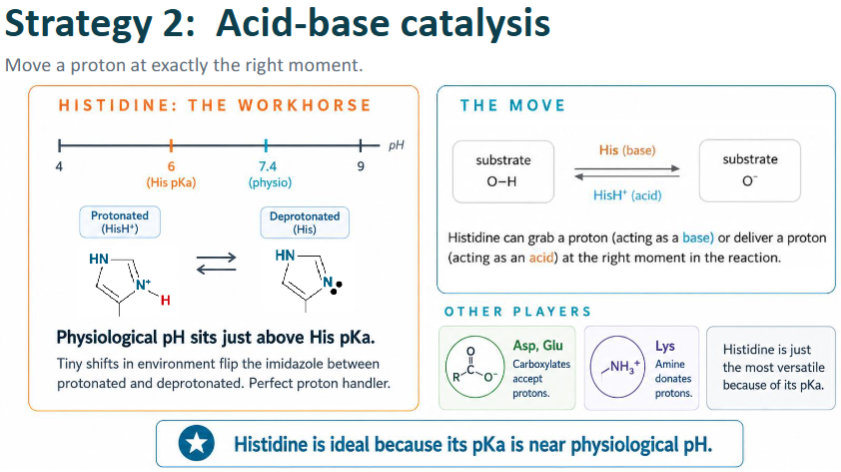
What is the key amino acid involved in this? Why?
General acid-base = residue side chain → accepts/donates proton @ right step → stabilizes TS
Histidine → imidazole ring → easily flip b/w protonated/deprotonated @ physiological pH
What is metal ion catalysis?
What are 3 common metal ion examples?
What are 3 functions?
Metal ion catalysis = Metal cations in enzyme active site → stabilize O-, polarize H2O, electrophile (wants e-)
Zn2+, Mg2+, Fe2/3+
What is approximation + orientation?
Approximation + Orientation = bind 2 substrates next to e/o @ correct position → ↑Rate
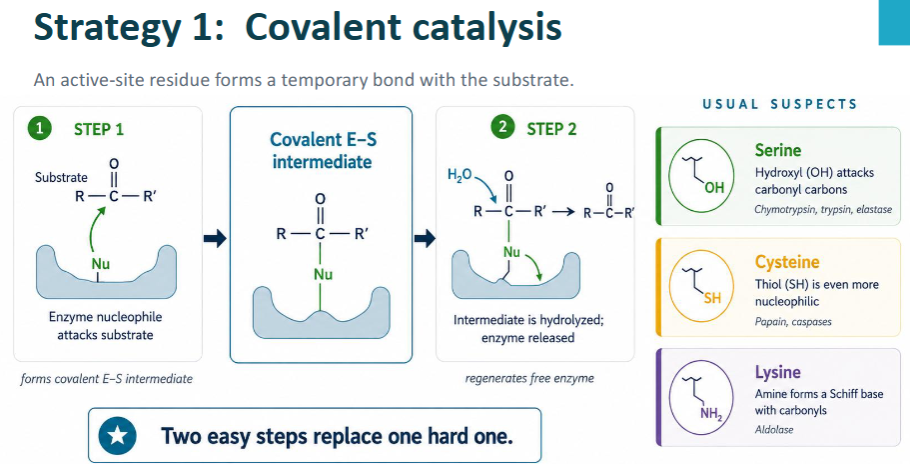
What are the 2 steps of covalent catalysis?
Why does this help lower activation energy?
What 3 amino acids have good nucleophilic side chains? Why?
Nucleophilic side chain in active site attacks substrate
Covalent E-S intermediate
Intermediate = hydrolyzed → Product + Enzyme = released
2 smaller steps replace 1 big step (↓EA barrier)
Serine → Serine proteases = Chymotrypsin, Trypsin, Elastase
R = -CH2-OH
Cysteine → Proteases = Papain + Caspases
R = -CH2-SH
S = more nucleophilic than O
Lysine → Lyase → Aldolase
R = -CH2-CH2-CH2-CH2-NH2
Amine forms Schiff Base w/ carbonyls
Schiff Base = temporary C=N
“Sad, Cry, Laugh”
What is the workhouse of acid-base catalysis? Why?
What environment influences equilibrium of deprotonation vs. protonation?
What term describes unique property of histidine?
What are 2 amino acids that act as bases or proton acceptors?
What is 1 amino acid that act as acids or proton donors?
Histidine = physiological pH = 7.4 ~ imidazole ring pKa = 6 → easily protonates/deprotonates
Local environment of active site
Nearby (+) charge → stabilizes (-) charge
Nearby (-) charge → stabilizes (+) charge
Amphoteric = acts as both acid + base
Aspartate + Glutamate → Carboxylates accept H+
Lysine → Amine donates H+
What fraction of enzymes have a metal cofactor?
What is enzyme is zinc involved in?
What do metal cofactors in active site do to water? How does it help the enzyme mentioned above?
What acts as the nucleophile?
1/3 enzymes → metal cofactor
Carbonic anhydrase = CO2 + H2O ⇔ HCO3- (bicarbonate)
Polarizes H2O → easier to deprotonate → OH- → attack CO2
OH- = Nucleophile

What enzyme is iron involved in?
What enzyme is magnesium involved in?
ATP can act as substrate w/o magnesium cofactor: (True/False)
Fe2/3+ of cytochrome P450 = electrophile
Fe2/3+ attacks substrate w/ reactive O → heme group inside enzyme → breaks down drugs/toxins + produce hormones
Mg2+ of Kinase → bind + stabilize phosphate -PO43- (VERY NEGATIVE) of ATP
Mg2+ hold in correct geometry → stabilize (-) charge → phosphorylate target
FALSE → ATP requires Mg2+ cofactor

What are 3 requirements of approximation + orientation?
What is the issue w/ first 2 requirements in dilute solutions?
What is the solution? Give an example of an enzyme and its 2 substrates.
About what factor does approximation + orientation increase the reaction rate by?
POE
Proximity = close together
Orientation = correct geometry
Energy = enough energy to react
Problem = substrates diffuse around, rarely make contact, wrong orientation
Solution = enzyme = 2 binding pockets → hold substrates close tg @ correct orientation
↑Local [A]:[B]
Hexokinase → Glucose + ATP
Glycolysis Initiation = Glucose → G6P
↑Rate by 105
![<p><span style="color: blue;">POE</span></p><ul><li><p>Proximity = close together</p></li><li><p>Orientation = correct geometry</p></li><li><p>Energy = enough energy to react</p></li></ul><p><span style="color: red;"><strong>Problem</strong></span> = substrates diffuse around, rarely make contact, wrong orientation</p><p><span style="color: green;"><strong>Solution</strong></span> = enzyme = 2 binding pockets → hold substrates close tg @ correct orientation </p><ul><li><p><span style="color: green;">↑Local [A]:[B]</span></p></li><li><p><strong><mark data-color="yellow" style="background-color: yellow; color: inherit;">Hexokinase</mark></strong> → Glucose + ATP </p><ul><li><p>Glycolysis Initiation = Glucose → G6P</p></li></ul></li></ul><p><span style="color: green;">↑Rate by 10<sup>5</sup></span></p><p></p>](https://assets.knowt.com/user-attachments/3f1008a4-21aa-4dd1-9ffe-874ebe842a15.png)
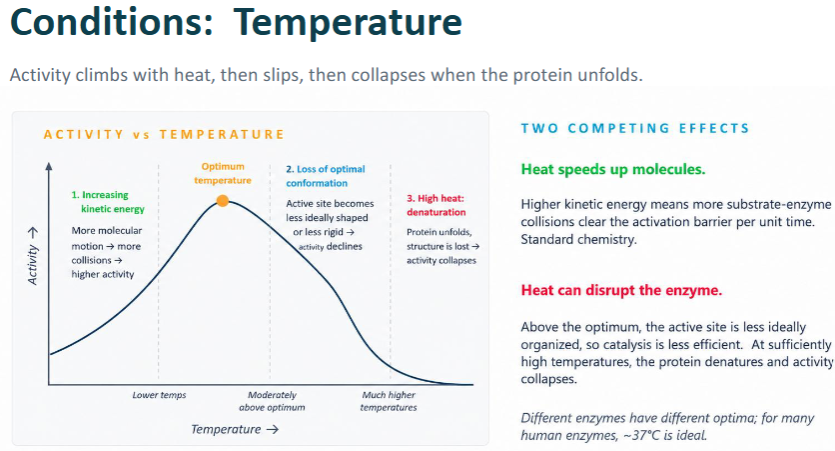
What are the 2 competing effects of increasing temperature/heat on enzymes?
What three interactions does too much heat disrupt?
Heat → ↑Speed of molecules
Heat → ↓ Rigidity → Denaturation (10-20°C > optimum)
H-bonds
Hydrophobic interactions
Salt bridges
What is optimum temperature for humans? What does it mean?
What is the high fever temperature for humans?
What types of enzymes lose activity?
Optimum temperature = 37°C → Rate gain = Geometric loosening
High fever temperature = 41°C → DANGEROUS
Temperature-Sensitive Enzymes

All enzymes have the same optimum temperature: (True/False)
What types of extremophile thrives in hot springs? Why are they able to do this?
FALSE → different enzymes = different optimum temperatures
Thermophiles = bacterium/archaeon
Proteins = stable to 80°C+
↑ H-bonds
↑ Salt Bridges
↑ Packing Tightness

What are the 4 major components of the Activity vs. Temperature curve?
↑Temperature → ↑KE = move faster, more collisions, more energetic
Clear EA barrier @ faster rate
Optimum temperature = 37°
Loss of optimal conformation = active site = less rigid
High Heat → Denaturation

Why does pH affect pepsin and chymotrypsin activities differently?
What are their optimal pH’s?
What are the pKa’s?
What organ does each enzyme occupy?
Different residues → affected differently by conditions
Pepsin → pH = 2 → stomach
2 Aspartate = carboxylate pKa = 3.5
1 protonated, other deprotonated
Only occurs @ pH = 8
Chymotrypsin → pH = 8 → small intestine
Histidine = imidazole pKa = 6
MUST be deprotonated to deprotonate Ser195 → pH = 8

What type of forces are involved in reversible inhibitors? Give 3 examples.
What bond is NOT involved in reversible inhibition?
(Most/Some) drugs are reversible inhibitors.
Give 3 examples + describe binding + what it does to body
Non-covalent forces
H-bonds
Ionic Interactions
Hydrophobic packing
Covalent bonds ≠ involved in reversible inhibition
MOST = bind → slow enzyme → let go (allows body to clear drug)
ACE inhibitors → blood pressure
COX inhibitors → ibuprofen
Statin → cholesterol
What do irreversible inhibitors do?
What must the cell do if an irreversible inhibitor binds to an enzyme?
What are 3 examples of irreversible inhibitors?
Irreversible inhibitors = form covalent bond w/ critical residue → Enzyme = dead
Cell MUST make new enzyme
Penicillin
Aspirin
Nerve agents
What are the 3 types of reversible inhibition?
Competitive inhibition
Uncompetitive inhibition
Noncompetitive (allosteric) inhibition
What is competitive inhibition?
What does the reaction look like?
What is an example?
What are the kinetic effects on Vmax and Km? Why?
Competitive inhibitor = shaped like substrate → binds to active site
E + I ⇔ EI (dead end)
Malonate = looks like succinate → blocks succinate hydrogenase in TCA Cycle
Vmax = unchanged
↑[S] = can outcompete competitive inhibitor
Km = increases
↑[S] required to reach ½ Vmax → ↓Binding Affinity
What is uncompetitive inhibition?
Can it bind free enzyme? Why or why not?
What does the reaction look like?
What are the kinetic effects on Vmax and Km? Why?
Uncompetitive inhibitor = binds to ES-complex → ESI complex
CAN NOT bind to free enzyme
Inhibitor binding site = forms AFTER ES-complex formed
ES + I ⇔ ESI
Vmax = decreases
↑[S] → ↑ES-Complex → ↑ESI Complex → ↑Inhibition
CANNOT outcompete uncompetitive inhibitor
Km = decreases
Less free ES complexes in solution
↓[S] required to reach ½ Vmax → ↑Binding Affinity
What is noncompetitive inhibition?
Affected/Unaffected by presence/absence of substrate?
What does the reaction look like?
What are the kinetic effects on Vmax and Km? Why?
Noncompetitive inhibitor = binds to allosteric site
Unaffected by presence/absence of substrate
E + I ⇔ EI
ES + I ⇔ ESI
Vmax = decreases
Reduced [functional enzyme] → Inhibited
Km = unchanged
~[S] required to reach ½ Vmax → ~Binding Affinity

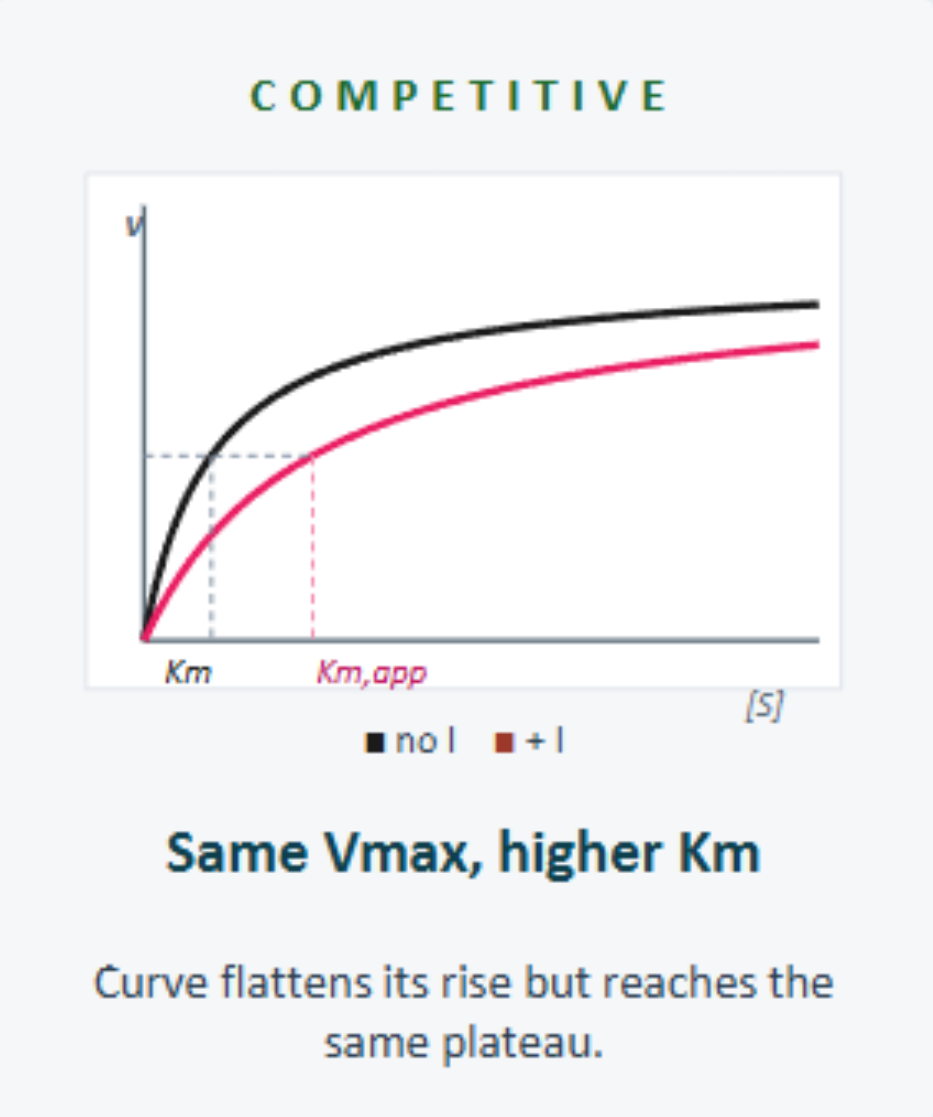
What type of inhibition is this graph? Why?
Competitive inhibition
Vmax = same
Km = increased
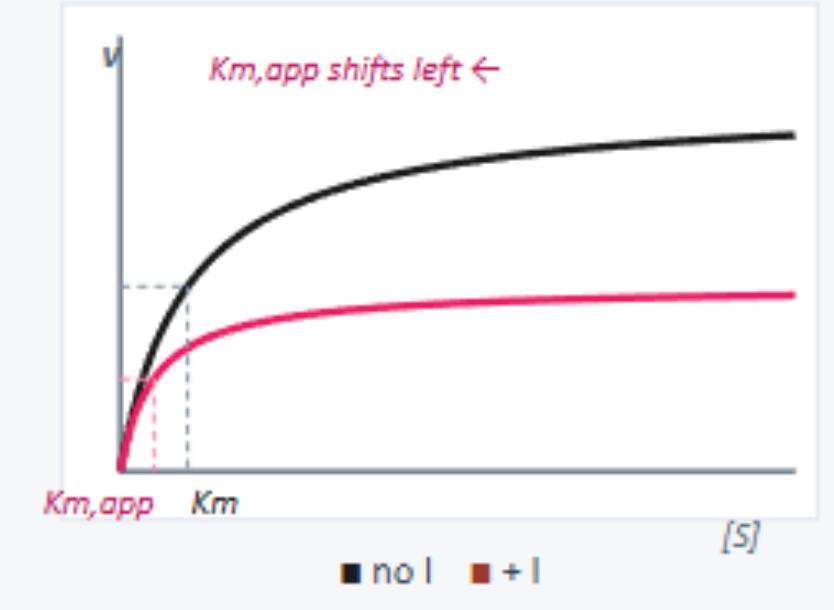
What type of inhibition is this graph? Why?
Uncompetitive inhibition
Vmax = decreased
Km = decreased


What type of inhibition is this graph? Why?
Noncompetitive (allosteric) Inhibition
Vmax = decreased
Km = same
What type of reversible inhibitor is methotrexate?
What type of reversible inhibitor is lithium?
What type of reversible inhibitor is ketamine?
Methotrexate = competitive inhibitor of folate
Dihydrofolate reductase = thymidine production
Chemotherapy, rheumatoid arthritis
Lithium = uncompetitive inhibitor
Inositol monophosphatase = neuron signaling
Bipolar disorder
Ketamine = noncompetitive inhibitor of glutamate
NMDA receptor (channel) = receptor
Anesthetic, Treatment-resistant depression
Can be long-lasting after signal clears
What is a Lineweaver-Burk plot?
What is the y-axis and what is the x-axis?
What is the y-intercept and the x-intercept?
What is the slope?
Lineweaver-Burk plot = graphical double-reciprocal representation of Michaelis-Menten equation in enzyme kinetics
Y-axis = 1/v; X-axis = 1/[S]
Y-intercept = 1/Vmax; X-intercept = -1/Km
Slope = Km/Vmax (double reciprocal)
![<p><strong>Lineweaver-Burk plot</strong> = graphical double-reciprocal representation of Michaelis-Menten equation in enzyme kinetics </p><p><u>Y-axis</u> = 1/v; <u>X-axis</u> = 1/[S]</p><p>Y-intercept = 1/Vmax; X-intercept = -1/Km </p><p>Slope = <strong>Km/Vmax</strong> (double reciprocal) </p>](https://assets.knowt.com/user-attachments/9aee2864-c5cb-47d6-9764-90d0ec1cd741.png)
What happens to the x-intercept, y-intercepts, and slope of Lineweaver-Burk plot in Competitive Inhibition? (How does it relate to Km and Vmax)?
What is the key characteristic of Competitive Inhibitor Lineweaver-Burk plot?
Competitive Inhibition → Vmax = same; Km = increases
X-Intercept = moves right (Km increases)
Y-Intercept = same (Vmax same)
Slope = increases (line = steeper)
Same y-intercept

What happens to the x-intercept, y-intercepts, and slope of Lineweaver-Burk plot in Uncompetitive Inhibition? (How does it relate to Km and Vmax)?
What is the key characteristic of Uncompetitive Inhibitor Lineweaver-Burk plot?
Uncompetitive Inhibition→ Vmax = decreases; Km = decreases
X-Intercept = moves left (Km decreases → -1/Km = more negative)
Y-Intercept = moves up (Vmax decreases → 1/Vmax = more positive)
Slope = same (Vmax & Km Δby same factor)
Parallel lines (same slope)

What happens to the x-intercept, y-intercepts, and slope of Lineweaver-Burk plot in Noncompetitive Inhibition? (How does it relate to Km and Vmax)?
What is the key characteristic of Noncompetitive Inhibitor Lineweaver-Burk plot?
Noncompetitive Inhibition→ Vmax = decreases Km = same
X-Intercept = same (Km same)
Y-Intercept = moves up (Vmax decreases) → 1/Vmax = more positive)
Slope = increases (line = steeper)
Same x-intercept (same Km)

What is irreversible inhibition?
What are 3 important examples?
What must happen for enzyme function to return?
Irreversible inhibition = permanent enzyme inhibition through covalent bond formation (b/w inhibitor + active site side-chain)
Aspirin
Penicillin
Proton pump inhibitors
Cell MUST make new enzyme → function return
What are the 3 common active site residues that irreversible inhibitors form covalent bonds w/? Why?
“Smile, Cry, Happy”
Serine
Cysteine
Histidine
Side chains = STRONG biological nucleophiles
What happens to the x-intercept, y-intercepts, and slope of Lineweaver-Burk plot in Noncompetitive Inhibition? (How does it relate to Km and Vmax)?
What is the key characteristic of Noncompetitive Inhibitor Lineweaver-Burk plot?
What type of reversible inhibition does this look like? How can the difference be determined?
Irreversible Inhibition→ Vmax = decreases Km = same
X-Intercept = same (Km same)
Y-Intercept = moves up (Vmax decreases) → 1/Vmax = more positive)
Slope = increases (line = steeper)
Same x-intercept (same Km)
Looks like Noncompetitive Inhibition
Differentiate → Time-Course Experiment
Loss of activity over time = irreversible inhibition
What are the 4 types of irreversible inhibitors? Describe the specificity of each type.
Group-specific = chemical molecules = react w/ specific amino acid side chains of enzyme
Least specific (Ex. any serine on enzyme)
Affinity label = chemical molecules = mimic substrate → react w/ enzyme active site
Reactive BEFORE binding
Only active site
Mechanism-based = chemical molecules = mimic substrate → react w/ enzyme active site
Inert = reactive AFTER binding
Trick enzyme → normal catalysis → TRAPS + inactivates enzyme
Only active site
“Suicide Inhibitor”
Transition-state analog = chemical molecules = mimic transition state of substrate → react w/ enzyme active site
DO NOT form covalent bonds
Only active site
What are the 4 types of irreversible inhibitors? Give an example of each.
Group-specific = chemical molecules = react w/ specific amino acid side chains of enzyme
DIPF = reacts w/ every serine = useful for research = find catalytic Serines of enzymes
Affinity label = chemical molecules = mimic substrate → react w/ enzyme active site
TPCK = substrate-shaped → tags His-57 of Chymotrypsin
Mechanism-based = chemical molecules = mimic substrate → react w/ enzyme active site
Aspirin = blocks COX Enzymes
Penicillin = blocks Transpeptidase
Transition-state analog = chemical molecules = mimic transition state of substrate → react w/ enzyme active site
Statin = blocks HMG-CoA reductase
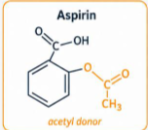
Describe the mechanism of aspirin as a mechanism-based inhibitor of Cyclooxygenase (COX Enzyme).
What are the reactants and products?
What is the nucleophile and leaving group?
COX’s Ser530 = Nu → attacks aspirin’s acetyl carbonyl
COX Ser530 + Aspirin → Salicylate + Acetylated COX
Salicylate = LG = painkiller
Acetylated COX= permanently acetylated = DEAD

What is the name of acid of aspirin?
Through what type of bond is acetyl group attached to aspirin by?
Why does aspirin have short-term effect?
What does low-dose daily aspirin help with? Why?
Aspirin = acetylsalicylic acid
Ester bond
Aspirin = short-term effect → most cells synthesize new COX Enzyme
Low-Dose Daily Aspirin → Platelets = cell fragments = NO nucleus → CANNOT synthesize new COX Enzyme (10 days)
↓Risk of heart attack + stroke
Describe the mechanism of penicillin as a mechanism-based inhibitor of Transpeptidase (Bacterial enzyme).
What are the reactants and products?
What is the nucleophile?
Transpeptidase Ser = Nu → attacks Penicillin β-Lactam Carbonyl
Penicillin β-Lactam (4-membered) Ring = STRAIN = substrate-shaped
Transpeptidase Ser + Penicillin → Transpeptidase Ser-Penicillin (Ring = open)
Acetylated Transpeptidase = permanently acetylated = DEAD
What is the normal function of transpeptidase?
What is peptidoglycan?
What is the normal mechanism of transpeptidase?
What function is inhibited by Penicillin?
Why does penicillin not kill humans?
Transpeptidase = cross-link peptide chains in bacterial cell wall
Peptidoglycan = sugar meshwork cross-linked by short peptide bonds = bacterial cell wall
Transpeptidase Active Site Ser attacks Natural Substrate Peptide Bond → Acyl-Enzyme Intermediate = transfers acyl group to neighboring chain → cross-links peptide chain
Bacterial cell wall = unable to synthesize wall → cannot divide → lyses
Penicillin → kills bacteria = antibiotic
Human cells = NO CELL WALLS = unaffected by penicillin
Penicillin = one of safest drugs @ recommended doses

What enzymatic function do Transition-State Analogs exploit in irreversible inhibition?
What is an example + enzyme it targets?
Enzymes = catalysts = bind to TS (bonds breaking, bonds forming) tighter than substrate = stabilize TS
↓EA → ↑Rxn rate
Transition-State Analog = TS-shaped → Enzyme tightly binds to TS analog
Statin = TS Analog → HMG-CoA Reductase

How much stronger do Enzymes bind to TS Analogs than Natural Substrate?
TS Analogs bind covalently to Enzymes: (True/False)
TS Analog drug = x1000 smaller Kd than Natural Substrate
Enzyme binds to TS Analog x1000 stronger than Natural Substrate
Tight enough to be functionally irreversible
FALSE → bind through Electrostatic Interactions

What process is HMG-CoA Reductase involved in? Why is it significant?
How are HMG-CoA (substrate) and the Transition State shaped differently?
What shape does statin take?
What enzyme pocket does statin occupy?
What fungus produces statin?
HMG-CoA Reductase = catalyzes 1st step of cholesterol synthesis in liver
Rate-Limiting Step
HMG-CoA (Substrate) = carbonyl C → trigonal planar
Transition State = negative O → tetrahedral
Statin (drug) = Transition-State Analog = tetrahedral
Statin → TS Pocket NOT active site
Penicillin Citrinum = fungus → statin = defense mechanism against organisms w/ cholesterol-like molecules

Explain the 3 steps of how irreversible inhibitors be used as research tools?
Treat Enzyme w/ Radioactively-Labeled Irreversible Inhibitor
Find Amino Acid Residue w/ tag
Protease → peptide fragments
Run → radioactively-tagged residue = active site
Does NOT yet prove residue = essential for catalysis
Confirm w/ Mutation
Mutate residue → Ala
Retest enzyme
Enzyme activity = decrease → 0
Residue = catalytic → needed to catalyze rxn
Enzyme activity = same
Residue = spectator
What are the 3 components of the Chymotrypsin Active Site?
Specificity Pocket = chooses substrate
Catalytic Triad = carries out chemistry
Oxyanion Hole = stabilizes developing oxygen negative charge
Chymotrypsin, Trypsin, and Elastase prefer the same residues to cleave after: (True/False)
FALSE → Specificity = specific residues chymotrypsin cleaves after
What 2 organs is chymotrypsin produced and activated in?
What type of enzyme is it?
Chymotrypsin = inactive precursor produced in pancreas
Protease = activated in small intestine → breaks down dietary proteins → smaller protein
What are the 3 cleavage sites of chymotrypsin?
How does substrate recognition explain why these 3 cleavage sites are preferred?
How does this demonstrate Approximation & Orientation?
S1 Pocket supplies the nucleophile: (True/False)
C-terminals of Phe, Tyr, and Trp
Substrate Recognition
S1 Pocket of Chymotrypsin = deep & hydrophobic
Phe, Tyr, and Trp = aromatic ring fit well
Allows cleaving @ correct site
FALSE → S1 Pocket CLEAVES bond

What are the 2 cleavage sites of trypsin?
How does substrate recognition explain why these 3 cleavage sites are preferred?
How does this demonstrate Approximation & Orientation?
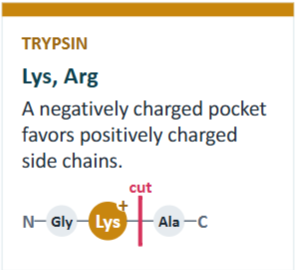
Lys, Arg
S1 Pocket of Trypsin = negatively charged
Lys, Arg = positively-charged side chains fit well
Allows cleaving @ correct site
What size amino acid residues does elastase prefer to cleave?
Small residues
S1 Pocket of Elastase = small
Ala, Gly, Val = small side chains fit well
What is the catalytic triad of chymotrypsin?
What 3 amino acids are involved and their general roles?
What 3 enzyme catalytic strategies does Chymotrypsin use and which amino acid residue does it align with?
Catalytic Triad of Chymotrypsin = coordinated set of 3 specific amino acid residues @ Chymotrypsin active site
Ser195 = Oxygen = Nu
His57 = proton transfer
Asp102 = orients His57
Catalytic strategies
Covalent Catalysis → Ser195
General Acid-Base Catalysis → His57
Approximation + Orientation → Asp102

What are the 3 steps of acylation?
Nucleophilic Attack
His57 = Base → deprotonates Ser195→ better Nu
Ser195 Oxygen = Nu attacks Carbonyl C of Substrate
Tetrahedral Intermediate
C=O bond kicked up to O- → tetrahedral intermediate
Oxyanion hole = stabilizes O- through H-Bonds
Acyl-Enzyme
His57 = Acid → protonates N-terminal of peptide fragment
N-C bond breaks
N-terminal of peptide fragment = LG
Ester bond = formed b/w Enzyme Ser195 Oxygen + Acyl Fragment

What is the oxyanion hole?
What does it stabilize?
What are the 2 residues that act as H-bond donors?
The side chains of residues act as H-bond donors: (True/False)
What is the difference between S1 Pocket and Oxyanion Hole?
Oxyanion Hole = preorganized set of H-bond donors of certain enzyme active sites
Stabilizes O- of tetrahedral intermediate of acylation + deacylation
Gly193
Ser195
FALSE → Backbone amino groups = H-bond donors
S1 Pocket = recognizes side chain
Oxyanion hole = stabilizes reacting carbonyl oxygen

What are the 3 steps of deacylation?
Water Attacks
His57 = Base → deprotonates H2O→ better Nu
H2O = Nu attacks Carbonyl C of Ser195 Oxygen + Acyl Fragment
Tetrahedral Intermediate
C=O bond kicked up to O- → tetrahedral intermediate
Oxyanion hole = stabilizes O- through H-Bonds
Enzyme Regeneration
His57 = Acid → protonates Ser195
N-C bond breaks
Carboxyl-Containing Product = LG
Ser195 = restored

What is Burst Kinetics?
What are the 2 phases?
What are 2 things rxn rates are dependent on?
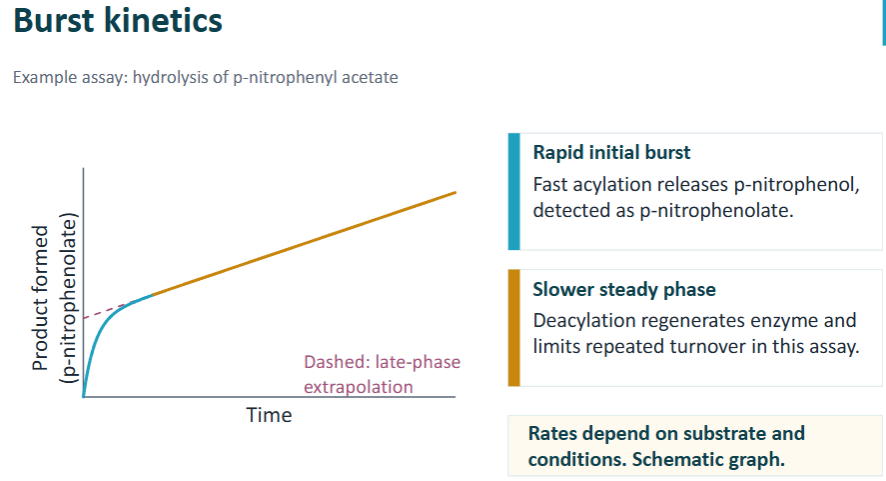
Burst Kinetics = 2-phase rxn pattern
Burst Phase = Rapid acyl enzyme formation
Acylation = fast
Enzyme rapidly releases p-nitrophenolate
1 product/enzyme
Steady-State Phase = Slow enzyme regeneration
Deacylation = slower
Required for Enzyme Regeneration
Rate-determining step
Reaction Rate dependent on:
Substrate
Conditions
What are the 3 methods that provide evidence for the Catalytic Triad of Chymotrypsin?
Ser195 → DIPF labeling
DIPF = Group-Specific Irreversible Inhibitor = BULKY
Attaches to Ser195 → Enzyme loses function
Chymotrypsin ~28 Serines
Mutation: Ser195 → Ala
Enzyme = unable to form acyl-enzyme
His57 → TPCK Labeling
TPCK = Affinity Label Irreversible Inhibitor
Looks like Phe → binds S1 Pocket → BLOCKS His57 from activation of Ser195 + H2O (proton transfer)
Asp102 → Structure + Mutation
Mutation: Asp102 → Asn
↓Enzyme activity despite:
S1 Pocket
Oxyanion Hole
Nucleophilic Ser195
Asp102 supports His57 → deprotonates + activates Ser195
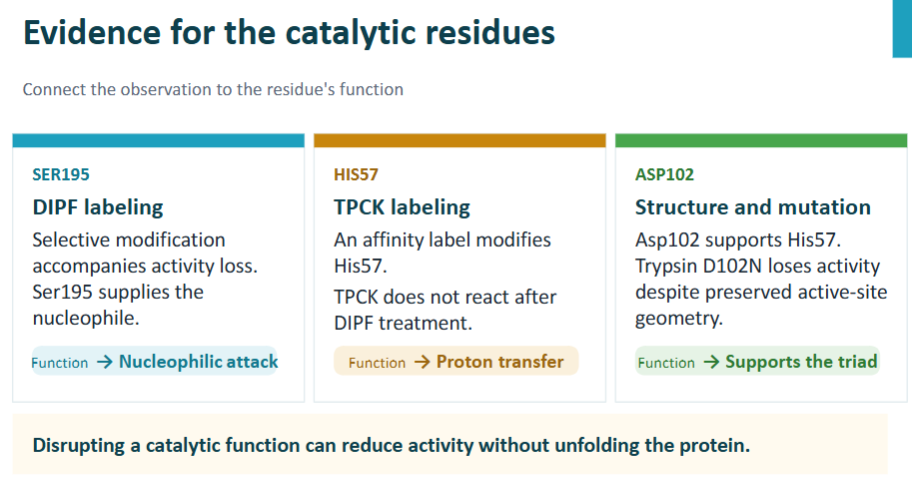
TPCK must bind to the active site before reaching His57. If Ser195 is already carries DIPF bulky group, will TPCK still label His57?
NO → TPCK will NOT react w/ chymotrypsin (BULKY)