Chapter 10 Trials and Appeals
 Call Kai
 Learn
 Practice Test
 Spaced Repetition
 Match
 Flashcards
 Knowt Play
1/4

There's no tags or description
Looks like no tags are added yet.
5 Terms
10.2 Attendance of Witnesses
Witness availability is essential to check, details of this - must be sent to the court in the directions questionnaire
Witness summons may be essential if they do not attend voluntarily
Issuing a witness summons done on Form N20
Should be issued at least 7 days before date of the trial, otherwise permission from court is needed to issue summons
Summons is binding if it is served at least 7 days before the date the witness is required to attend
However there are exceptions where a court will hold that summons are binding even if not satisfying the 7 days
For service of witness summons to be binding, when served the witness should either be paid or have been offered to be paid for expenses and compensation (for loss of time)
Summons served by the court, unless requested otherwise that the party serves it themselves (must be requested in writing)
If a witness doesn’t attend after a summons they may be fined or imprisoned for contempt (unlikely - used for High Court Proceedings)
If a summons is served and the witness still doesn’t attend, the judge is more likely to adjourn the trial (rather than just continue without the witness)
Court can set aside a witness summons
generally only used where the grounds for the application for summons is speculative, oppressive or irrelevant
10.3 Preparations for Trial
Pre-Trial Checklist (Listing Questionnaires) and Reviews
On fast, intermediate and multi-track, a pre-trial checklist (Listing Questionnaire Form NI70) must be fully completed by all parties
The purpose of the Listing Questionnaire is to
Confirm compliance with directions
State number of witnesses
Establish if there are any vulnerable witnesses
Names and fields of expert evidence
Identify legal representatives
Time estimate and trial timetable setting
in fast track and intermediate track cases, ask if the party will accept less than three weeks’ notice of the date fixed for trial
Completed checklist must be filed at court no later than 8 weeks before the trial date (and parties should exchange)
Failure to provide the checklist:
By both parties - court will order than it be completed within 7 days or the particulars of claim, defence or counterclaim will be struck out
By one party - court will fix a hearing to ensure the case is ready for trial
From the checklist the judge will decide whether further directions/review hearing is necessary before trial
This is called listing hearing on the fast track
Called Pre-Trial Review on intermediate and multi tracks
Legal representatives must attend the hearings
The court will:
(a) give a time estimate and confirm a timetable for the trial if deemed necessary;
(b) fix the place of trial; and
(c) confirm the actual date of the trial or state the week within which it will begin.The timetable may limit the time for cross-examination and re-examination of each particular
witness.Thereafter, the court will order that a trial bundle of documents be prepared.
Trial Bundles
is a file of all the documents the judge may need to decide the outcome of the case
Generally should be no longer than 250 pages
Responsibility for preparing trial bundle is with claimant’s solicitor (they remain responsible even if they delegate this job)
If claimant is not represented, the court may order the other side prepare the trial bundle
Must be filed between 3-7 days before the start of the trial
Trial bundle should include:
the claim form and all statements of case;
∘ a case summary and/or chronology where appropriate;
∘ requests for further information and responses;
∘ witness statements;
∘ notices of intention to rely on hearsay evidence;
∘ experts’ reports and responses;
∘ directions orders; and
∘ any other necessary documents containing evidence that a party intends to rely on
Skeleton Arguments
Used in multi-track cases
Each party should prepare a skeleton argument to be used at trial
Shows what points are still in issue and the nature of the arguments about dispute
Skeleton argument should:
Summarise background facts, issues to be determines and party’s submissions on these issues
Set out any propositions of law to be relied upon
Identify any key documents that the trial judge should read before the trial begins (with estimate of how long the read will take)
Typical direction is that skeleton arguments should be filed and exchanged by email at least 3 days before the trial

10.4 The Trial
Things Lawyers should be aware of
Court Room Etiquette
(notably adults are referred to by their title and surname and children referred to by their first name)
Modes of Address (on screenshot)
Difference between leading and not leading questions
Venue
There are county courts across England and Wales
High Court is based in Royal Court of Justice in London, but there are district registries that act as trial centres
Order of Proceedings
Party may wish to raise preliminary issues before the trial commences (e.g application to adduce additional evidence from witness)
Opening speeches (claimant first, then defence)
Examination in Chief
Cross Examination
Re-examination (if necessary)
(Decide whether any witness where unfavourable witnesses (unhelpful) or hostile witnesses (unwilling to help the side that called them))
Defendant will then present all their evidence in the same way
Expert Evidence
Closing Speeches (Claimant first)
Judgement
This will either be delivered immediately or given another day if complex
Judgement will take effect the day it is given unless the court specify a different date
Every judgement should have the date it was made and be sealed by the court
10.5 Appeals
Grounds of Appeal
Permission for first appeal will only be given where:
Court considers the appeal would have a real prospect of success
Some other compelling reason for the appeal to be heard
Permission for second appeal will only be given where:
the appeal would have a real prospect of success and raise an important point of principle or practice
Some other compelling reason for the appeal to be heard
Procedure
Application must be made to request an appeal
Usually made orally at end of the trial - trial judge will decide whether to grant permission
Or may be made by sending an appeal notice to court
If the application to appeal is made to the Court of Appeal, the judge may direct that application should be determined at an oral hearing (if so, hearing must be listed no later than 14 days after this direction)
Time Limits
Must file the appeal notice within these periods:
21 days to appeal against a County Court or High Court decision
28 days to apply for leave (permission) from the Court of Appeal to the Supreme Court
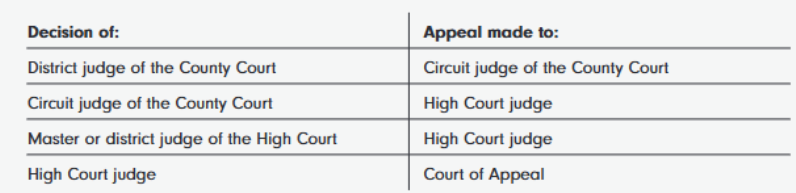
Destination of Appeals
(shown in screenshot)
Leapfrog Appeals
An appeal that would normally take place in the County Court or High Court can leapfrog straight to the Court of Appeal where the matter raises an important point of principle or practice, or there is some other compelling reason for the Court of Appeal to hear it.
Possible to leapfrog straight from High Court to Supreme Court (in exceptional circumstances - where issue is related to urgency of the matter where case involves a point of law of general public importance)
Stages of a leapfrog appeal:
the grant of a leapfrog certificate by the trial judge
the grant of permission to appeal by the Supreme Court
Hearing of Appeals
Unless ordered otherwise the appeal court will not receive any evidence which was not before the lower court
Appeal will have to persuade the court that the decision of the lower court was either wrong or unjust