0010 Week 3 — Depth Cues & Perceptual Organization
 Call Kai
 Learn
Learn Practice Test
 Spaced Repetition
 Match
Match Flashcards
 Knowt Play
1/34

There's no tags or description
Looks like no tags are added yet.
Name | Mastery | Learn | Test | Matching | Spaced | Call with Kai | Chat |
|---|
No analytics yet
Send a link to your students to track their progress
35 Terms
What is the 3D-from-2D problem?
The visual system must reconstruct a 3D world from a 2D retinal image, but the retinal image is inherently ambiguous — many different 3D scenes can produce the same 2D projection
What three questions does the visual system answer?
What is it? (object and face recognition); Where is it, and where am I going? (spatial perception and navigation); How do I interact with it? (visually guided action)
Which depth cues require two eyes?
Binocular disparity and convergence — both are binocular cues

What is binocular disparity?
Each eye receives a slightly different image; the difference between the two images provides depth information — greater disparity signals nearer objects

What is convergence?
The eyes rotate inward more for nearby objects; the degree of convergence provides distance information

What is linear perspective?
A monocular depth cue: parallel lines appear to converge with distance
What is interposition?
A monocular depth cue: nearer objects block or overlap (occlude) farther ones

What is texture gradient?
A monocular depth cue: surface texture appears finer and denser with distance
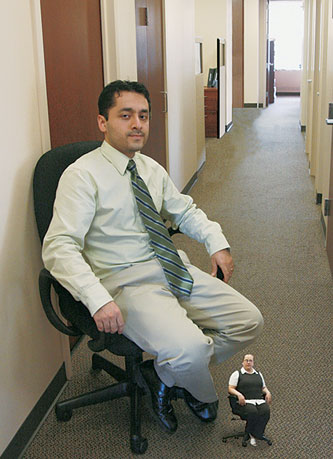
What is relative size?
A monocular depth cue: if two objects are known to be the same size, the smaller-looking one is farther away

How does the Müller-Lyer illusion relate to depth cues?
It is explained via linear perspective — misapplied depth cues distort size perception

What is the Ponzo illusion?
Converging lines make two identical bars look different sizes — the bar in the region of greater apparent depth looks larger

How does the Ames room create a size illusion?
The distorted room exploits size/distance assumptions — people appear to change size as they move across the room
Which size illusions were discussed with depth cues?
Müller-Lyer, Ponzo, Ames room, and the moon illusion

What is motion parallax?
As the observer moves, nearby objects move rapidly across the retina while distant objects change more slowly — a motion-based depth cue

What is optic flow?
Movement through the environment creates a systematic pattern of visual motion; it tells us about self-motion
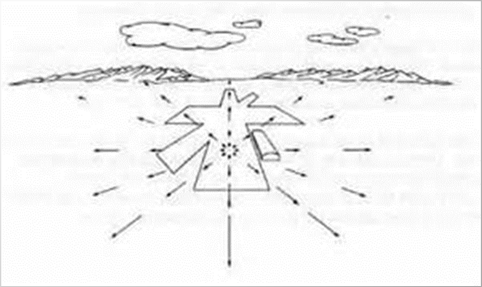
In optic flow, what do expansion and contraction indicate?
Moving toward something → expansion; moving away → contraction
What is apparent motion?
Stationary stimuli shown in rapid succession are perceived as moving
What does apparent motion demonstrate about perceptual processing?
Perception is constructed, not passively recorded

What is the general idea behind Gestalt principles of perceptual organization?
Perception organizes features into coherent wholes — the whole guides perception of elemental features (top-down: the whole constrains the parts)

How do bottom-up and top-down processing differ in perception?
Bottom-up: building a perceptual experience from smaller pieces (feed-forward, without top-down knowledge). Top-down: the whole guides perception of smaller elemental features (feedback, imposing knowledge constraints on bottom-up processing)
True or false: even though objects are perceived from simple features, perception is independent of context
False — perception is NOT independent of context
What properties do neurons in early visual cortex respond selectively to?
Orientation, color, and spatial frequency

Describe the response pattern of an orientation-selective neuron
Weak response to nonpreferred orientation, intermediate response to intermediate orientation, strong response to the preferred orientation

Why is neural evidence described as probabilistic?
Trial-to-trial variability in spike count creates overlapping response distributions — detecting a feature works like SDT (correct rejection, false alarm, miss, hit depending on whether the preferred orientation is present)

What is feature search?
A target defined by one distinctive feature "pops out" — search time changes little as distractors are added

What is conjunction search?
A target defined by a combination of features (e.g., a red vertical line among red horizontal and green vertical lines) — search gets slower as items are added
What does the set-size slope index?
Search efficiency — a flat slope (feature search) means efficient pop-out; a steep slope (conjunction search) means inefficient search
What is texture segregation?
A boundary is easy to detect when adjacent regions differ in a basic feature (orientation, shape, or color) — the boundary appears without tracing individual elements
What is the binding problem?
Early processing represents individual features (e.g., color, orientation) separately, NOT their combinations — so the visual system must group and bind features into coherent objects
Why does binding become especially important when several objects share the same features?
Because a list of separate features is ambiguous about which features belong to which object
What processes help bind features into coherent objects?
Attention and grouping processes
Who was patient HJA and what were his lesions?
Bilateral posterior ventral lesions involving the lingual and fusiform gyri
What could patient HJA do and not do?
He could detect individual features but had difficulty integrating them into coherent object shapes
What does patient HJA's case demonstrate?
Features are processed separately from their binding — binding is a distinct step in object perception
Summarize the evidence that early visual processing is mediated by simple features and that analysis precedes synthesis
Orientation-selective neurons in early visual cortex; feature search pops out while conjunction search is slow (set-size slope); texture boundaries detected from single-feature differences; patient HJA could detect features but not bind them into objects