Evolution
 Call Kai
 Learn
 Practice Test
 Spaced Repetition
 Match
 Flashcards
 Knowt Play
1/49

There's no tags or description
Looks like no tags are added yet.
50 Terms
what is a fundamental definition of a living system?
An imperfect replicating system that evolves by natural selection.
What are the key properties shared by all living organisms?
Order
Evolutionary adaptation
Response to stimuli
Regulation (homeostasis)
Energy processing
Growth and development
Reproduction
What does the property of 'Order' refer to?
The highly organized, non-random structure that characterizes living organisms, from cellular arrangements to macro-structures.
What biological property allows an organism to closely match its surrounding habitat, as seen in camouflaged species?
Evolutionary Adaptation, acquired over generations through natural selection.
What is the smallest unit of biological organization that can perform all activities required for life?
The Cell
Arrange the following biological levels from smallest to largest: Tissue, Organelle, Atom, Cell, Molecule.
Atom → Molecule →Organelle → Cell → Tissue
Arrange the following biological levels from smallest to largest: Organ System, Organism, Organ, Tissue.
Tissue → Organ → Organ System → Organism
Arrange the ecological levels of organization in proper ascending order starting from an individual organism.
Organism → Population →Community → Ecosystem →Biosphere
What is the key difference between a biological 'Population' and a 'Community'?
A population consists of individuals of a single species living in a specified area,
A community consists of all differing populations (multiple species) inhabiting that area.
How does an 'Ecosystem' differ from a biological 'Community'?
An ecosystem includes all living organisms (community) in a given area along with all non-living (abiotic) components of the environment with which they interact.
What are 'Emergent Properties' in biological systems?
New functions or characteristics that arise at each higher level of organization that were not present in the individual components alone.
Why do emergent properties appear as you move up the hierarchy of life?
They emerge from the specific arrangement and interactions of parts as they combine in the correct orientation.
How does assembling bicycle components illustrate the concept of emergent properties?
Disassembled parts cannot provide transportation; the ability to ride (the emergent function) appears only when the parts interact in the correct orientation and assembly.
What is 'Microevolution'?
Changes in allele frequencies within a population across generations.
What is 'Macroevolution'?
Broad-scale phenotypic changes that occur above the species level over long periods of evolutionary time, resulting in speciation and new taxonomic groups.
How is microevolution related to macroevolution?
Persistent accumulation of microevolutionary allele frequency changes over vast geological time ultimately leads to macroevolution and speciation.
What primary scale of evolutionary change is evident in the fossil record?
Macroevolution
In what year did Charles Darwin publish 'On the Origin of Species'?
1859
What phrase did Darwin use to summarize his core concept of evolution before 'natural selection' became widely used?
Descent with modification
What were Darwin's three main observations about nature?
The unity of life (shared ancestry)
The diversity of life (modifications)
The match between organisms and their environment (adaptations)
Which of Darwin's core observations about populations is illustrated by the puffball fungus?
Overproduction of offspring (producing far more offspring than can possibly survive to maturity).
Which of Darwin's primary observations is illustrated by these varying ladybugs and garter snakes?
Variability and heritability of character traits among individuals in a population.
What two inferences did Darwin draw from his observations of trait variability and overproduction of offspring?
Competition for limited resources exists between offspring.
Individuals with favorable, heritable traits leave more offspring, making those characters the 'fittest'.
How is 'Darwinian Fitness' quantitatively measured?
By reproductive success — specifically, the relative contribution an individual makes to the gene pool of the next generation.
Why is the common phrase 'survival of the fittest' often misunderstood in evolutionary biology?
Fitness is defined by relative reproductive output and gene transmission, not simply physical strength or individual longevity.
What is 'Artificial Selection'?
The selective breeding of domesticated plants and animals by humans to encourage the occurrence of desirable phenotypic traits.
How does artificial selection differ fundamentally from natural selection?
artificial selection: human preference determines which individuals reproduce,
natural selection: environmental pressures determine differential reproductive success
What concept did Darwin illustrate in this famous 1837 notebook sketch?
The Tree of Life, illustrating branching descent with modification from a common ancestor.
In a phylogenetic tree or cladogram, what does each numbered branch point (node) represent?
The most recent common ancestor shared by all descendant lineages branching beyond that node.

Which derived trait is shared by mammals, lizards, crocodiles, and birds, but absent in amphibians?
The Amnion (amnion boundary at node 3).

Based on the clade below, which taxon shares the most recent common ancestor with Crocodiles?
Birds (Ostriches, Hawks, and other birds, branching at node 5).
How can natural selection cause a single ancestral population to diverge into distinct species?
Subpopulations occupying different environmental niches face distinct selective pressures, accumulating diverse adaptations over generations until reproductive isolation occurs.
What are 'Homologous Structures'?
Anatomical features in different species that share a common evolutionary origin, even if their current functions differ.
What are 'Vestigial Homologies'?
Remnants of structures that served important functions in an organism's ancestors, but currently have reduced or no function.
In molecular evolutionary studies, what does a lower number of amino acid differences in Cytochrome C indicate?
A closer evolutionary relationship and a more recent common ancestor between the compared species.
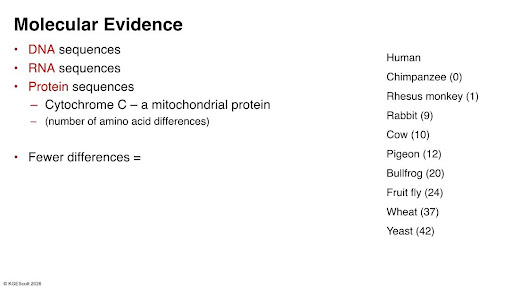
Which organism shares the most recent common ancestor with Humans?
The Chimpanzee (0 amino acid differences).
What general trend is observed in the fossil lineage of horses over the past 55 million years?
A transition from small-bodied forest browsers with short teeth to large-bodied open-grassland grazers with high-ridged teeth.
What is 'Divergent Evolution'?
The process where lineages originating from a common ancestor evolve distinct phenotypic traits as they adapt to different environments.
What is 'Convergent Evolution'?
The independent evolution of similar functional features in distantly related lineages due to similar environmental pressures.
What are 'Analogous Structures'?
Structures in different species that share similar functions and appearances but arose independently through convergent evolution, without shared ancestry.
Comparing Homologous structures to Analogous structures, which type provides evidence of shared common ancestry?
Homologous structures reflect common ancestry, whereas analogous structures reflect independent adaptation to similar environments.

Why are the streamlined body forms of Dolphins (mammals) and Ichthyosaurs (reptiles) considered analogous structures?
They evolved independently in separate mammalian and reptilian lineages due to similar selective pressures in aquatic environments, not from a shared aquatic ancestor.
According to the Biological Species Concept, what defines a 'species'?
A group of populations whose members have the potential to interbreed in nature and produce viable, fertile offspring.
How is a 'Mass Extinction' quantitatively defined in macroevolutionary history?
A period during which >50% of all extant species on Earth go extinct across geological time.
How many major mass extinction events are traditionally recognized in Earth's fossil record?
Five (5) agreed-upon mass extinctions.
Which major mass extinction event occurred 251 million years ago, resulting in the loss of >80% of species?
The Permian Mass Extinction (marking the boundary between the Paleozoic and Mesozoic eras).
In macroevolution, what ecological benefit do mass extinction events offer surviving species?
They vacate ecological niches, driving natural selection and allowing surviving lineages to expand and adaptively radiate.
Which event occurred first in Earth's history: the appearance of eukaryotic cells or the accumulation of atmospheric oxygen?
The accumulation of atmospheric oxygen (produced by early photosynthetic prokaryotes) occurred before the origin of eukaryotic cells.
Why is it incorrect to view evolution as having a predetermined 'goal' or directed path toward complex organisms?
Evolution is an unguided process driven by natural selection acting on random genetic mutations in response to changing local environments.
In evolutionary biology, what term describes traits that increase an individual's ability to survive and reproduce in a specific environment?
Adaptations