Lecture 16: Carbohydrate structure and Support
 Call Kai
 Learn
 Practice Test
 Spaced Repetition
 Match
 Flashcards
 Knowt Play
1/29

There's no tags or description
Looks like no tags are added yet.
30 Terms
Carbohydrates are hydrated carbons
• General chemical formula = (C·H2O)n
This is why molecules are considered carbohydrates (water spanning across the carbon backbone)
• The suffix -ose is used to denote a carbohydrate.
• Carbohydrates vary in size and structure
• Can be modified – dramatically increasing their complexity.
E.g. glucose-6-phosphate: adding a phosphate
Deoxyribose: losing a hydroxyl group
Acetyleglucosamine and glycosylation (a serine molecule)
• Carbohydrates participate in a many biological and physiological processes

Carbohydrates are also a source of energy
• One for the energy-producing macronutrients found in the diet
can extract alcohol (calories), energy, lipids, and proteins
• Recommended Dietary Allowance (RDA) = 130 g/day (needs this much glucose per day to fuel processes)
• Amount of glucose used by neurons each dayFigure. 2.14, Smolin et al, 2020
Naming and describing carbohydrates
• One carbohydrate = a monosaccharide
• Aldoses contain an aldehyde group (aldehyde containing group)
• Ketoses contain a ketone group (keystone continuing group)
Numbering carbohydrates
for
Ketose: the number begins from the highest carbon
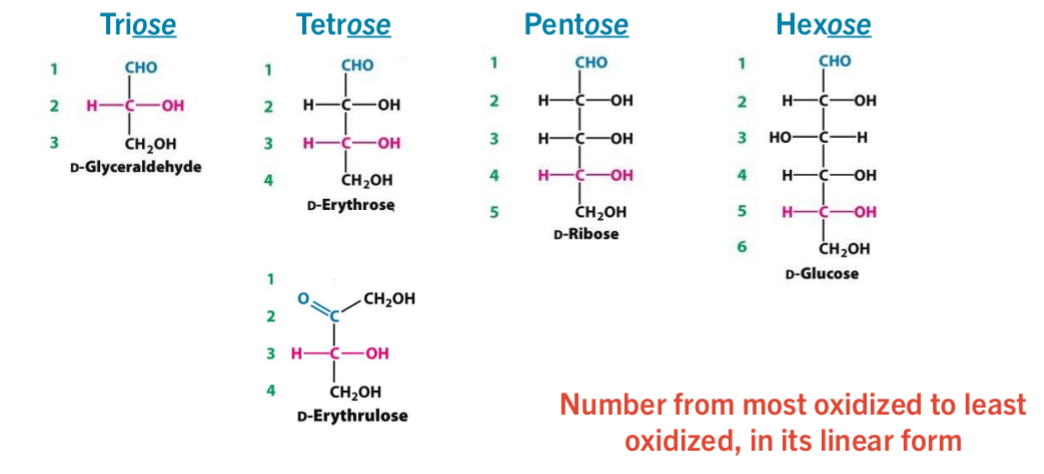
Carbohydrates often have chirality
In a Fisher Projection:
• if the –OH is on the left = l (isomer)
• if the –OH is on the right = d (deisomer)
Naming
naming each individually
Or naming the carbon farthest away L or D

Shortcut to determine isomers
2^n = number of total isomers
Glucose vs Fructose
both are pentose
glucose is an aldose and fructose is a ketose
both are D-isomers
Both are hydrophilic

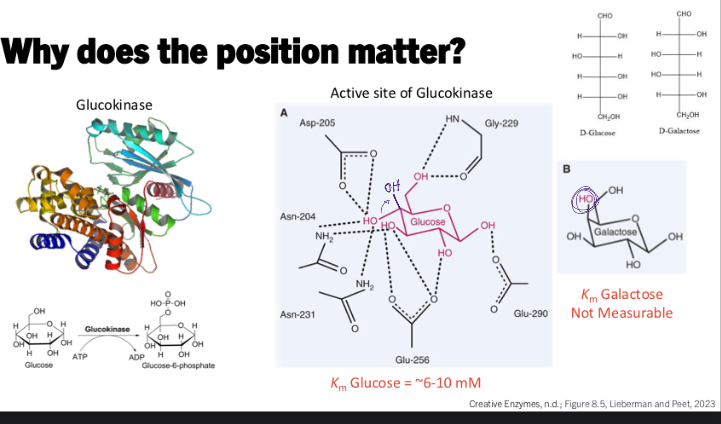
Glucokinase
Glucose fits to the active site with km = 6-10 mM
is measuring the enzyme with galactose (one chiral center is flipped) and no activity with kinase (can’t interact with proper stability)
Carbohydrates can form rings
lots of nucleophilic attacks, results in a ring, cyclic ring to form (intramolecular reaction)
• Aldehydes, ketones and hydroxyl
groups are very reactive.
• Intramolecular hydroxyl groups
attacks the carbonyl group,
forming the ring.
• The new bond may be a:
• Hemiacetal: aldehyde derivative
• Hemiketal: ketone derivative
Cyclization forms anomers and is reversible
• Haworth projections let you ‘see’ cyclic sugars in 3D.
• Cyclization results in the formation of two (2) additional chiral structures (anomers).
• alpha () – the -OH is under the ring
• beta () – the -OH is above the ring
• Intramolecular cyclization is reversible in solution.
The linear form is not often there (because it is not stable in a solution)
Beta is more common, more stable because no steric hindrance and stay in that structure longer (again can still move to a form)

Linear carbohydrates are reducing sugars
• A reducing sugar is a carbohydrate that contains a free aldehyde or ketone group.
Can react with itself or with another molecule to form a very reactive linear form of the carbohydrate
• Allows it to act as a reducing agent by donating electrons to another molecule (the oxidizing agent) in a chemical reaction and become oxidized itself
• Reducing sugars are very reactive due to the free carbonyl group

Hemoglobin A1C
• Reducing sugars will react with other proteins and lipids spontaneously, contributing to disease.
• For example, glucose in the blood will react with the N-terminal Valine on hemoglobin, producing a glycated hemoglobin.
• Red blood cell life-span = 90-120 Days
• Ranges (Diabetes Canada):
• Normal: less then 6%
• Prediabetes: between 6-6.4%
• Diabetes: Greater then or equal to 6.5%
High levels indicate a prolong period of high blood [glucose’
Carbohydrates in the energy drink is known as a reducing sugar
Therefore more glucose, more glycated hemoglobin (cannot be undone)
Not glycosylation: a post-translational change that can be undone

Glycosidic bonds hold carbohydrates together
• Monosaccharides are joined by glycosidic linkages to form disaccharides and more complex structures.
• Catalyzed by an enzyme.
• Glycosidic bond formation is a condensation reaction where H2O is produced.
• Cleaving glycosidic bonds requires H2O (Hydrolysis).

Glycosidic bonds are also ⍺ or β

Variations of Glycosidic bonds: N- or O-linked
• N-linked or O-linked glycosidic bonds
• Intermolecular glycosidic bonds formed between an
amine or hydroxyl and a reactive anomeric carbon.
• e.g. DNA and RNA bases
• e.g Glycoproteins may be O-linked (Ser/Thr) or N-
linked (Asn)

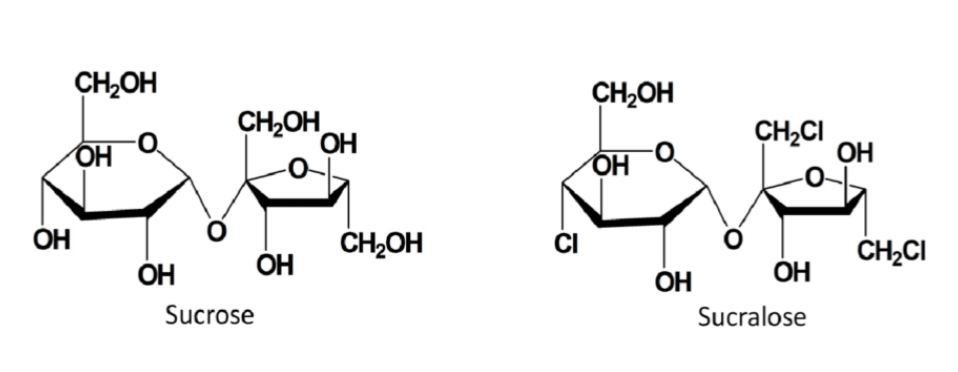
Sucrose vs sucralose
better levels of HbA1C, but hypoglycaemia still occurs
The sucralose cannot bind to enzyme and break it down into glucose
It is very hydrophilic, making it unable to break down and will be excreted out of the body
Carbohydrates can be complex
• Monosaccharides – 1 sugar
• Disaccharides – 2 sugars
• Oligosaccharides – 3 to 20 sugars
• Polysaccharides – up to 1000s
Polysaccharides can serve many functions
• Important for energy storage, cellular structure, and protein recognition.
• Can be linear or branched polymers.
• Also known as glycans.
• Homopolymer: same monosaccharide.
• e.g. only made as glucose molecules: starch (polysaccharide), cellulose (dietary fiber) and glycogen (homoglycans).
• Heteropolymer: different monosaccharides.
• e.g. sugars found in glycoproteins (heteroglycans).
Starch – energy storage in plants
• Amylose:
• unbranched glucose units (i.e. linear)
• α(1→4)-linkages
However these linear forms can form helical shapes in 3D
• Amylopectin:
• linear glucose chains joined by α(1→4)-linkages.
• α(1→6)-linkages at branch points every 30 glucose units.
• Humans can hydrolyze starch to release free glucose molecules.

Glycogen – energy storage in animals
• A storage form of long, branched chains of glucose.
• Linear glucose chains joined by α(1→4)-linkages.
• α(1→6)-linkages at branch points every 8-12 glucose units (more branches than starch).
• Contains a dimer of glycogenin at the centre.
• Glucose units are added and removed from the non-reducing ends from enzymes (opposite from the endomeric carbon.
• Found in the liver and muscle (maintains glucose levels).
Cellulose – structure and support
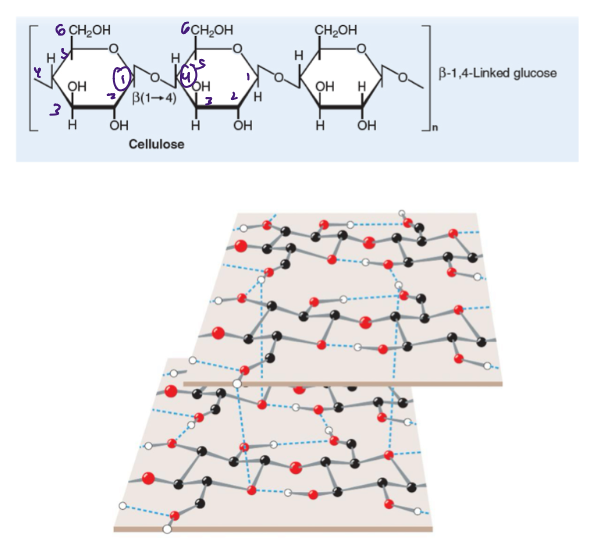
• The most abundant organic compound, serving a structural role in plants.
• Unbranched chains of glucose units are joined by β(1→4) linkages
• Many hydrogen bonds provide strength. Forming sheets
• Cellobiose is a disaccharide of glucose linked by β(1→4) .
• Humans cannot hydrolyze cellulose (because there is no enzyme that can bind and stabilize the structure to allow a hydrolysis reaction to occur)

Digesting carbohydrates
• Cells can only transport and use monosaccharides.
• Disaccharides/polysaccharides must be broken down to monosaccharides by digestive enzymes before they can be absorbed and used.
• Key digestive enzymes include α-amylase (a 1-4, breaks down starch, not found in the stomach), maltase (a 1-4), isomaltase (b 1-4), lactase (breaks lactose fructose and glucose) and sucrase (breaks down sucrose).
• Humans do not express a cellulase enzyme.
• These enzymes are released by the salivary glands, pancreas and embedded in enterocytes in the microvilli to help with absorption.
dietary fibres are release from the ody )cannot be broken down by the body)

How to identify and number the carbon
Find the anomeric carbons (most bonds to oxygen)
Number the carbons
Assign alpha or betas

Why carbohydrate structure is important for digestions
affects the enzymatic rate To break it down into monosaccharides which then gets absorbed into the blood (polysaccharides are not getting absorbed)
Transporting glucose
• Moving glucose around the body is critical.
• Glucose is a very polar molecule and cannot diffuse through the lipid bilayer.
• Transporters help move glucose from one area to another based on the concentration gradient and their binding affinity.
• Different cells will use different
glucose transporters
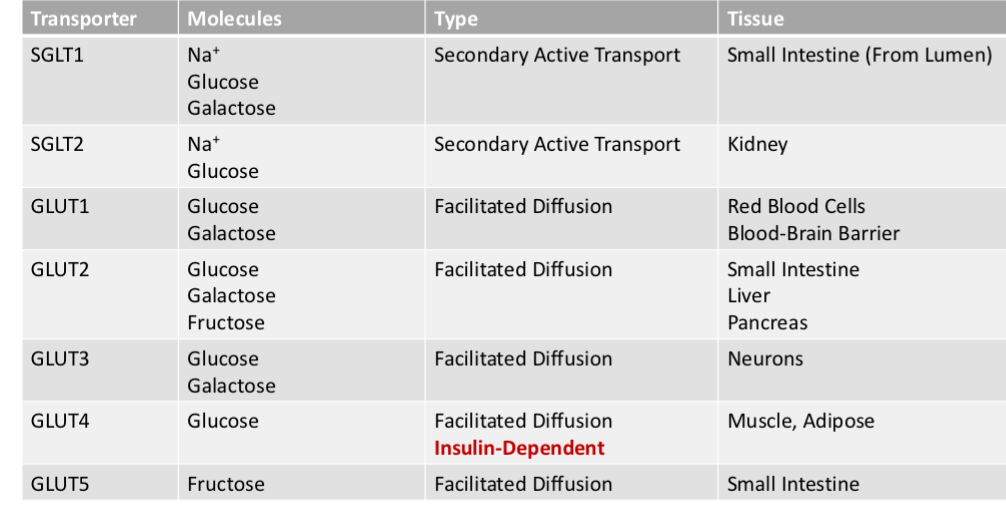
• Sodium-Glucose Co-transporters
• Secondary Active Transport
• Glucose Transporters
• Facilitated Diffusion
• Fructose Transporters
• Facilitated Diffusion

A few of the glucose transporters (MUST MEMORIZE ALL)
Working together to transport glucose
the blood brain barrier, glut1 involved
For the neurons, glut 3 involved

Fasting, explain the transporters
km = 4-5.5

Fed state, explain the transporters
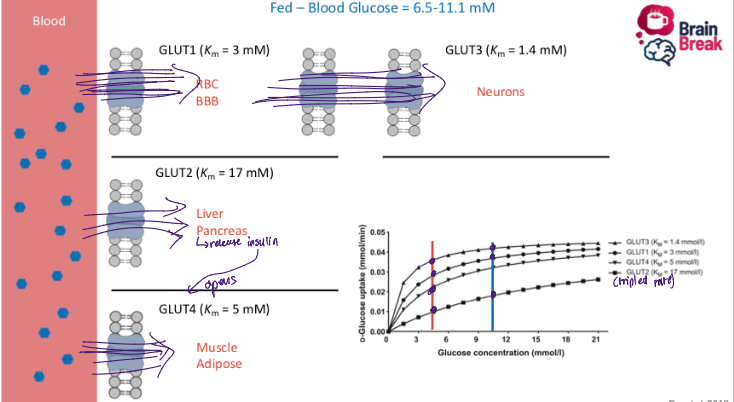
Issue with insulin injections
insulin opens the GLUT4 transporters, but if there is not enough glucose (therefore there is all the glucose going into muscles and adipose cells) and there is a drop in glucose