Unit 3, Chapter 6: Cellular Respiration
 Call Kai
 Learn
 Practice Test
 Spaced Repetition
 Match
 Flashcards
 Knowt Play
1/44

45 Terms
Define Cellular Respiration as a Process
Cellular respiration is the process by which cells create usable chemical energy in the form of ATP via a series of biochemical reactions, involving the breakdown of glucose molecules.
Define Aerobic Cellular Respiration
Aerobic respiration is the process by which cells use glucose and oxygen to produce ATP, and by products of carbon dioxide, and water. This can only occur in the presence of oxygen.
State the Chemical Equation of Aerobic Cellular Respiration

List the 3 Stages of Aerobic Cellular Respiration
Glycolysis
Krebs Cycle
Electron Transport Chain
Briefly Outline the Purpose of Glycolysis
Glycolysis is the first stage of aerobic cellular respiration, which occurs in the cytosol and involves the conversion of glucose into 2 pyruvate molecules, creating 2 ATP and 2 NADH molecules in the process.
Briefly Outline the Purpose of the Link Reaction
The link reaction is the step in between glycolysis and the Krebs cycle, during which pyruvate is converted to acetyl-CoA, which can then enter the Krebs cycle.
Briefly Outline the Purpose of the Krebs Cycle
The Krebs cycle is the second stage of aerobic cellular respiration in which a series of chemical reactions occur in the mitochondrial matrix to produce high-energy coenzymes - 2 FADH2 and 6 NADH with byproducts of 2 ATP and 4 CO2 for every 2 pyruvate molecules (for every one glucose molecule).
Briefly Outline the Purpose of the Electron Transport Chain
The electron transport chain is the third stage of aerobic cellular respiration, occuring in the mitochondrial cristae/inner membrane, in which energy from electrons unloaded from the NADH and FADH2 is harnessed to generate large amounts of ATP (26 or 28 ATP per glucose molecule).
Define Pyruvate
Pyruvate is a 3 carbon molecule that can be formed from the breakdown of glucose during glycolysis.
Define NAD+ and NADH
NAD+ and NADH are coenzymes that acts as proton (H+) and electron carriers in cellular respiration. NAD can cycle between NAD+ and NADH forms, depending on the reaction it takes part in.

Identify the Inputs and Outputs of Glycolysis
Inputs:
1 glucose (C6H12O6)
2 NAD+ + H+
2 ADP + Pi
Outputs:
2 pyruvate
2 NADH
2 ATP
Identify the Fates of the Outputs of Glycolysis
The 2 ATP are free to be used to power cellular reactions
The 2 NADH are transported to the mitochondria for the electron transport chain
The 2 pyruvate are converted to Acetyl-CoA to enter the Krebs Cycle
Define FAD and FADH2
FAD and FADH2 are coenzymes that acts as proton (H+) and electron carriers in cellular respiration. FAD can cycle between FAD and FADH2 forms, depending on the reaction it takes part in.

Define Acetyl-CoA
Acetyl-CoA is a 2 carbon molecule that is the primary product of the link reaction where pyruvate is cojugated to CoA (coenzyme A), creating the primary input of the Krebs cycle.
Identify the Inputs and Outputs of the Krebs Cycle
Inputs:
2 acetyl-CoA
6 NAD+ + 6 H+
2 FAD + 4 H+
2 ADP + P
Outputs:
4 CO2
6 NADH
2 FADH2
2 ATP
Identify the Fates of the Outputs of the Krebs Cycle
The 2 ATP are free to be used to power cellular reactions
The 6 NADH are transported to the mitochondria for the electron transport chain
The 2 FADH2 are transported to the mitochondria for the electron transport chain
The 4 CO2 molecules are waste products that diffuse out of the cell
Define ATP Synthase
ATP synthase is an enzyme in the inner mitochndrial membrane that facilitates the movement of H+ ions across the membrane and down their concentration to power the synthesis of ATP from ADP+Pi.
Identify the Inputs and Outputs of the Electron Transport Chain
Inputs:
6 O2
10 NADH
2 FADH2
26 or 28 ADP + P
Outputs:
6 H2O
10 NAD+ + 10 H+
2 FAD + 4 H+
26 or 28 ATP
Briefly Describe how the Electron Transport Chain Works
NADH and FADH2 unload electrons and protons
Electrons power the active transport of H+ into the intermembrane space
The build-up of H+ in the intermembrane space creates a steep proton gradient
The H+ have to diffuse back across the inner membrane via ATP synthase
ATP synthase spins as H+ goes through, generating energy which is allows ADP+Pi to become ATP
Identify the Role of O2 in the Electron Transport Chain
After the protons and electrons from NADH and FADH2 have passed through the electron transport chain, oxygen binds with H+ ions and electrons to form harmless water molecules.
O2 + H+ + e- = O2 + H = H2O
Define Anaerobic Fermentation
Anaerobic fermentation involves the breakdown of glucose and production of ATP via the process of glycolysis, which can occur in the absence of oxygen.
Explain Why Aerobic Cellular Respiration Cannot Occur in the Absence of O2
In anaerobic conditions, protons and electrons can’t bond with O2 to form water, which is required for the electron transport chain. Without the ETC, the loaded coenzymes NADH and FADH2 cannot drop of their electrons to be converted back to NAD+ and FAD, which are required inputs of the Krebs cycle and glycolysis (only NAD+ for the latter).
State the Worded Equation for Lactic Acid Fermentation
glucose —> 2 lactic acid + 2 ATP
State the Worded Equation for Ethanol Fermentation
glucose —> 2 ethanol + 2 CO2 + 2 ATP
Describe the General Process of Anaerobic Fermentation
Glucose is broken down into 2 pyruvate during glycolysis
This produces 2 ATP and 2 NADH
Pyruvate is broken down into lactic acid (in animals) or ethanol and CO2 (in yeast and certain bacteria
This reaction is necessary to cycle NADH back to NAD+ for reuse in glycolysis
Explain why Anaerobic Fermentation Cannot Continue Indefinitely
The byproducts of lactic acid or ethanol cannot accumulate indefinitely as they can become toxic in high amounts.
Briefly Explain what Happens to the Byproducts of Anaerobic Fermentation when O2 Returns
Lactic acid is metabolised back into pyruvate and used for aerobic cellular respiration (link reaction and then into Krebs cycle)
Ethanol can be converted to acetyl-CoA and used for aerobic cellular respiration (into Krebs cycle)
List 5 Factors that Affect Cellular Respiration Rates
Temperature
pH
Glucose concentration
O2 concentration
Enzyme inhibition
Describe the Impact of Temperature on Cellular Respiration Rates
Cellular respiration and ATP production rates are highest when the temperature aligns with the enzyme’s optimal temperature. Below the optimal point, enzymes and substrates collide less frequently with less kinetic energy, and above it enzymes can begin to denature.

Describe the Impact of pH on Cellular Respiration Rates
Cellular respiration and ATP production rates are highest when the pH aligns with the enzyme’s optimal pH. Above or below the optimal point, enzymes can begin to denature.

Describe the Impact of Glucose Concentration on Cellular Respiration Rates
Since glucose is the input for glycolysis, required for both pathways of cellular respiration, increased glucose concentrations increase rates of cellular respiration until rates plateau due to enzyme saturation or another limiting factor.

Describe the Impact of O2 Concentration on Cellular Respiration Rates
Since oxygen is necessary for the electron transport chain in aerobic respiration, increased O2 concentrations increase rates of aerobic cellular respiration until rates plateau due to enzyme saturation or another limiting factor. If oxygen levels become too low, cells will have to undergo anaerobic fermentation to produce energy instead.

Describe the Impact of Enzyme Inhibition on Cellular Respiration Rates
Enzyme inhibitors can influence the functions of enzymes involved in cellular respiration:
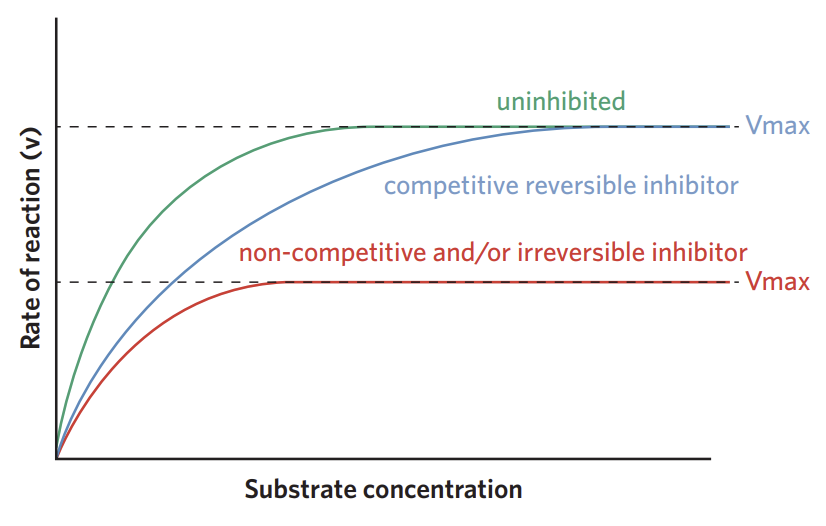
NOTE: End-product inhibition and other feedback loops involving enzyme inhibition can make respiration more efficient (eg. pausing glycolysis when cellular ATP levels are high).
Define Bioefuel
Biofuel is fuel created from biomass (organic material) that offers an alternative to traditional fossil fuels.
Compare the Renewability of Biofuels and Fossil Fuels
The biomass used to create biofuels only takes months or years to grow and the processing of biomass can occur within days. This makes biofuels renewable.
Fossil fuels are formed over tens of millions of years from the remains of dead organic material. This makes fossil fuels non-renewable.
Compare the Carbon Footprint of Biofuels and Fossil Fuels
Biofuels can be carbon neutral if the CO2 released from their combustion is proportionate to the amount absorbed by the photosynthesising biomass that becomes the fuel
Fossil fuels are a major contributor to global CO2 emissions, as they release significant amounts of CO2 that is not offset
List 4 Steps of the General Process of Creating Bioethanol
Deconstruction of biomass
Digestion of biomass by enzymes
Ethanol fermentation
Purification and dehydration of ethanol
Describe the Step of Deconstruction (Bioethanol Step 1)
The biomass is treated to help it break down enough to make fermentation more efficient, breaking down the cell walls and cellulose (eg. through grinding, enzyme breakdown, exposure to acids, heating, etc.).
Describe the Step of Digestion by Enzymes (Bioethanol Step 2)
The broken down biomass is exposed to enzymes which break down the starch and cellulose into glucose and other sugars, aided by the presence of water (hydrolysis).
Describe the Step of Ethanol Fermentation (Bioethanol Step 3)
Yeast (or other bacteria) are used to facilitate the anaerobic fermentation of the sugars, producing a large amount of ethanol. This ethanol diffuses from the yeast cells and is harnessed for biofuel.
Describe the Step of Purification and Dehydration (Bioethanol Step 4)
The ethanol is distilled via water removal, converting it to a usable form. It is then purified and ready for distribution as liquid fuel.
Define First Generation Biofuels
Biofuels produced from edible food crops such as corn or sugarcane. These can directly compete with agricultural land.
Define Second Generation Biofuels
Biofuels produced from non-edible crops such as agricultural and forestry waste/residues and municipal waste. These typically do not directly compete with agricultural land.
Identify 3 Positive Implications of Biofuel Use and Production
Climate impact (as fossil fuel alternatives that may help to reduce climate change through lower carbon neutrality)
Energy security (renewable source of energy that could help meet growing demands and reducing our reliance on finite fuel sources)
Localised energy (can be sourced and farmed around the globe, reducing international reliance on fossil fuel imports and exports, which could also decentralise control over fuel supplies)
Identify 3 Negative Implications of Biofuel Use and Production
Food vs Fuel (food demands will grow with energy demands, so using viable cropland for harvesting biomass may decrease necessary agricultural output)
Cost and Difficulty of Uptake (typically more costly to produce than typical fuels and may not be compatible with current vehicles and machinary and the scale of the industry is small in compared to fossil fuels, making it difficult to penetrate the market)
Second Order Environmental Impacts (increased nitrous oxide emissions, deforestation for biomass, and potential reduction of crops genetic diversity in some species)