Art History Quiz 4
 Call Kai
 Learn
 Practice Test
 Spaced Repetition
 Match
 Flashcards
 Knowt Play
1/92

There's no tags or description
Looks like no tags are added yet.
93 Terms

The Spread of the Islamic Caliphate
Arabia to Spain and Central • c. 622–750 CE Asia
Qibla
the direction Muslims face to pray, toward the Ka'ba in
Mecca.

The Ka'ba, al-Haram Mosque, Mecca
Mecca, Saudi Arabia • pre-Islamic shrine
Mihrab
a prayer niche, usually concave in shape with an arched
top, located in the qibla wall of a mosque and indicating
the direction of Mecca.

The Dome of the Rock
Jerusalem — Umayyad period
• c. 691–92 CE
Minaret
a tower at a mosque; can be used to give the call to prayer
and also functions as a visible marker of the mosque on the
skyline.

The Dome of the Rock
(Cross-Section)
Jerusalem — Umayyad period • c. 691–92 CE
Qibla wall
the wall in a mosque that indicates the direction toward
which Muslims face to pray, usually indicated by the
presence of a mihrab
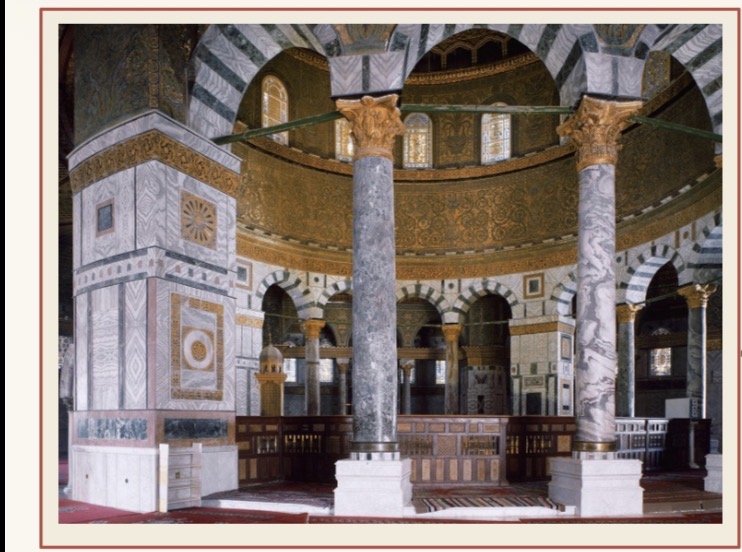
The Dome of the Rock (Interior)
Jerusalem — Umayyad period • c. 691–92 CE
Minbar
a stepped pulpit from which the sermon at Friday noon
prayer is given in a mosque; usually placed directly next to
the mihrab on the qibla wall.

The Great Mosque of
Damascus
Damascus, Syria — Umayyad
period • c. 715 CE
Aniconism
opposition to visual depictions of living creatures or
religious figures.
EUROPE
Aral
Sea

The Great Mosque of Damascus
(Plan)
Damascus, Syria — Umayyad period • c. 715 CE
Pendentive
a curved triangular wall section linking dome with a
supporting vertical pier or wall.

Mosaics, West Portico, Great Mosque
of Damascus
Damascus, Syria — Umayyad period • c. 715 CE
Apse
a recess at the end of an interior space, often
semi-circular, and typically reserved for someone or
something important, such as the altar in a church or
the throne of a ruler.

Umayyad Prince, Khirbat al-Mafjar
near Jericho — Umayyad period • c. 724–44 CE
Icon
a painted or mosaic image of a holy figure, used in
prayer and devotion.

Spiral Minaret,
Great Mosque of al-Mutawakkil
Samarra, Iraq — Abbasid period • 848–52 CE
Narthex
the entrance hall or vestibule of a church.

Stucco Wall Panel from a Private
House, Samarra
Samarra, Iraq — Abbasid period • c. 836–93 CE
Iconoclasm
the intentional destruction or rejection of images on
religious or political grounds.

Mihrab and Minbar, Great Mosque of
Qayrawan
Qayrawan, Tunisia — Abbasid period • 862–63 CE
Pantocrator
"ruler of all": a frontal image of Christ as universal ruler
and judge, usually placed in a dome or apse

Folio from the Blue Qur'an
Tunisia, probably Qayrawan — Abbasid • c. 850–950 CE

Folio from a Qur'an
Copied by Ibn al-Bawwab
Baghdad, Iraq — Abbasid period • 1000–1001 CE

The Byzantine Empire
Constantinople and the eastern Mediterranean
• c. 540–1450 CE

Hagia Sophia
Constantinople (Istanbul),
Turkey
• 532–37 CE

Hagia Sophia (Interior)
Constantinople (Istanbul), Turkey • 532–37 CE

Methods of Supporting a Dome

Church of San Vitale (Cutaway and
Plan)
Ravenna, Italy • c. 546 CE

Justinian and His Entourage
Apse mosaic, San Vitale, Ravenna • c. 546 CE

Theodora and Her Entourage
Apse mosaic, San Vitale, Ravenna • c. 546 CE

Virgin and Child with Angels and
Saints
Monastery of St. Catherine, Mount Sinai, Egypt • c. 700 CE

The Crucifixion with Iconoclasts,
Khludov Psalter
Byzantine manuscript • c. 850–75 CE

Christ as Pantocrator, Church of the
Dormition, Daphni
Daphni, Greece • c. 1090–1100 CE

The Virgin of Vladimir
Constantinople (Istanbul), Turkey • c. 1131 CE

Lamentation
Nerezi, Macedonia • 1164 CE

Deësis, Hagia Sophia
South gallery, Constantinople • c. 1261 CE

Anastasis
Church of Our Savior in Chora, Constantinople
• 1316–21 CE

Purse Cover from the Sutton Hoo
Ship Burial
Suffolk, England • c. 625 CE
Cloisonné
decorative enamelwork technique in which cut
gemstones, glass, or colored enamel pastes are
separated into compartmented designs by
flattened strips of wire.

St. Matthew, from the Book of
Durrow
Durrow, County Laois, Ireland • c. 650–700 CE
Codex
a handwritten bound book

St. Matthew, from the Lindisfarne
Gospels
Lindisfarne, Northumberland, England • c. 698–721 CE

Carpet Page, from the Lindisfarne Gospels
Lindisfarne, Northumberland, England • c. 715–20 CE

Chi-Rho-Iota Page, from the Book of
Kells
Possibly Iona, Scotland • c. 750–800 CE

Muiredach Cross
Monasterboice, County Louth, Ireland
• 923 CE

The Carolingian Empire
Western Europe • 768–843 CE

Palatine Chapel (Plan), Aachen
Aachen, Germany • 792–805 CE

Palatine Chapel (Interior), Aachen
Aachen, Germany • 792–805 CE

Charlemagne's Throne, Palatine
Chapel
Aachen, Germany • chapel built 792–805 CE

Plan of an Ideal Monastery
from Reichenau, Germany • c. 816–37 CE

St. Matthew, from the Coronation
Gospels
Charlemagne's court workshop • c. 800–10 CE

Front and Back Covers of the Lindau
Gospels
Lindau, Germany; Saint-Denis, France • c. 760–890 CE

Abbey of St. Michael (Plan)
Hildesheim, Germany • 1001–31 CE

Column of Bishop Bernward
originally St. Michael's; now Hildesheim
Cathedral • c. 1000 CE

Doors of the Abbey of St. Michael
Hildesheim, Germany • 1015 CE

The Theological Program of
the Doors
Hildesheim, Germany • 1015 CE

Gero Crucifix
Cologne Cathedral, Germany • c. 970 CE
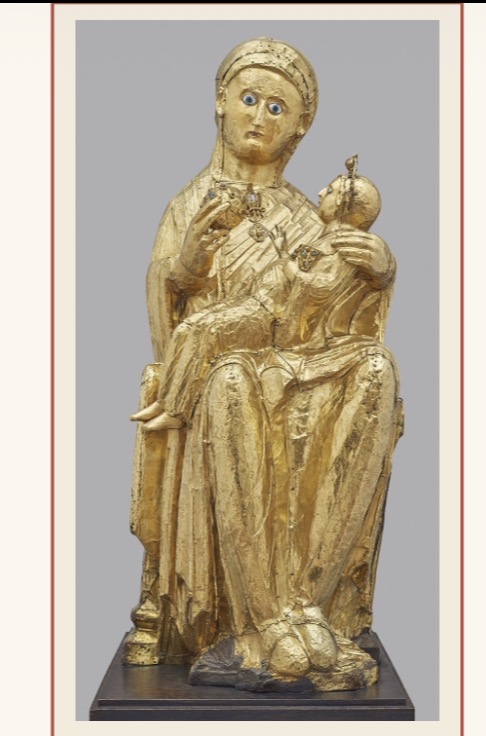
Golden Madonna of Essen
Essen, Germany • 973–82 CE

Oseberg Burial Ship
Tønsberg area, Norway • c. 815–34 CE

Prow of the Oseberg Burial
Ship
Tønsberg area, Norway • c. 815–34 CE

Stave Church of St. Andrew
Borgund, Norway • c. 1180–1250 CE

Carved Portal and Wall Reliefs,
Stave Church at Urnes
Urnes, Norway • c. 1080–1130 CE

The Americas, 600–1300 CE
North, Central, and South America • 600–1300 CE
Hieroglyph
a type of written script that uses conventionalized signs to represent concepts,
sounds, or words.

Chocolate Vessel with Palace Scene
Maya • c. 600–900 CE
Fresco
wall or ceiling painting on wet plaster (also called true or buon fresco). Wet
pigment merges with the plaster.

Presentation of Captives to Lord
Chan Muwan (Reproduction)
Bonampak, Mexico — Maya • c. 791 CE
Lintel
a horizontal support above a door or other opening.

Portrait Head of Pakal
Temple of the Inscriptions, Palenque, Mexico • c. 683 CE
Stele
a carved stone slab that is placed upright and often features commemorative
imagery and/or inscriptions.

Sarcophagus Lid (Detail), Tomb of
Pakal
Temple of the Inscriptions, Palenque, Mexico • c. 683 CE
Sarcophagus
a container for human remains.

Mosaic Funeral Mask of Pakal
Palenque, Mexico — Maya • c. 683 CE
Roof comb
lattice structure surmounting the roof of a temple; often used to support
monumental sculptur
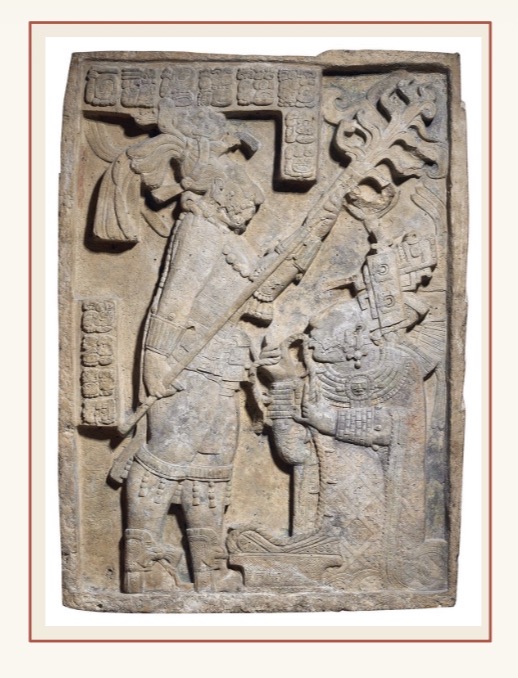
Shield Jaguar II and Lady K'ab'al
Xook, Lintel 24
Temple 23, Yaxchilan, Mexico • c. 725 CE
Atlantid
monumental figural sculpture that serves to hold up a roof or other
architectural element.

Temple 1, Tikal
Tikal, Guatemala • c. 734 CE
Zoomorphic
having an animal-like form.

Central Ball Court, Copán
Copán, Honduras • completed 738 CE
Rammed-earth
building technique in which damp earth is compressed within a frame or mold,
to form a solid structure.

Great Serpent Mound
Adams County, Ohio • c. 1070 CE (dating debated)
Effigy
a sculpture or model, usually created for its symbolic and/or material value in
relation to the thing it represents.

Pipe, Adena Culture
Ohio • c. 100 BCE–100 CE
Kero
an Andean decorated drinking cup used in feasts.

Central Cahokia as It Would Have
Appeared About 1150–1200
near present-day St. Louis • c. 1150–1200 CE
Gorget
an object worn near the neck area as a costume item.

Pueblo Bonito
Chaco Canyon, New Mexico — Pueblo culture • 830–1250 CE

Seed Jar
Ancestral Puebloan • c. 1050–1250 CE

Gorget with Running Warrior
Sumner County, Tennessee • c. 1250–1350 CE

Mimbres Bowl with Two Cranes and
Geometric Motifs
New Mexico • c. 1250 CE