Microbio Exam 3: Microbial Ecology and environmental microbiology
 Call Kai
 Learn
 Practice Test
 Spaced Repetition
 Match
 Flashcards
 Knowt Play
1/30

Earn XP
Description and Tags
Lecture 13 (Chapters 21-22)
31 Terms
What do animal-associated microbial communities provide for their hosts?
Can provide essential components for hosts.
Bacterial Provisions for hosts examples
Bacteria can encode enzymes to synthesize nutrients that are limited in the host’s diet (can allow invasive stinkbugs to colonize wide range of plants)
Population
Group of individuals of one species living in a common location
Ecosystem
Populations of species plus their habitat/environment.
Microbiome
Microbes associated with a host or animal/plant
Metagenome
The sum total of all DNA sequences from an environmental sample.
Environment can be any natural or human-made environment or the microbiome of a plant or animal
The DNA sequence obtained directly from a mixture of genomes.
How are environmental taxa’s identified?
SSU rRNA sequencing
Requirement for sampling
First, defining a target community to study
Steps of Samping/Sequencing
Separating the microbes from their physical environment
Break open the cells
Isolate the DNA
Drawback/Benefit of Different DNA Isolation methods
Different methods may lead to different view of a metagenome.
Single universally applied method can allow for comparison across projects.
Multiple extraction methods may maximize coverage for all genomes in a sample
What is the purpose of a preliminary metagenomic screen?
To asses sequece diversity in a microbial community.
What is metabarcoding?
Using NGS to sequence SSU rRNA genes and identify taxa in a microbial community.
What are operational taxonomic units (OTU)’s?
Groups of similar DNA sequences used as a metagenomic approximation of species.
What must be constructed before complete metagenomic sequencing?
A DNA library.
What are the three steps of making a DNA library?
Concentrate DNA
Fragment DNA by size
Add adapters to fragment ends
What is the purpose of adding adapters to DNA fragments?
To prepare DNA fragments for sequencing by allowing them to interact with the sequencing platform.
What happens after DNA sequencing?
Computer analysis assembles overlapping sequences into scaffolds and helps reconstruct genomes.
How are DNA sequences assembled into genomes?
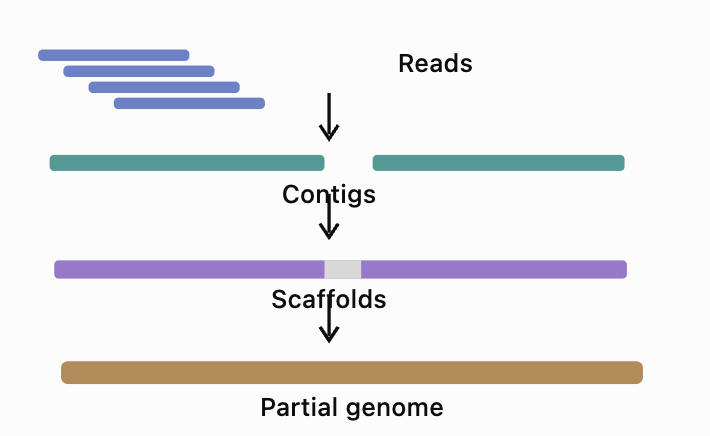
Overlapping DNA fragments (reads) are assembled into contigs, then scaffolds, and eventually patial genomes.
Contigs
Continuous DNA sequences assembled from overlapping reads, with no gaps.
What are scaffolds?
Larger DNA structures made by ordering and connecting contigs, potentially with gaps between them.
What tools are used to assemble and analyze DNA fragments and contigs?
Advanced computational tools (bioinformatics).
What is taxonomic binning?
Grouping DNA sequences based on which organism or taxonomic group they likely belong to.
What is the order of metagenomic sequence assembly?
Reads→ Contigs→Scaffolds→Partial genomes (through taxonomic binning).
What is a computational pipeline in genome assembly?
A series of programs combining mathematical tools and biological assumptions to reconstruct genomes from DNA sequences.
What is a de Bruin graph used for in genome assembly?
To identify connections between overlapping DNA sequences and help reconstruct the original genome.
What are the two types of genome assembly?
Reference-based assembly
De novo assembly
Reference-based genome assembly
Aligning DNA reads to an existing reference genome to help reconstruct the sequence.

De novo genome assembly
Assembling DNA reads into longer sequences without using an existing referenc

e genome.
MAGs
Metagenome-Assembled Genomes
Matthias Hess
His study yielded 15 partial genomes (MAGs) ranging from 60% to 93% estimated completeness.
Completeness of each genome was estimated from the number of “core genes” identified.
Core genes
Genes found in nearly all members of a given taxonomic order. (made it to slide 14)