PT 780 - Prognostic Indicators
 Call Kai
 Learn
 Practice Test
 Spaced Repetition
 Match
 Flashcards
 Knowt Play
1/42

There's no tags or description
Looks like no tags are added yet.
43 Terms
A prognosis is a process that predicts what?
- Which outcome could happen
- Likelihood that outcomes will happen
- Timeframe for outcome development
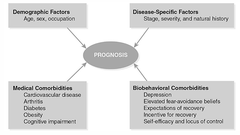
Prognosis in PT practice is used to assess what?
- Risk of developing future pathology
- Ultimate outcome and timeline
- Results of PT intervention

When talking about prognostic factors, the words factor, indicator, and predictor are what?
Synonyms

A prognostic indicator may predict what?
Any type of event or outcome
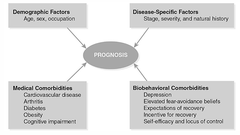
A risk factor may predict what?
Adverse events or outcomes

What is the difference between a case control and cohort study?
A case control goes from the disease and then examines who had the risk factor
A cohort follows people with the risk factor then looks at who develops the disease
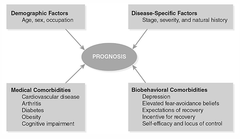
What are the nine questions that assess study credibility?
1) Is sample operationally defined?
2) Were subjects representative of the population?
3) Were subjects at the same stage of the condition?
4) Was study long enough to capture outcome?
5) Did investigators collect outcome data for every subject?
6) Was outcome criteria operationally defined?
7) Were individuals collecting data masked to prognostic factors?
8) Did sample includes subgroups where prognosis will differ, and is this accounted for?
9) Did investigators confirm their findings?
What does, did investigators operationally define their sample, mean?
- Are there clearly defined inclusion and exclusion criteria
- Is the sample homogenous
What does, are subjects representative of the population from which they are drawn, mean?
Is the sample representative of the pop to address bias
What does, did all subjects enter the study at the same stage of their condition, mean?
Was their starting point the same, addresses issue of timing for development of outcome of interest
What does, was the study time frame long enough to capture outcome of interest, mean?
If time frame too short then outcome will be missed, addresses bias in results
What does, did investigators collect outcome data from all subjects enrolled in study, mean?
Addresses potential bias in results due to attrition (ITT analysis) (5 and 20 rule)
What is the 5 and 20 rule?
A 5% loss is little impact a 20% loss is a large impact
(for loss of subjects)
What does, were outcome criteria operationally defined, mean?
Addresses methods by which investigators will identify which subjects achieved outcome of interest
What does, were individuals collecting outcome measures masked to status of prognostic factor in each subject, mean?
Addresses investigator behavior that may create bias in sample
What does, did the sample include subgroups of patients for whom prognostic indicators will differ, mean?
Did investigator conduct separate subgroup analysis or adjust for prognostic factors (addresses possibility of other characteristics influencing outcome)

What does, did the authors repeat the study on another set of subjects, mean?
Addresses reproducibility of results (not usually included in single research report)
What additional considerations are you thinking about when assessing the credibility of a study on prognostic indicators?
Is there a description of the sample
Operational definitions, protocols, reliability, validity used to identify prognostic factors
Pearson's r, spearman p, and chi square are used to assess what?
Relationship between a predictive factor and outcome
Linear and logistic regression are used to predict what?
Value of outcome, and determine relative contribution of each prognostic indicator to outcome
What is odds ratio?
Odds an outcome will occur given a particular exposure compared to odds of outcome occurring without the exposure

Which types of studies use odds ratios as a risk estimate?
Case-control studies and logistic regression (Exp(B))

What is the range of odds ratios?
0 to ∞
What does an odds ratio less than 1 mean?
Decreased odds

What does an odds ratio greater than 1 mean?
Increased odds

What does an odds ratio equal to 1 mean?
No better chance, basically a coin flip?
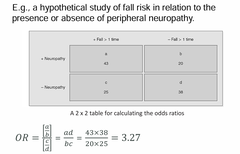
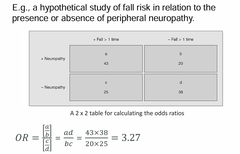
In a hypothetical study of fall risk in relation to presence or absence of peripheral neuropathy, what does an OR of 3.27 mean?
Odds of falling more than once are 3.27 times higher for those with peripheral neuropathy than those without peripheral neuropathy

For the study pictured, is the odds ratio significant and what does it mean?
OR is significant
With a BMI greater than 30 the odds of plantar fasciitis increases 6.74 times

For the study pictured, what is the odds ratio for each of the factors and is it significant?
1) Age - significant
2) ADL - sig
3) Martial status - sig
4) Gender - not sig
If age increases by one unit then there is a 1.125 greater odds of discharged to LTC over home

In the study pictured, determine if the odds ratios are significant and how to read them?

What is risk ratio?
Also called relative risk (RR) - represents ratio of risk for developing adverse outcome in patient with risk factor versus patient without risk factor
What is the difference between risk ratio and odds ratio?
Risk ratio based on total group (with or without risk factor)
Is not used in case-control, used in cohort
Used for adverse events
What does an RR greater than 1 mean?
Increased risk of developing adverse outcome
What does an RR less than 1 mean?
Decreased risk of developing adverse outcome
What does an RR equal to 1 mean?
Equal chance (50-50)
What does an RR of 1.72 mean for neuropathy and falling more than once?
Subject with neuropathy have 1.72 times higher risk for falling more than once relative to subjects without neuropathy
For the study pictured, what is the relative risk and is it significant?
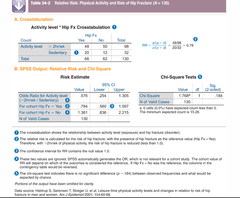
What is a survival curve?
Graph of descriptive statistics showing differences differences over time
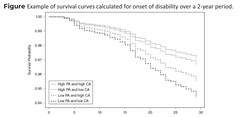
How do you read a survival curve?
Higher event rate (which is adverse)/worse survival prognosis will have a steeper slope

What is a p-value?
Probability that result occurred to chance
What is a 95% CI interval?
Range of values within which true value is estimated to lie with 95% prob
How do you determine if a RR/OR is significant based on the confidence interval only?
If the CI includes 1.0 in its range it is not sig
When appraising a prognosis study, what questions should you ask before using it as evidence?
Is it high quality?
Are results important?
Was patient represented in sample?
Do the patients values and preferences align?
- do they desire to know
- do they believe in science
- do they have a previous experience