CP Midterm
 Call Kai
 Learn
 Practice Test
 Spaced Repetition
 Match
 Flashcards
 Knowt Play
1/117

There's no tags or description
Looks like no tags are added yet.
118 Terms
Gordon Childe
Famous author of “Urban Revolution”
Cities vs civilization
the city provides the dense population and farming surplus.
These create the conditions for specialists, rulers, writing, trade and the state, which together make up civilization.
Gordon Childe’s revolutionary ideas
Evolutionary stages
Childe’s 10 Criteria for cities
Childe’s Evolutionary stages

Savagery
Nomads with no production surplus
Barbarism
Triggered by Neolithic revolution
Intro to agriculture and animal domestication (early social surplus); larger villages forming; religion
Civilization
Triggered by urban revolution
Fully developed economies and uses of technologies; full time specialists (long distance trade)
Neolithic revolution
The shift from hunting and gathering to farming and herding
People started to settle and product food instead of just collecting (farming)
Urban revolution
Farming surpluses grew large enough to support cities, full-time specialists, rulers, writing, monuments and the state
Childe’s 10 Criteria for cities
pinned down exactly what changed when villages became cities, so “civilization” had a concrete meaning instead of a vague one
Size and density
Full time specialization
Surplus
Monumental public buildings
Class structure
Knowledge
Writing and record keeping
Artistic expression
Long distance trade
Political organization
Size and Density
More densely populated than previous settlements (not just nomad groups)
Surplus Production
The production of more food and resources than was consumed by the population (farming instead of collecting)
Monumental Public Buildings
Large and impressive public structures (temples, palaces, etc.)
Class Structure
Clear distinction between social classes (rulers, elites, working classes)
Knowledge of Science and Engineering:
public projects on infrastructure
Long-distance Trade
Cities as centers of foreign trade for raw materials
Political Organization
Functioned as political centers; based on residence rather than kinship
what is urbanization
higher percentages of the population come to live in the city
migration of country to city
S curve
defines migration of country to city
Increased rapidly and slowed down
Rural population is fairly constant while urban population is growing
RURAL POPULATION ISN’T DECLINING
Population growth caused more population in urban areas (Great Migration and postwar baby boom)
Urban Graveyard effect
Urban population was declining due to deaths until clean water systems were implemented (urban natural growth became positive)
Where do urbanites come from?
Reclassification of growing settlement to towns or cities (rural places become urban places)
Excess births over deaths is greater in the city than the country
People moving from the country to city (ONLY REAL SOURCE)
immigration
Rural Urban Migration influences
Workers freed to take on other specializations other than agriculture
Increase in factory production (boost for consumer goods)
How do Gordon Childe’s 10 criteria still apply today?

Which of Childe’s 10 criteria need to be modified or added?
and large-scale infrastructure, such as water, sewage, electricity, transit?

Urban Agglomeration
the concentration of people, firms, economic activity in a geographic area
Non agglomeration economy example: long distance trade
How is productivity quantified
High wages:
urban workers earn more than rural workers
higher wages=higher productivity
High rents
office and housing costs more
high cost=high value of location
Why do firms and people stay in expensive cities?
For firms: high wage and rent means higher operating costs
firms stay because cities make them more productive than anywhere else
For workers: higher wages are offset by commuting and housing costs
But they benefit from culture and social amenities
Three causes of agglomeration
Sharing, Matching, Learning
Sharing aspect of urban agglomeration
Large markets allow efficient share of infrastructure and supplies (would be costly to maintain alone)
ex: shared hospitals, airports, ports, suppliers, workers, and infrastructures (roads, transit, utilities)
Matching aspect of urban agglomeration
Lots of people; better match between employees and employers and buyers/sellers
Learning aspect of urban agglomeration
Knowledge passes easier (workers switch jobs and pass knowledge as well)
ideas spread at coffee shops, conferences, and meetings
Survival of the fittest firms
Cities create productivity by filtering out the unproductive firms
Are there new forms of agglomeration economies in the digital age?
Virtual/digital agglomeration: online networks link workers and firms without being physically close
Can remote tools like Zoom replicate the matching and learning benefits of cities?
NO
Matching works fairly well online through job boards (Linkedin)
Learning : Less face-to-face contact: hallway chats, mentoring, casual discussions
What industries will always need to cluster, and which ones dont
Will keep clustering: anything tied to physical places, such as healthcare, hospitality and advanced manufacturing.
Can disperse: =customer service, data entry, software maintenance
3 theories of Urban Form
Concentric Ring Theory, Sector Model, Multiple Nuclei Theory
Concentric Ring Theory
Central business district in the middle, and the surrounding rings have distinct uses
inner rings are factories and working class
outer rings are wealthier residential zones
Central Place Theory
Triangular lattice of a hierarchy of places (each size of a settlement with a different function)
Growth in wedges/corridors radiating along transit lines
Industry/manufacturing sector: follows railroads, rivers or highways outward.
Low-income housing: grows next to the industrial sector because of noise, pollution and cheap land
Multiple nuclei theory
Closest to modern urban area
Polycentric (more than one distinct center)
Lots of blobs of different districts (Growth around multiple specialized
centers)
Friedrich Engels
Wrote “The Condition of the Working Class in England”
Concentrate on consequences of urbanization
overcrowding, health hazards, spatial segregation
John Snow
Found out that a contaminated water pump was the cause of cholera
(influenced the creation of GIS)
Study of Cholera by John Snow
Deaths were concentrated around one pump
Beer craftsmen only really drank beer (they lived)
Workhouse had a well (clean source of water)
US’s mini revolution
Major technological advances led to increased transportation, communication, urbanization
Steam, electricity, steel buildings, railroads
Problems in early US cities
Poor housing and overcrowding
sanitation issues (cholera spread, horse manure)
social disorder (gangs)
traffic congestion
Jacob Riis
Wrote “How the Other Half Lives”
Descriptions and photographs of unsanitary and unsafe housing
Lack of light, ventilation, immigrant labor
Inspired reformers
Why did housing have such horrible living conditions, and why were landlords able to find so many loopholes
Residents were making maximally rational decisions given a set of options that were all bad
The root cause is the economy itself, not individuals poor morals
The argument is still live today
City Beautiful Movement Goal
create aesthetically pleasing cities to enhance urban areas and make them more sanitizing
City Beautiful details
APPROACHES: Public buildings, streets be lined with trees
Daniel H Burnham and Olmstead led the City Beautiful Movement
Efficiency, beauty, civic pride (residents should be proud)
Introduction the Plan of Chicago (Grant Park, museums)
ex: central park in New York
Druid Hills, ATL
created as “ideal residential suburb”
used beauty, parks and planned order to create an “ideal” place to live
Garden City Movement main idea
concept of a city that is hierarchy based (criticism because it’s utopian, literally creating a new city)
central ideas;
Combine urban and rural life
• Communal ownership of land
ebenezer howard
City beautiful criticism
Physical and aesthetic focus at the expense of social conditions (assumes buildings would fix housing/social issues)
Focus only on public architecture
Led by elites
Garden City Movement controversy
Utopianism / unrealistic
Inaccessible to those who could not afford
Negative environmental impact (lawns)
Might lead to social isolation
For City Beautiful, Who is the intended beneficiary? Who is left out
Intended beneficiary: in theory, the whole public
Left out: the poor, immigrants and minorities. Clearing land for grand projects often displaced low-income residents.
For Garden City, Who is the intended beneficiary? Who is left out
Intended beneficiary: the working class. Howard wanted to give industrial workers healthy homes
Left out: the poorest workers. ended up mostly middle class because rents and moving costs were too high
What are wicked Problems
Problems that scientists and engineers focus on don’t consider social aspects (benign)
Wicked problem: No definitive formulation
can’t formulate atlanta traffic: road capacity, public safety
No stopping rule
when is it “good enough”?
Solutions are not true or false, but good or bad
What’s good for one group may be bad for another
Those in political power and wealth those needs are always met first
No immediate ultimate test of a solution
Effects through complex systems ripple over decades; some impacts may only become visible after political or economic changes
Ex: I-20 destroyed black neighborhoods
Every solution is a one shot operation
no trial or error
No enumerable set of solutions
Infinite list of possible solutions
New ideas and issues can always emerge
Could implement youth programs or crime efforts
Even if problems look similar, local context (culture, history, environment) can make a big difference
Ex: “my state has the worst drivers”: based on different causes
Symptom of another problem
Traffic can be bc of poor lane planning, which could be a cause of something else
Can’t divide the problems; they’re interconnected
Wicked Problems applied to the beltline

Wicked Problems applied to the beltline cont

Who was the lead figure in the growth machine, and what is he asking?
Moltoch
who runs cities, and why?
Moltoch’s arguments against the growth machine
argues that a city operates essentially as a mechanism for local elites to generate wealth and enhance property values
Explained the city as an engine for land value intensification driven by a coalition of local elites whose wealth depends on land use and growth
Growth machine’s view on land
Land is the central commodity
Rising land value=rising rent (profit for owners)
Landowners need local governments to maximize their investments
Growth machine’s view on elites
Growth unites rival elites
Local businesses lobby for highways, stadiums, airports
Try to attract federal investments and infrastructure
Growth machine supposed benefits
Growth reduces property taxes for everyone
Creates jobs and reduces employment
Molotoch’s reality of the growth machine
Growth often costs existing residents more as infrastructures scale with population
No significant correlation between city growth and unemployment (workers migrate nationally. Growth just distributes jobs)
who challenges the growth machine?
Anti-growth movements
workers
environmentalists
political vision of molotch
break up the growth machine; better the local government
Molotch wanted residents to challenge the pro-growth consensus and push for local government that serves people’s quality of life (use value) rather than landowners’ profits (exchange value)

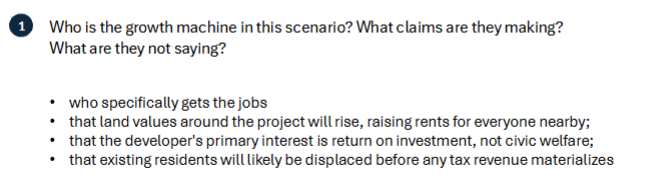
Who is the growth machine and what claims are they making? waht are they not saying?
Land use planning vs zoning
Land use planning: goal and plan of what a city will become
zoning: laws and regulations
What are the broad categories of zoning
residential, commericial, agricultural, mix use, industrial
Types of zoning
Euclidean, performance, form-based
Euclidean zoning: the basic one
separates land by use: residential, commercial and industrial each get their own zones
Called “exclusionary zoning”: it can keep certain people out, especially low-income and minority residents
Hierarchical: Uses are ranked from most to least protected (open space and single families are most protected)
performance zoning
sets standards for things like noise, traffic, pollution, density and open space, so any use is allowed if it meets them (floor area ratio)
form-based zoning
regulates the physical form of buildings and streets, such as height, placement, façades and how buildings relate to the street
encourages walkable, mixed-use neighborhoods
Comprehensive plan
presents a city’s vision for the future (ATL updates it every 5 years)
Why does zoning still exist?
homeowners gain profit from scarcity of homes.. zoning limits supply
Kevin Lynch’s core question
How do people form mental images of hte places they live in?
kevin lynch research method
interviewed residents and asked them to draw mental maps of hteir cities
lynch’s 5 elemnts
paths
edges
districts
nodes
landmarks
path
where people move (streets, walkways)
connects destination to orgin points
edges
boundaries between two phases (shores, railroads, walls)
districts
medium to large sections of cities (ex: china town)
nodes
strategic spots in which to enter (major railroad stations, crossing of paths)
ex: shibuya in tokyo
landmarks
external point of reference that helps people identify where they are (stands out) ex: eiffel tower
What’s ferst drive
path
what’s tech square
district
whats tech green
node
whats bobby dodd
landmark
William Whyte’s study: what did it focus on
documented pedestrain behavior and city dynamics
how did whyte conduct his study
he observed pedestrains in different cities
how did his method help him reach his conclusion
revealed patterns invisible in the moment, such as why one plaza was crowded and another empty
William Whyte conclusions
people tend to sit most where there are places to sit
benches are awkward
must be centrally located
sun: people follow the sunlight
trees: sense of closure
water: works best when fountain water can be touched
food: vendors
triangulation
the process where something causes strangers to interact and talk together (ex: surrounding a street preformer, finding a bank robber)
Economic growth vs economic development
economic growth: increase in a region’s output of goods and services
economic development: broader improvement in wellbeing (social, economic, environmental aspects) (economic development is more broad and CAN include economic growth)