CHEM TEST 3 REACTANTS + PRODUCTS
 Call Kai
 Learn
 Practice Test
 Spaced Repetition
 Match
 Flashcards
 Knowt Play
1/42

There's no tags or description
Looks like no tags are added yet.
43 Terms
carboxylic acid to acid chloride
use SOCL2, replace OH with Cl

compound reactivity order
reactivity corresponds with the acidity of the conjugate acid LG
acid chloride > acid anhydride > ester > amide
most acidic H
the one that would be the most reasonance stabilized if it was a - charge
Ch2 in the middle of methylene is best!
order of reactivity/rxn speed for electrophiles in an enolate (R)
allylic/benzylic compounds > CH3 > RCH2
due to molecular orbital effect
stability of -X
I > Br > Cl
carbanion stability
1 > 2 > 3
another way to make an acid chloride
react oxalyl chloride with a carboxylic acid using DMF catalyst
making the vilsmier reagent
react an amide with oxalyl chloride
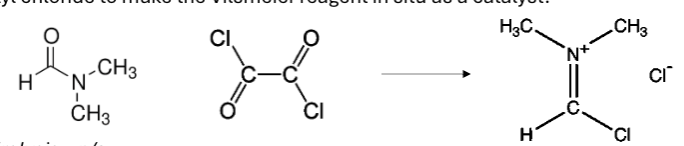
use DMF catalyst
conversion of carboxylic acid derivatives to esters
use carboxylate ion and an SN2 reaction
use fisher esterification (carb acid + acid cat + ROH
forming an ester via SN2 reaction

for adding methyl or ethyl groups, not any larger than that
use RX
Fisher esterification
use strong acid to catalyze: HCl or H2S04

and ROH
converting a carboxylic acid to an amide
use RNH2 and DCC to catalyze reaction

reduction of an acid derrivative
via LiAlH4, turn
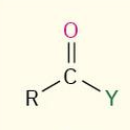

make primary alcohol
carboxylic acid with grignard reagent
add R group 2x across, giving 3’ alc

carboxylic acid with gilman reagent
no reaction
acid chloride reactions
react with H20 to make carboxylic acid
react with carboxylic acid (ion) to make acid anhydride
react with ROH to make an ester
react with amine to make an amide
acid chloride reaction with gilman reagent
adds across 1x to make a ketone

acid anhydride reaction to make an ester
use NaOH and H20 to make an ester!

acid anhydride reaction to make amide
use NaOH, H20
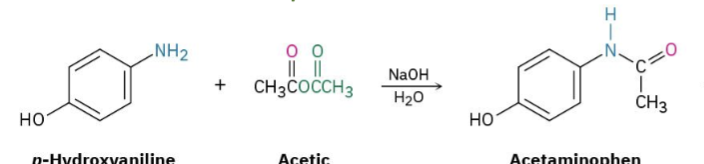
add O Ch3 group to where one of the H on N was
saponification of esters
can be acid induced (H20 with H30+)
or base induced (H20 with NaOH)
replace R group with an H, make carboxylic acid
ester reaction with amine
react with NH3 to get
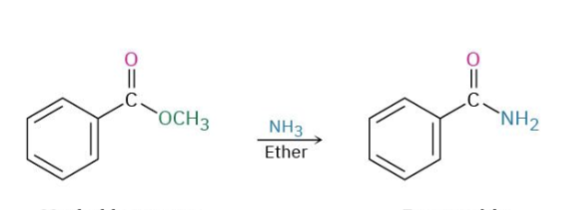
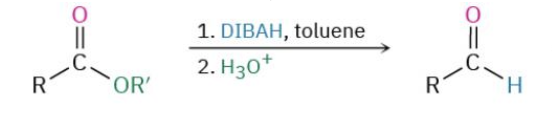
ester to aldehyde
via dibal-h with H30+
ester with grignard reagent
add across 2x to make 3’ alcohol

ester with gilman reagent
no reaction!
amide to carboxylic acid
react with H20, need to catalyze with NaOH or H30+
reducing an amide
react with LiAlH4, remove carbonyl and replace with 2X

basic carbonyl alpha-substitution (mon-halgenation)

Favorski RAR
kick off the X group, make one C ring smaller with carboxylate ion and R coming off same C position
use a base like NaOH
acid-catalyzed bromination
react with Br2 and acetic acid
only add one Br to nuc spot

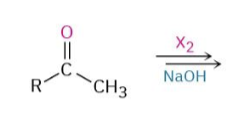
Haloform reaction
react a methyl ketone with X2 and NaOH to get a carboxylate and Ch-X3
CH-X3 is haloform

Hell-Volhard-Zelenski Reaction
react a methyl carboxylic acid with Br2, PBr3, and H20 to add a Br to the nuc attack site

Malonic ester synthesis
1.) react compound with 2 esters with Na+ -OEt in ethanol
2.) react with RX, replace one of the H with the R
3.) react with H30+ and heat to replace an ester group with H and to replace an ester group with a carboxylic acid group

acetoacetic acid synthesis
ketone with ester group attached with Na+ -Oet in ethanol and RX
H group will add twice to replace the EtO groups

direct alkylation of ketones, esters, nitriles
use LDA and then RX
LDA = strong, non-nucleophilic base
aldol condensation
react an aldehyde with itself in NaOH, EtOH, then H30+ to kick off OH and make C=C
Ch- attacks carbonyl, make new C=C bond

in a directed aldol condensation
one of the components has no alpha H (only one group can serve as the electrophile (gets attacked)
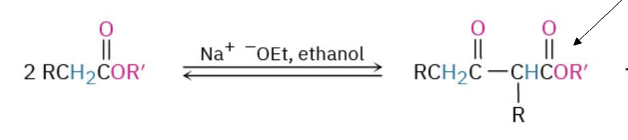
Claisen condensation
react 2 esters together with Na+ -OEt in EtOH to make a b-keto ester product
Dieckmann Condensation
is an intramolecular claisen!
form a ring one smaller than C chain with a ketone and an ester group on adjacent C

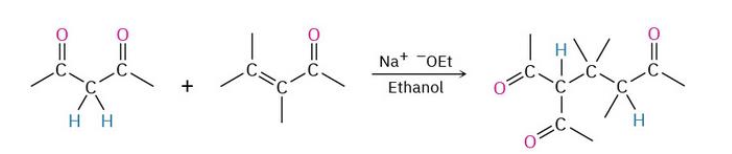
Micheal reaction with an activated methylene and unsaturated carbonyl
Ch2 minus attacks C=C
use Na+ -OEt in etoh
robinson annulation
a micheal addition reaction followed by an intramolecular aldol to make a ring
reactants in robinson annulation
NaOH in etOH
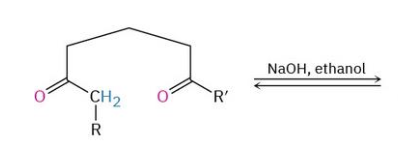
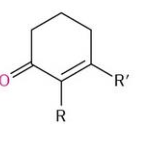
stork eamine reaction
alternative to use an eamine instead of activated methylene for micheal reaction
at the end, replace N with =O
use THF and H3O+