Bio Quizy wizzy
 Call Kai
 Learn
 Practice Test
 Spaced Repetition
 Match
 Flashcards
 Knowt Play
1/8

There's no tags or description
Looks like no tags are added yet.
9 Terms
Friedrich Miescher
a Swiss physician, first isolated DNA in 1869 as part of his work on proteins. He, and everyone else at the time, was certain that proteins were the genetic material.
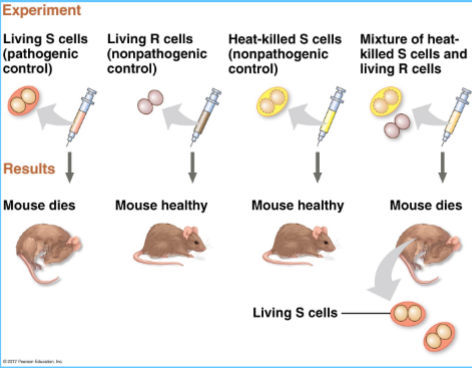
1928: Fredrick Griffith and colleagues
“S” bacteria = pathogenic (“virulent”)
“R” bacteria = non-pathogenic (“avirulent”)
Whatever the genetic material is, it survived heating and can be transferred from S cell debris into R cells, stably converting the R cells into S cells; called “transformation”

1944 Avery experiment
DNA is the genetic material….at least for bacteria

1952: Alfred Hershey and Martha Chase
Label phage DNA with radioactive phosphorus (32P) phosphorus is in the DNA backbone, but not in protein 32P emits a high energy b particle
Label phage protein with radioactive sulfur (35S) sulfur is in 2 amino acids (methionine and cysteine), but not DNA 35S emits a low energy b particle
DNA (32P) is found primarily in the pellet, with the bacterial cells; Protein (35S) is found primarily in the supernatent, with no cells.
Since viral DNA but not viral protein enters the cell, DNA but not protein must be the genetic material.
1939: Florence Bell
DNA is a long column or rod that forms a rigid structure. The bases lie perpendicular to the axis of the column and stack every ~3.4 Å.(1Å = 10-10 meter)
Erwin Chargaff’s 1949
A = T
C = G
Purines = pyrimidines

Early 1950’s: Rosalind Franklin and Maurice Wilkins
X-ray crystallography revealed the basic helical structure of DNA
Francis Crick and James Watson1953
1. DNA is helical, like a spiral staircase
2. DNA is composed of more than one chain, likely 2-3 chains
3. DNA has a “regular” structure long and narrow constant width
1958 Meselson-Stahl Experiment
Again label for a long time in 15N and then switch to 14N, but for only one generation
2. Isolate the DNA from the cells
3. Use heat to separate the two strands of DNA from one
another so now all of the DNA was single stranded
4. Test the density of the single stranded DNA preparations
by equilibrium density centrifugation
Half of the DNA was completely composed of 15N and the other half of the DNA was completely composed of
14N This is consistent with the semi-conservative model but not the dispersive model.