Animal Biology Exam 2
 Call Kai
 Learn
 Practice Test
 Spaced Repetition
 Match
 Flashcards
 Knowt Play
1/84

There's no tags or description
Looks like no tags are added yet.
Name | Mastery | Learn | Test | Matching | Spaced | Call with Kai | Chat |
|---|
No analytics yet
Send a link to your students to track their progress
85 Terms
MAF sponge type
Microciona aggregation factor
HAF sponge type
Halichondria aggregation factor
FAF sponge type
Ficulina aggregation factor
Phylum Porifera (5000-10,000 species)
Class Demospongiae
Class Calcarea
Class Hexactinellida
Phylum Placozoa 6
Trichoplax adhaerens
Multicellular
Lack tissues
Highly mobile and flexible
May be basal metazoans
Between 3 and 100 species
Asconoid
simple and continuous
Syconoid
moderate folding
Leuconoid
intricate subdivisions
Steps for the water flow in sponges
Water → Ostium of porocyte → Sponocoel → Osculum
Phylum Porifera Class Demospongiae 4
Largest class of sponges
Primarily leuconoid construction
Lack CaCO3 in their skeleton
All freshwater sponges
Phylum Porifera Class Calcarea 2
Spicules composed entirely of CaCO3
Asconoid, Syconoid and Leuconoid construction all present
Phylum Porifera Class Hexactinellida
6 rayed siliceous spicules
Syconoid or leuconoid
No pinacoderm
What’s a sponge’s synapomorphy?
Choanocytes
Choanocytes 3
Flagellated cell lining the spongocoel
Generate currents for feeding/waste removal/reproduction
Innermost layer of cells
Pinacocytes
Line epidermis (pinacoderm)
Porocytes
Perforate epidermis and are sites of ostia
Solenocytes
Secrete calcareous or siliceous spicules
Spongocytes
Produce spongin (made of collagen → metazoan synapomorphy)
Shared ancestral traits is sympleomorphy
What is collagen the synapomorphy of?
Metazoans
Spongocoel
Lined by choanocytes
Perforated by porocytes
Not a true coelom
Water filled cavity
Mesohyl
Not a cavity but a mass of nonliving “tissue”
Contains living cells between pinacoderm and the spongocoel
Archaeocytes
Stem cells
Sponge functions
Movement
Immune system
Carnivory: long spicules, critters get impaled, sponge has cells that grow over top of little crustacean
They don’t have a traditional nervous system
What do sponges have instead of a traditional nervous system?
Have true nerves but not CNS
Nerve net with two nerve networks
Slow: many non polar nerve cells signals travel any direction
Fast: less branched, bipolar, greater diameter
Larger nerves signal faster: space for signal to move along axon. Quicker for big group to get out of big door than small
Neuroid cells
Neuroid cells
Gene expression similar to synapses sending signals, digestive cells with expression similar to synapses receiving signals
Sponge reproduction
Hermaphrodites
Sexual reproduction - internal fertilization (choanocytes capture and transport sperm to the eggs)
Non feeding larvae
Swim for less than 1 day
Asexual reproduction - gemmule production. Take stem cells, package them up, thrown into water, nest until spring. Happens with stress.
Phylum Cnidaria (subphylum + classes)
Subphylum Medusozoa
-Class Scyphozoa
-Class Cubozoa
-Class Hydrozoa
Non medusozoans
-Class Anthozoa
Synapomorphies of Phylum Cnidaria
Nematocytes (stinging cells, cnidae)
Planula larva
How do nematocytes work?
Chemical/physical stimulus to cilia triggers firing
Trigger if something touches at the top
Spines and barbs rupture the operculum after change in osmotic pressure
Single shot/nematocyst
Specialized for stinging, penetrating or secreting toxins
Paralyze prey with stinging and stick to them and pull back in.
Class Scyphozoa (ph cnidaria)
True jellyfish
125 spp
Named for thick, gelatinous layer of nonliving material between tissue layers: mesoglea
What similar structures did sponges have that class Scyphozoa has?
Mesohyl
Scyphozoa medusa: digestion and reproduction (ph cnidaria)
Food goes in the mouth → pouches → seals for storage and digestion → secreted through mouth (no anus)
Branching canals needed for digestions and excreting waste
Gonads lining gastro pouches
Usually one gender
Scyphozoa medusa: rhophalia (ph cnidaria) 3
Eye (light + dark)
Navigating by tilt
Nerve signal to squeeze certain ways
Scyphozoa life cycles (ph cnidaria)
Sexual with gonads
Asexual strobilation - scyphistomas polyps
Ramets clones because came from the same polyp
Sexual recombination in adults
Class Cubozoa (ph cnidaria) (7 things)
Box jellyfish
Complex eyes with lenses
Small: a few cm long
Highly toxic nematocytes
Primarily consume fish
Can be fatal to humans
Only 20 species, primarily in the Pacific
Box jellies (Class Cubozoa (ph cnidaria))
At surface they can look into air. Can look into water. Use lenses to see different liquids.
Lense eyes (color, movement, shapes, mazes)
Class Hydrozoa (ph Cnidaria) (5 things)
Polyp phase dominates life cycle
Medusae are much smaller than “true” jellies
Nematocysts restricted to epidermis
Around 3000 species
Orders Hydroida and Siphonophora
Class Hydrozoa Order Siphanophora
Gonozoids - reproduction
Gastrozoids - digestion
Class Hydrozoa Life Cycles
Differentiated polyps to have different functions (food, reproduction, defending). But some genetic individual.
Class Hydrozoa Hydrodia Medusoid stage
Velum
Moves faster than squeezing bell and opening closes up and is smaller so water goes through faster and farther (like hose on brother)
Class Anthozoa (ph Cnidaria, non mezazoan) 7
6000 species (largest class of cnidarians)
All marine and polypoid
Mesentary: increase surface area as they get bigger. Bring in food as much as possible. Helps them keep nutrients. Any food they don’t eat has to be puked up.
No mesoderm (not true coelom)
Has body cavity
Pseudocoelomate
Stinging cells = nematocysts
Class Anthozoa Behaviors 6
Stinging cells = nematocysts
Stomphia swim response
Acrorhagi as weaponry in Cnidarian warfare
Anemone make big colonial groups
Fight for space on a rock
Different jobs in the colony (defense, reproduction, scouts)
Cnidarian digestion and waste removal
Cnidarians are carnivores
Digestion initially extracellular in GVC. Completed intracellularly in vacuoles
Lack of an anus means waste is expelled through the mouth
Cnidarian reproduction
-Medusoid form in Scyphozoa and Hydrozoa
-Anthozoans develop into planula larvae from sperm and eggs released during spawning events
Satiate predators: not all eggs will die
Phylum Ctenophore 8
150 species, all marine
Comb rows = plates of fused cilia. Helps them move.
Colloblasts
Nerve nets similar to Cnidarias
Superficial similarity to jellyfish but have the mesoderm (triploblastic) and biradial symmetry
Digestion and waste removal
Anal pores
Gelatinous but small
Colloblasts
Sticky granules, stick to things rather than sting
Ctenophores
What’s the synapomorphy of phylum Ctenophora?
Colloblasts
Ctenophore Reproduction
Simultaneous hermaphrodites
External fertilization
Cydippid larvae even in groups that lose tentacles later in ontogeny
But cydippid “larvae” turn out not to be larvae at all
Ctenophore behavior 4
Nemeopsis (prey)
Beroe (predator)
Prey preferences
Devastate fisheries
Which fluid is denser, water or air?
Water
Which fluid is more viscous, water or air? (viscous is fluid resistance to flow)
Water
What physical measurement other than density and viscosity is needed for calculating Re?
Velocity
Which organism would have the lowest Reynolds number?
a) Whale swimming
b) Eagle flying
c) Sperm swimming
d) Human walking
c) sperm swimming
Which of the following has the lowest Reynolds number?'
a) Human swimming in tarter sauce
b) Human swimming in olive oil
c) Human swimming in tar
Human swimming in tar
What is the Reynold’s number?
increasing speed, pipe diameter, density of fluid
decreasing viscosity of fluid
Low: slow/heavy
High: fast/humans
Humans are fast but can simulate low Reynolds number
Relative size fluid is viscous (for animals we think it’s easy for)

Ratio of inertial forces to viscous forces
p = density
l = characteristic length
v = velocity of fluid relative to the organism
u = dynamic viscosity of the fluid
Non-Slip condition 8
Fluid mechanism stating that a fluid in contact with a solid surface moves at exactly the same velocity as that surface
How dust and grime accumulate on a fast moving fan. Not moving, stuck on first layer.
Takes space to get from 0-100
You move as fast as obstructing current as you go up in space
No fluid movement at ground level. Takes multiple plates to get up to water at current.
Important for little critters. Food is up so not getting to them. Want to get passed boundary layer where not moving
Anemones get tall/skinny to reach food and waste goes into current
Lophophores stick up into air with feather like structure
What is a hydrostatic skeleton and how does it work?
Skeleton that relies on fluid pressure
A fluid filled cavity (often called a coelom) surrounded by muscles that alternate between contraction and relaxation of different muscle sets to allow the organism to change its shape and move.
Common muscle fiber arrangements. There are different types of muscles that squeeze
Collagen fibers
Bunch of animals use them
Collagen fibers
A metazoan synapomorphy
Key to allowing bending and not kinking
Cross fiber at angle helps with stretching and getting longer or fatter without kinking
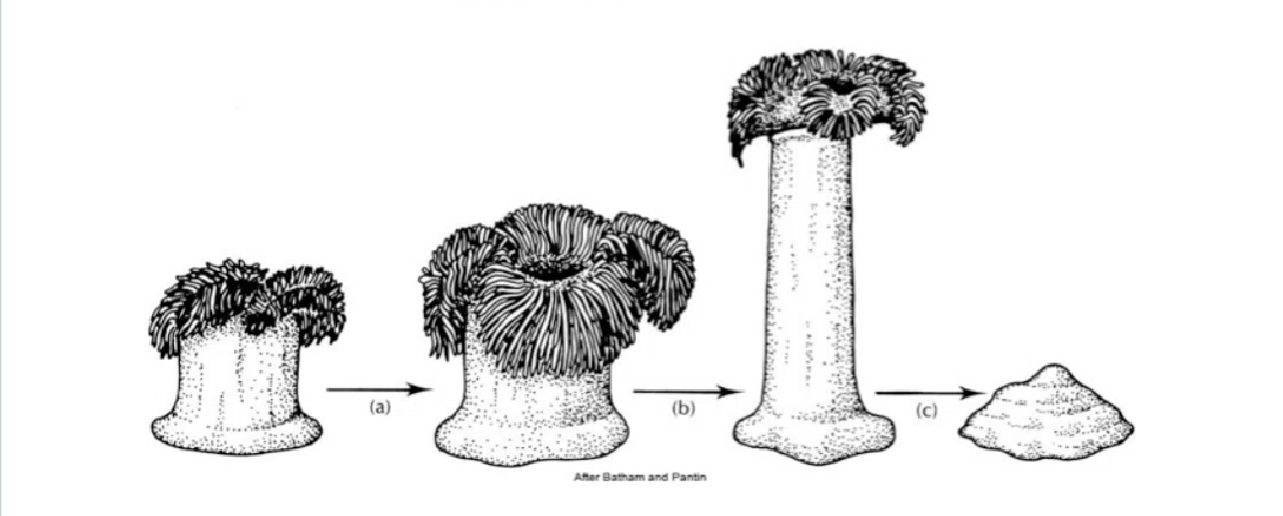
2 antagonistic sets of muscles. Can’t shrink and such by itself, you have to antagonize it
Water allowing it to happen
Sphincter/radial controls water intake and outtake. Expand and contract to open hole. Ciliary action is how they get water in. Sphincter and radial are always opposite. Sphincter relaxed lets water in
Transition A - It wants more volume. Contract radial, relax sphincter and use ciliary action to let water in. Relax circular muscles to let it expand
Transition B - Keeping some volume of water. Relax radial muscles, contract Sphincter. Contract circular muscles. Relax longitudinal.
Transition C - Relax Sphincter. Contract radial. Contract longitudinal and circular muscles
Transition D (from the end to the start) - Keep sphincter open, keep radial contracted. Use ciliary action to pull water in. Slightly contract circular and relax longitudinal.
Why would an anemone want to stretch out to become tall + skinny 6
At surface of rock there’s no flow (no slip). Further up, faster the flow. Little flow for diffusion when near rock
Out of boundary: increase access of food and more oxygen
Frills increase surface area
Reproduction: carries gametes further
Swim/float further
Increases waste removal
Why would an anemone want to get short and fat?
Avoid getting eaten
Maybe too strong velocity and you’d get ripped off the rock
How does a hydrostatic skeleton permit an earthworm to crawl? What role does metamerism (segmentation) play?
Fluid pressure/muscle contractions
Septa: allow one segment to change shape without changing the other
To get short/fat: contract longitudinal (shorter), relax circular (fatter)
How does a hydrostatic skeleton permit a sea urchin or sea star to crawl?
Collagen prevents kinking
Tube foot can change shape without affecting the other foot
With no more fluid to get longer it’ll relax the longitudinal muscles
Mostly don’t release water but an open one allow water to be pushed
How does a hydrostatic skeleton of a soft shell crab allow it to crawl?
Protozoans
Ecdysozoa
Occurs after a molt
The skeleton is a complex water balloon shape using pressure in body to create force for walking and such
Use it for parts of life cycle but still counts exoskeleton and hydrostatic skeletoon
Lophotrochozoa
Lopho: alofore feeding structures
Tropho: larval form trophophore
Since flatworms don’t have feeding structures they need that larval stage

Phylum Acoelomorpha 8
Small (untrue) flatworms
Bilaterally symmetrical and superficially resembling flatworms
Phylogenetic placement contentious, but generally assumed as sister to remaining bilateral
350 spp typically marine and benthic
Triploblastic
Acolomate
Reduced complement of Hox genes
Unique type of cleavage. Duet spiral cleavage.
Phylum Platyhelminthes 9
Class turbellaria
Class Cestoda
Class Tremetoda
Triploblastic - mesodum
Acoelomate
Bilaterally symmetrical
Cephalization
Organs + organ systems
No synapomorphies
Class Turbellaria (ph Platyhelminthes) 5
3000 sp
Most are free living
General less than 1cm (up to 30cm)
Locomotion using pedalwaves
Duo-glands required
Dougland system
Helps flatworms attach and unattach
One of them is sticky and one of them is unsticky
Used for locomotion
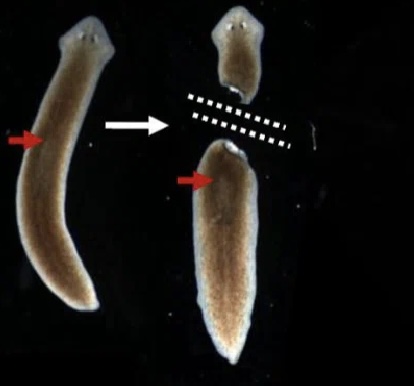
Regulation in Planaria
Train planaria to find a foot source
Decapitate their head above the pharyx (red arrow) removing their brain
Allow head to regrow
Test planaria ability to find food
Result: just as good as animals that kept their head
Conclusion: memories can be stored and retrieved from outside of the head
Excretion in Turbellaria
Beating of cilia

Class Cestoda (ph Platyhelminthes) 7
No mouth
Endoparasitic
Scolex used for attachment
Proglottids for reproduction
5000 spp
Tape worms
Hundreds of thousands of eggs per day per cestode

Class Trematoda (ph Platyhelminthes)
8000 sp
Entirely parasitic
Most are digenean “two births”
Requires multiple intermediate hosts (snail and fish to human)
Some of the most complex life cycles of all metazoans

Class Trematoda (ph Platyhelminthes) Lancet Liver Flukes
Hypnotists to the invertebrate stars
Ants as as intermediate hosts are directed to clamp down on the tips of grass blades to increase likelihood of consumption by grazers (final hosts)
Temperature dependance in the switch
Just one fluke controls the brain but tends to die in the next host. Single organism sacrifices itself for clonemates to survive
The Lophophorate Phyla. What’s a lophophore?
A circumoral body region characterized by a circular or U shaped ridge around the mouth bearing 1-2 rows of hollow, ciliated tentacles
The internal space is a coelomic cavity and the anus lies outside of the tentacles.
What’s a lopho for?
Gas exchange (and waste removal)
Food collection
Shared characteristics of Lophophorates (symplesiomorphies) SBSU
Sessile
Benthic
Suspension feeders
U-shaped gut
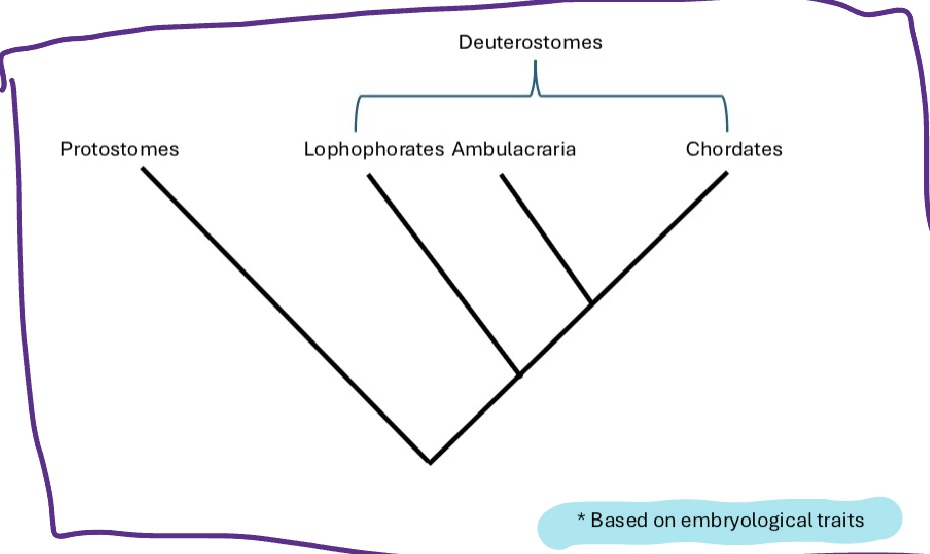
Traditional view of Lophophorates

Current view of Lophophorates
Phylum Brachiopoda
Class inarticulata
Class articulata
Bivalved shell secreted by mantle tissue
Valves are dorsal and ventral (cf with bivalve molluscs)
Entirely marine
350 extant spp
Individual free living bivalves that aren’t molluscs
Phylum Phoronida
15-20 spp
Benthic, tube-building, suspension feeding worms
10-12cm long
Highly modified brachiopods
Water flow through phoronid lophophore
3 part body plan
Feathery at top

Metamorphosis in phoronida (takes 15 minutes)
Phylum Bryozoans
“moss animals”
5000 spp
Colonies produced by asexual reproduction
Basically floating mouths
“overwinter” when it gets cold. Similarto gammules in phyla profiera (resting stage). Avoid bad environmental conditions
Class Phylactolaemata (freshwater)
Class Gymnoloemata
Class Stenolaemata

How splits influence
Outgroups
Differences that are synapomorphies
Collagen - multi = metazoans
Triploblastic/comb synapomorpy of ctenophore
Not all sponges are triploblastic but ctenophore is