w1 l2 - effects of bilingualism on cognition
 Call Kai
 Learn
 Practice Test
 Spaced Repetition
 Match
 Flashcards
 Knowt Play
1/31

There's no tags or description
Looks like no tags are added yet.
32 Terms
“Disadvantages” of bilingualism
smaller vocab
delayed milestones
cross-language interference
Creates the illusion they are delayed in lang development
These ‘disadvantages’ disappear as a child grows up
smaller vocab
(when only one language is tested) - finding problematic, in earlier studies they only measure the child’s vocab in one lag, eg only test english rather than spanish. Misleading - may know 50 in english and 50 in spanish whereas english mono knows 100.
delayed milestones
e.g. in verbal intelligence tests (e.g., Darcy, 1953) - might take longer to start speaking in full sentences in both langs - two ling systems competing with each other
cross-language interference
might mix languages when speaking, or apply rules to the other lang
Outdated view
Bilingualism viewed as a source of difficulty
Speaking the home language will delay/impair child’s acquisition of the community language and their cognitive development, and even their IQ (Saer, 1923; Jersperson, 1922).
Influential - shaped government policies, promote community language
Saer 1923 - eg of issues in these kinds of studies
Saer 1923: Compared Welsh-English bilingual with English monolingual children
These early studies are flawed in many ways - bias in recruitment - were not fully proficient in english, but only tested english
Did not control for ses or education or opportunity - w-e households more economically disadvantaged - may have impacted cog development
idea now
Bilingualism does not delay cog development
Obvious advantages of bilingualism
Speaking two languages!
Employ-ability - english-german bilinguals usually earn 20-30% more than monolinguals
Access to the communities that use the languages and their cultural products - eg netflix, have more options
Travel
Less obvious advantages of bilingualism - relatively less contested
increased metalinguistic awareness
ease of learning additional languages
phonetic perception
social cognition/perspective
increased metalinguistic awareness
(Cummins, 1978) - ability to think about and understand language as a system, learn dif grammatical rules and vocabs so become moore aware of how lang works
ease of learning additional langs
language aptitude (Rogers et al., 2017) bilingual inds have a heightened ability to learn more languages as familiar with the process of learning multiple linguistics systems. Understand grammatical rules easier
Better phonetic perception
Antoniou et al., 2015) - more easily distinguish between dif sounds
Social cognition, perspective taking
(Rubio-Fernández & Glucksberg, 2012). Better at understanding perspectives as used to switching between languages and cultures. More adaptable in diverse social situations
Contested advantages of bilingualism (the debate)
More creative thinking (Lee & Kim, 2011) - better at coming up with new things/ideas
Protection from cognitive decline/dementia (Bialystok et al., 2007) - bilingual older adults show onset of Alzheimer's later than monolingual speakers
Better executive functions (Bialystok et al., 2004)
What is executive function
Cog processes that help us manage, control and regulate our behavior
Guides our attention, planning, problem solving + decision making
Frontal cortex
Ensures beh appropriately in dif contexts and make decisions as quick as possible
Children with better executive functions do better later on in life
Components of exec functions
relatively less contested
Inhibitory control - helps control impulses, resist automatic beh - helps behave in an appropriate way
Attentional control - helps us focus on important tasks while ignoring distractions
Cog flexibility - switch between tasks and adapt to new situations
Why would bilingualism benefit executive function?
simultaneous activation
occasional switch from one to another language
(1) and (2) may rely on domain-general executive functions, which get “trained”
Bilinguals perform better in non-verbal executive functions tasks (inhibition, task switching, selective attention).
explanation 1
Both langs active in the brain at the same time, even when they are speaking or listening in one language
So focus on target lang and suppress non-target
Involves process of inhibition - suppress other langs spoken
explanation 2
Switch between langs depending on context + person they're speaking to - requires deliberate choice to switch langs - involves exec function (cog flexibility). Doing this fosters mental activity and enhances the brains ability to adapt to new situations quickly
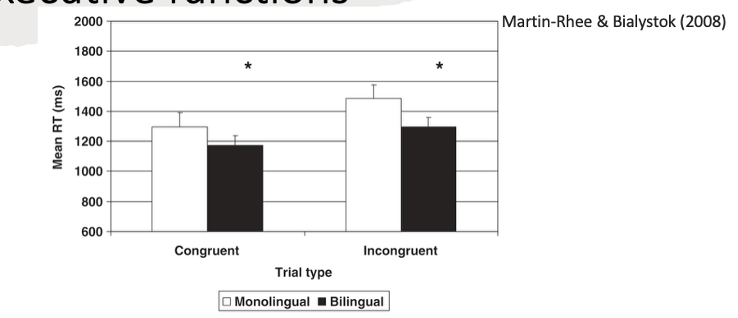
Simon Task (one of many tasks used for testing executive functions):
A blue or red square appeared on the left or the right side of the computer screen. Participants were instructed to press the left arrow key when they saw a blue square and the right arrow key when they saw a red square.
Incongruent trial - colour square is on the opposite side to the direction of the arrow eg blue on right, red on left. So have to suppress irrelevant info (where the shape was on the screen), while focusing on the rule
Martin-Rhee & Bialystok (2008)
results of Simon test
Bilingual children (4-6-year-olds) outperformed monolinguals on the Simon task, in both the congruent and incongruent trials. Suggests bilingual children making faster decisions etc in both trials.
bilingual advantage in preverbal infants
Advantage has also been reported in pre-verbal infants
All they are doing is listening to people speak
Lie babies flat, see something on computer screens, see what they are looking at
babies shown either a square or circle - if square then star would be on the left, if circle then star would be on the right. So if shown a square, want them to look to the left hand side
Comishen et al., 2019
results
Babies are able to learn the predictability - dotted line is performing at chance - performed above chance
reverse pattern results
Pattern is reversed - square = right, circle = left. Want to see if babies are able to update expectations
If able to update should learn the new predictions
Monolinguals performing close to chance - doing it at random
Bilinguals - even if not fluent in multiple langs - have adapted to new evidence in post switch phase. Suggests can update expectations. May be more flexible in their thinking, better at adapting to new or diverse situations, enhances cog flexibility from an early age

Executive functions in older adults
50-60yos
Y-axis represents simon effect - lower score = better at suppressing irrelevant info
Across lifespan, bilinguals better at simon test
Advantage becomes widened as adults age - larger the gap larger the advantage compared to mono
Second thing - lower the score, better the simon task - difference between the two groups. executive function advantage seems to persist across the lifespan - may become more pronounced later in age

what did these studies result in
media frenzy
why is there a debate
Evidence for bi advantage in executive functions inconsistent
Estimated that more than 80% tests after 2011 don't demonstrate an effect
What might have caused the inconsistent findings?
ses
hard to define bilingual
publicaiton bias
ses
Correlated with things such as IQ and executive functions
Children who come from high ses backgrounds have better exec functions
Dif between two groups is smaller the higher the ses
So gap has widened between mono and bi for low ses
Researchers tend to overrecruit pps from high ses backgrounds - tend to have resources and capacity to send children to psych studies. Harder to detect a difference - as dif is not as big.
Hartanto et al. 2018

variability of bilingual samples
type of bilingual upbringing (e.g., balanced bilingual - use equally, passive bilingual, subordinate bilingual, late bilingual - learn second later on). Dif ways in which they acquire and use langs.
age of first exposure
amount of daily use; switching patterns
Linguistic difference - degree of similarity between languages eg vocab, grammar, structure. Eg norwegian and swedish similar - someone who speaks norwegian can understand swedish pretty well. Whereas english vs arabic - dif on a lot of levels. Can we compare these two bilinguals.
Study recruited bilinguals from dif backgrounds - reason why results may be so inconsistent
publication bias
Creates illusion that the advantage is a widely documented phenomenon
De bruin et al. (2014)
No media frenzy

summary
Raising a child bilingual does not impair language or cognitive development.
There is some indication that bilingual experience has some positive effects on executive functions, but the extent or nature of these benefits are debated.
Even if it doesn’t benefit executive functions, being multilingual opens up a lot of opportunities.
Advice from a psycholinguist:
Raise your children bi/multi-lingual whenever possible