The New World of The Hellenistic Period Week 11
 Call Kai
 Learn
 Practice Test
 Spaced Repetition
 Match
 Flashcards
 Knowt Play
1/49

There's no tags or description
Looks like no tags are added yet.
50 Terms
What does Hellenistic mean when referring to the Hellenistic Period?
Greek-like
What was the struggle for Succession?
Alexander left no clear heir after his death as he had no born child and he killed off his male siblings
However his wife was pregnant
What was the compromise for the rulers of the empire?
Alexander's half brother and his unborn child
What is a regent and why was one needed?
Person who rules on behalf of king who cant rule themselves
The half brother was king in name but could not effectively govern
Alexander's child was still unborn
Who was Perdiccas?
He was appointed to be the regent
How did Perdiccas organize the regency?
He reallocated the satrapies of the empire
How did Perdiccas deal with the veterans and exiles after Alexanders death?
Perdiccas settled veterans and managed Greek exiles after Alexander's death to reward loyal soldiers, prevent rebellion, and keep the empire stable.
What was the Revolt in Greece?
Athens and other Greek states launched the Lamian War to regain independence from Macedonia
Revolt was failed and many Athenian democratic leaders + Demosthenes were executed
How did Perdiccas die?
Assassinated by his officers
Due to a failed invasion of Egypt against one of his satraps who wanted independence
Also because they feared he was becoming too powerful and would make himself king
What satrap became extremely powerful after the death of Perdiccas?
Antigonus the One Eyed
What did Antigonus convince the other satraps to do?
To disband the regency
This would give Antigonus more power
How did the Macedonian Argead Dynasty end?
Half brother of Alexander is killed during the war of Diadochi
The son + wife was not killed but put under house arrest (died later on in war)
No males left
What happened to the Satraps after the end of the Macedonian Argead dynasty?
Various satraps declare themselves kings
Antigonus’ Last Gamble
Attempt to defeat all rival successors in the battle of Ipsus
Antigonus was killed in this battle
Birth Pangs of the New Order
Refers to the wars of the diadochi
violent struggle after Alexander’s death that led to the breakup of his empire and the creation of the Hellenistic kingdoms.
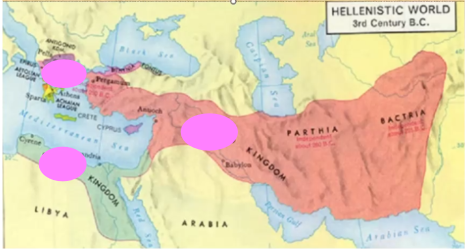
Name the three kingdoms
Seleucid Asia, Ptolemaic Egypt, Antigoid Macedonia
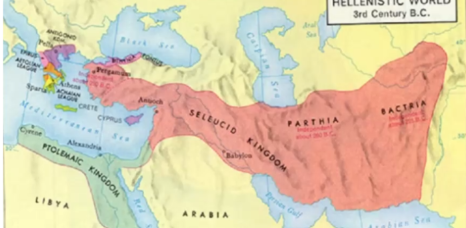
What was the wealthiest yet most vulnerable kingdom?
The Seleucid kingdom
What was the most stable and persistent kingdom?
Ptolemaic Egypt
Which was the smallest kingdom?
Antigoid
What were the three hellenistic kingdoms that emerged from the Wars of Diadochi?
Egypt: Ptolemies
Asia: Seleucids
Macedon: Antigonids
What does a polis value?
Independence and autonomy
Why were the greek poleis forming leagues?
A counter measure against powerful kingdoms being formed aka Antigoid
How did travel Between Poleis in the Hellenistic Period change the Aristocracy?
After Alexander's conquests, large Hellenistic kingdoms made travel between poleis much easier, allowing people to move for trade, work, education, and government service.
What was a new avenue to gain power? How did this create a new class of aristocracy?
Could become influential with connections from outside of the greek polis
This created a new class of aristocracy
Was no longer a traditional way of becoming an aristocrat
How did Hellenistic Athenian culture differ from Classical Athenian culture?
Most obvious difference was in the dramas that were produced
Genre of New Comedy was formed
What do the following three philosophies say how one can find stability?
Nature
The stoics
Believed in a natural law and a rational universe
If you use reason, you can uncover the path of the universe
The Epicureans
Believed nature can only be understood through senses
Believe pleasure is the absolute goal you should seek
Aka must trust your senses for long term pleasure
What state did the Epicureans believe was the state that gave you ultimate pleasure?
Ataraxia
Aka freedom from disturbance
The Cynics/Skeptics
Believe that people should follow instincts just as animals do
Diogenes was a cynic philosopher “the dog”
Believe people should live simply
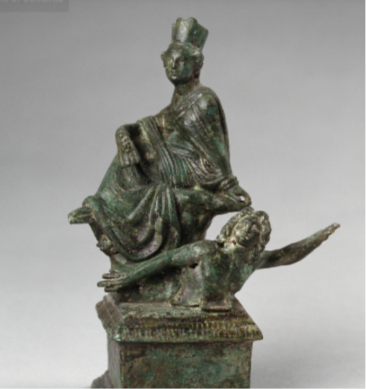
What is this image of?
Lost statue of the Tyche
Goddess of luck
What does Tyche mean?
Luck/fortune
How did the kings try to make themselves appear legit?
By dressing like Alexander
What is an absolute monarchy?
No limit to a kings power
What were state monopolies?
Industries or goods that are controlled by the government to increase revenue
Textile, papyrus and oil production became state monopolies to generate max revenue for the king from fees and taxes
Document 12.1 - Letter of King Ptolemy II to Apollonius on the Revenues of Egypt
A royal letter from King Potlemy to Apollonius about Egypt's economy and how taxes should be managed to maximize royal revenue
What happened to Hellenistic Women in hellenistic society?
Opportunities expanded for women to some extent
Gained more legal rights, economic independence, careers
Document 12.2 - Marriage Contract of Heraclides and Demetria
A legal marriage contract that comes from egypt
Gave women more legal recognition compared to earlier greek societies
Alexandria and Hellenistic Culture
Alexandria = major city founded by Alexander the Great in Egypt
One of the largest and richest cities
Was a multicultural society with advanced learning and was a major centre of innovations
What does classical mean?
Anything that is balanced/symmetrical
Classical vs Hellenistic Art
Classical: symmetrical, still
Hellenistic: dramatic, movement
Who is the woman in most of the naked statues?
Aphrodite
What is the Antikythera mechanism?
An ancient Greek mechanical device used to predict astronomical events, often called the world’s first analog computer.
What did Erastosthenes establish?
Produced accurate estimate of circumference of Earth
How extensive was the process of becoming greek?
Becoming greek was strong in cities but limited in rural areas leading to a blended cultural world
Who took the lead in hellenizing?
The local population themselves
What was Hellenistic religion like?
Was flexible
Non dogmatic
Syncretism = blending of cultures + religions
What is the Rosetta stone?
Trilingual hieroglyphic inscribed on stone
Written in different languages so that it could be read by different cultures
Box 12.1 - Dedication to Vishnu by Heliodorus, son of Dion
An iron column in north central India
Shows how individuals of Greek background in India adopted or honored local deities like Vishnu.
Box 12.2 Stele of Sophytos, Son of Naratos, Second Century
A stone inscription from ancient india written in greek
Tells a story of Sophytos rebuilding his family's fortune through hard work
Shows the influence of Greek culture in india